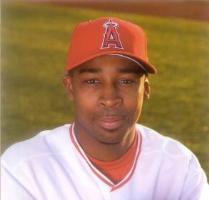
|
PERSONAL:
|
- His name is Desmond DeChone Figgins. But when he was a kid in Georgia, his pals couldn't pronounce Desmond, so he went by DeChone, which is pronounced "DeShawn." That became Chone, pronounced "Shawn."
- Figgins grew up in Georgia cheering for St. Louis during the heyday of Vince Coleman, Ozzie Smith, Willie McGee and Company.
-
Figgins got used to stadium announcers, fans, and reporters botching his name early in his career. He can still hear one atrociously mispronounced version of his name reverberate over the stadium speakers of the Class-A Potomac Cannons.
"You hear it every once in a while," he said, "but it's not as bad as it was. It's not a well-known, out-there name, so it doesn't bother me when it happens. It's just good to have somebody call your name. Especially in the Major Leagues."
-
"I was a huge Ozzie Smith fan, and I used to do the back-flip all the time—Little League all-star games on up," Figgins said. "I did it in '98 and '99 at the start of the game on Opening Day [in the minor leagues].
"I've always thought about coming here (to St. Louis) and playing, and maybe having Ozzie watch me. I grew up in Georgia watching the Braves on TV, and I loved the Cardinals because they played my game. I see guys like Jose Oquendo and Andy Van Slyke now, and they're shocked to hear things I remember."
Chone, with the Angels, played in St. Louis in June 2007 interleague play.
CHONE'S FAMILY
- Chone comes from a church-going Baptist family that observed baseball seven days a week. His parents, Charles Figgins and Eva Callins, were born on the same day to families who lived in adjacent houses in rural Leary, Georgia. Charles breathed baseball and taught his sons all about the game: how to play it right, and the history of it. (Daniel G. Habib-Sports Illustrated-9/12/05)
-
Chone's older brother, Demetrius, played third base for two seasons in the independent Northeast and North Atlantic Leagues. In 2005, he shared a Newport Beach, California condo with his brother and worked as an instructor at a local batting cage.
In October 2006, the Angels sent Demetrius to Major League Baseball's scout development program, then hired him as an area scout in South Florida.
Demetrius remembers the baseball history lessons of his Dad: "He told us about how Hank Aaron worked for an ice company in the offseason, and that's why his forearms and wrists and hands were so strong—from carrying blocks of ice." (Daniel G. Habib-Sports Illustrated-9/12/05)
-
Demetrius admires Chone's athletic ability.
"He's a better basketball player than baseball player," his brother said, laughing. "He's all of 5-7, he can dunk, and he's got Allen Iverson speed up and down the court. He's always said if he were 6-2, he would be playing basketball."
- Mr. Figgins moved his family to Brandon, Florida, when Chone was one year old. Now, Charles drives a truck for a carpet company in Orlando.
-
Chone says the gift he remembers most from a Christmas was, "when I was seven or eight and Demetrius was about 10 or 11. We got a Nintendo game. We had been messing around with the gift, and we peeked at it and pulled at the tape, but we never quite saw the game.
"That Christmas Eve, we opened it and saw that it was Nintendo. We played that game until the wee hours when we were kicked off and sent to bed. Then we got up in the morning and started playing it again. It was a baseball game, and the people really didn't move, but it was fun."
And his first Christmas memory?
"My Dad bought me my first fishing pole. It was a bass fishing pole, and we went outside and we set up a bucket. We spent a long time just casting into that bucket. I was about five or six. I don't have that pole anymore, but that memory stands out. I love to fish, and I really wanted that fishing pole." (Mike Scarr-MLB.com-12/23/06)
-
In 2002, Chone set a new single-season stolen base franchise record for the Salt Lake City Stingers (PCL-Angels).
- On September 15, 2002, on a nationally televised game on ESPN2, Figgins got his first Major League hit, a single that knocked in a run and helpd the Angels beat the Texas Rangers.
-
Chone and Marlins' OF Juan Pierre are good friends. They have been since their first year of professional baseball, when they were teammates and roommates in Portland, Oregon with the Rockies' Northwest League team.
- After the 2003 season, the Angels wanted Figgins to play winter ball in Puerto Rico, but Chone talked it over with the team and turned down the opportunity, choosing instead to spend time fishing with his grandfather, who was in the late stages of terminal cancer.
-
"I got my speed growing up on a farm, running away from dogs and my brother," Figgins said. "Everyone in my family can run, including my mother."
His parents played for a highly competitive coed softball team in Tampa. "Dad pitched and Mom played third. She says I got my ability from her."
The slow-pitch softball team was composed mostly of five of (mother) Eva's seven brothers and their extended family and friends. The team barnstormed Florida, playing weekend games. Chone would play in the kids' pickup games, played with wadded up paper cups. But when he was old enough, he played in the big games.(Tim Kurkjian-ESPN The Magazine-June 7, 2004)
- Figgins is not a big guy. But he is a strong little guy. And his body holds up well to the rigors of a Major League season.
-
In 2007, Chone had a lake built on his property in the Tampa, Florida area, so he could fish close to home.
"It's just something I grew up doing," Figgins said. "It's peaceful. It's fun. Plus, I can eat some of it."
Figgins isn't about to give up his day job, but the best anglers these days need not choose between fishing and making a healthy living. He pointed to Mike Iaconelli, a champion bass fisherman with more than $1 million in career earnings and additional income from corporate sponsors such as Toyota and Yamaha.
"It's like car racing," Figgins said. "They make a good living." (Bill Shaikin-LA Times-3/16/07)
-
Chone had one of the best games any player has ever had. On June 18, 2007, Figgins engineered a six-hit night, highlighted by a walk-off triple smoked down the rightfield line, to anchor his team in an improbable Angels' 10-9 come-from-behind win against the Houston Astros.
Jim Northrup, an outfielder for Detroit from 1964-1974, was the last player since Figgins to accomplish the six-hit, walk-off feat, going a perfect 6-for-6 with a marathon-ending, two-run blast during a 13-inning contest on Aug. 18, 1969.
-
Asked why he always wears a butterfly bandage on his left forearm, Chone said, "That's for my family, for my mom, dad and brother in Florida," Figgins, the Angels' leadoff catalyst, said. "I've been doing it since 2003 to let them know how much I appreciate all their support and what they did to get me where I am now."
Eva, his mother, lives in Tampa. Charles, his father, calls Orlando home. Brother Demetrius, an Angels scout, is Miami-based.
"We've got Florida covered," Figgins said, grinning. "We went through all of this together, and I'm representing them. I always said if I made it, I would do something to let them know I'm thinking of them. I didn't want to do anything that was overexaggerated. This is pretty simple." (Lyle Spencer-MLB.com-9/16/07)
-
Chone Figgins was placed on the bereavement list so he could spend time with his ailing father, who suffered a stroke. Figgins flew to Florida to be with his family and will miss the remainder of the three-game series against the A's. He's expected to return to the club next Friday—a player can't be on the bereavement list for more than 10 days.
"Our thoughts and prayers are obviously with his family," manager Mike Scioscia said. "He's very close to his family and this is a shock. Hopefully, you know, he'll get back there and see where things are."
Figgins' father, Charles, is suffering from the effects of a second stroke in two years. (7/12/2008 David Biderman MLB.com)
-
Very early in 2010 spring training, Figgins awoke one morning to disturbing news. An earthquake of an 8.8 magnitude had rocked central Chile, a South American country where his girlfriend of eight years, Claudia, was visiting with relatives. Figgins was able to get in contact with her by phone and determine she was OK, though the family was struggling to get her wheelchair-bound grandmother down the stairs in a building where the elevators were knocked out.
It could have been far worse, since the quake left more than 400 people dead, 800,000 homeless and caused an estimated $30 billion in damage. Figgins realized there wasn't much he could do from here, but he did reach out with a $5,000 donation to the International Red Cross, one of his first forays into charitable giving that he plans for his new "Get Figgy With It" foundation.
-
What happened to Chone Figgins? How does a player go almost overnight from invaluable to invisible? Put it in the files of unsolved baseball mysteries.
"I can't tell you what went on in Seattle," said Mike Scioscia, Figgins' manager with the Angels. "But I can tell you this: Figgy was such a big part of what we did in those years [2002-09]. Not only was he a complete player; he didn't carewhat position he played and he didn't care where he hit in the lineup. The fearless drive in the way he played the game was very important to us. I think he can still play."
During his final season with the Angels in 2009, Figgins was judged the fifth most productive position player in Major League Baseball by the statistical machinery of baseball-reference.com. His 7.7 WAR [Wins Above Replacement] placed him between Joe Mauer and Hanley Ramirez. Nice company.
"We had a great team," he said. "It was a great time."
Around midseason, then-Tigers manager Jim Leyland was moved to rhapsodize over the Angels' catalyst who received AL Most Valuable Player votes in four seasons.
"I think Chone Figgins is one of the most valuable players in the league," Leyland said. "He's a catalyst, can play all over, plays good wherever you put him. I think he's one of those guys that every manager would love to have on his team. This guy makes a lot of things happen. He has fun playing; he loves the game. You can see it. He's actually fun, even for an opposing manager, even though he's been a pain in the [posterior] for us. He's got a passion to be real good. His numbers aren't going to be MVP numbers; I'm talking about for a team, he's really a tremendous asset to an organization."
Asked about his trials and tribulations in Seattle, Figgins wearily shook his head. "It was like they wanted me to be a different player than who I was," he said. "I allowed it to happen, to change the way I played the game."
His all-out aggression eventually regressed into submission. The fire that burned so brightly in Southern California left him. In the spring of 2014, he hoped to return to the scene of his growth and development. Characteristically, he was the first guy to arrive at the Dodgers' Camelback Ranch facility -- showing up by 6 a.m. -- and among the last to leave.
At 36, Figgins has resurfaced in Dodger Blue with a resolve to resurrect his career as an all-purpose sub, if not a regular. He has capably handled six positions -- excluding pitcher, catcher and first base -- in 11 Major League seasons.
"If you need somebody to move around and do different things," Figgins said, "there's nobody better than me doing that. I can still run and throw and hit. I have to go back to when I proved to the Angels what I could do. I'm still the same person with a passion for the game."
Dodgers manager Don Mattingly assured Figgins before he signed that he had a realistic shot at making the club. Mattingly remembers him as a "speed guy who was aggressive and smart and could play all over."
Figgins, a switch-hitter with uncommon speed and quickness and a surprisingly strong arm given his 5-foot-8 stature, has excelled at third and in center field, enhancing his profile. He brought four different gloves to camp and has worn out his bats in the cage. As an Angel, Figgins was dedicated to honing his skills, making his struggles in Seattle all the more baffling.
"Baseball is a humbling game," he said. "You always hear that, and it's the truth."
Figgins has had enough of being humbled. He feels it's time to turn back the clock and show he still has the right stuff to help a Major League team -- the Dodgers -- win games and influence pennant races. (Spencer – mlb.com 2/22/14)
-
Chone didn't need to be released by the Marlins or sit out all of 2013 to earn the chip on his shoulder. It's something Figgins has always had -- the nagging desire to improve, to push his own boundaries. The 36-year-old brought that mindset with him to Spring Training, and it carried through with him during the 2014 season as a Dodger.
"I've played with a chip on my shoulder from Day 1 of signing [to play] professional baseball, whether I was going good or whatever," Figgins said. "I've always played with a chip on my shoulder. Not in a cocky way. It's more of to keep getting better as a player."
He and Dodgers manager Don Mattingly said that his bat speed has improved throughout the course of the season after sitting out all of 2013.
"I've been putting a lot more better swings on the ball, so that's a good sign," Figgins said. "I'm driving some balls. I'm starting to play a little bit more, too. But as far as driving some balls, I'm starting to do that more, and I'm starting to hit my slots where I want to as far hitting balls in certain places."
Figgins said he's never lost in faith in his skills. "It was never doubt as far as my ability, it was more just upsetting that I didn't get picked up," Figgins said. "I had a good spring last year, and there was moves to be made, and I think that's what made it tougher more than anything.
"The more rewarding part is I'm showing that I still have it, after not playing for a year. I still have some more work to do, but it's moving in the direction I want it to." (Lananna - mlb.com - 6/3/14)
-
March 21, 2016: Figgins, a 12-year veteran and a member of the Angels' 2002 World Series championship team, will signed a one-day contract with the club to announce his official retirement from baseball.
During his eight-year career with the Angels, Figgins combined to hit .291 with 31 home runs, 341 RBIs and a club-record 280 stolen bases.
-
Chone was the smallest of the Angels, but in the hearts and minds of their fans, nobody was bigger than Chone Figgins -- not even the great Vladimir Guerrero or Figgy's good buddy, Garret Anderson.
Figgins took it to the limits of his abilities every time he pulled on a uniform. That was his signature. His desire was as impressive as anything he did on the field -- and he did just about everything to win games and influence pennant races.
"I went on my first vacation ever in 2015 with my wife," Figgins said. "Nobody in this game worked harder than me. I might not have been the best player on the field, but nobody worked harder."
Constantly studying to improve, Figgy absorbed everything he could from teammates such as Anderson and Bobby Abreu, along with Angels manager Mike Scioscia and the coaching staff.
"Baseball made me who I am," Figgins said, "and I will always be grateful for that. I thank everyone who helped me -- and especially the fans for how they treated me. To this day, when I see an Angels fan, it'll be, `I loved the way you played the game.' I always wanted to retire as an Angel, and I thank everyone for making that happen."
Figgins was Scioscia's Swiss Army knife, driving the offense with controlled aggression. His 58 triples, including 17 in '04, are second in franchise history.
"Chone was small in stature, but he played big, in every respect," Scioscia said. "Probably the only thing he didn't do was hit balls out of the park. But he was fearless in every aspect of the game, and I think that's what drew all of us to feeling he was going to be a winner in whatever position he played.
"He was really a shortstop/second baseman. He had the opportunity to play third base and just said, 'Absolutely,' and worked hard to become a really, really good defensive third baseman. And he was one of the best leadoff hitters we've ever had here."
Figgins is busy now helping his wife, Claudia, take care of their 10-month-old son, Desmond Jr. Eventually, he said, he'd like to get back in the game in some capacity. As Jim Leyland once pointed out, Figgins would be an asset to any organization with his knowledge, versatility and competitive fires. (Spencer - MLB.com - 3/21/16)
TRANSACTIONS
- June 1997: The Rockies chose Figgins in the 4th round, out of Brandon High School in Florida.
- July 13, 2001: The Angels sent OF Kimera Bartee to the Rockies to acquire Figgins.
- January 14, 2006: Figgins signed a three-year, $10.5 million contract with the Angels. It called for $2.25 million in 2006, $3.5 million in 2007, and $4.75 million in 2008.
- February 6, 2009: Chone filed for free agency.
- December 5, 2009: Figgins signed a four-year, $36 million contract with the Mariners. He got a $2 million signing bonus and was to be paid $8 million for 2010, $9 million for 2011, 2012, and 2013, according to contract figures obtained by The Associated Press. There's also a $9 million vesting option for 2014 if he reaches 600 plate appearances in 2013.
- November 20, 2012: The Mariners released Figgins after three lackluster seasons.
-
February 8, 2013: Chone signed with the Marlins organization.
March 20, 2013: The Marlins released Figgins.
- January 22, 2014: Figgins signed with the Dodgers organization.
- August 13, 2014: The Dodgers released Chone.
- March 21, 2016: Figgins retired as an Angel.
| |
|
|
BATTING:
|
- Figgins has developed a very good knowledge of the strike zone. But he still strikes out too much for someone who can't hit home runs. He has to put the ball in play and beat it out to help his team.
This said, Chone is one of the best leadoff hitters in baseball, with the on-base-percentage to prove it. Chone has shortened his swing and become a solid switch-hitter. He hits seemingly unhittable pitches because of his surprisingly quick bat speed. - "Figgy plays big in a little body," Angels Manager Mike Scioscia said. "He's fearless. He'll drive the ball to the gap like Jose Guillen and Vladi. He'll get in front of a ball at third base like a bigger guy. He's a little guy who plays big."
TRIES FOR TRIPLES - Chone prefers hitting a triple to hitting a home run. He thinks it is better for his team.
"I think a triple changes an inning more than a home run," Figgins said. "You've got a lot more opportunity for the guy hitting behind you to keep the inning going. Pitchers can't throw the ball in the dirt when there's a man on third, so a lot of pitchers can't throw their out pitch." Figgins knows the hard part isn't scoring from third, but getting there. So, every time he hits a ball out of the infield, Figgins thinks as hard as he runs. "It's mostly a speed thing, but I'm watching the ball the whole time while I round first base, to see if it's gonna kick [off the wall]," Figgins explained. While many players just try to reach second base before contemplating whether they can take third, Figgins often commits to the triple a second or two after hitting the ball. Consequently, Chone cuts some of the tightest turns in the Major Leagues when he's legging out a three-base hit. "A lot of times you get that rounded angle that takes away a couple steps," he said. "It's just a matter of cutting down the angle of the bases you need to run through." (Mark Thoma-MLB.com-5/28/05) The little switch-hitter makes good contact and uses his speed to get on base. He doesn't have a whole lot of homerun power. But his speed and ability to hit the ball to the wall enables him to nab more doubles and triples than most players.
"He's got power; that's why he gets triples. It's not just his speed," hitting coach Mickey Hatcher said. "He has a short, strong swing both right-handed and left-handed. He has good hands and if you make a mistake he will drive it. He will still take the pitch the other way because that has to be part of his game but he has the power to get the ball past the outfielders." Figgins uses a 32-ounce bat when hitting righthanded and a 31-ouncer for hitting lefthanded. "Every at-bat, I'm trying to get hits, walks, have good at-bats," Figgins said. "Guys who get 200 hits a year—Ichiro, Michael Young, Juan Pierre—they get two hits every game; I want three or four.
"And if it's a blowout, instead of giving away an at-bat, I'll try to get a walk or a hit, because that carries over to your next game. Now, every time I step to the plate, it's time to hit."
In June 2007, Chone went on a tear, hitting .461 with 53 hits—setting the Angels franchise record for hits in a month. Chone can really lay down a good bunt. But he doesn't attempt a bunt very often because the conditions, he says, are rarely right.
"It's so tough, because pitchers don't come right at me, they throw me the kitchen sink. It's hard to bunt curves and sliders and split-fingered fastballs. And the third basemen are so good now, it's tough to do. So I pick my spots. It depends on who is pitching, how they're throwing to me. I'm not going to drop a bunt just to drop a bunt because then you're going to make an out," Figgins said. (April 25, 2009)
In 2009, Figgins finished second in the AL with 114 runs, one behind Boston second baseman Dustin Pedroia. The 2011 season was a big dissapointment for Figgins. He had a strong Spring Training after being switched back to third base, but never got untracked once the season got under way. He wound up hitting .188 in 288 at-bats over 81 games with a .243 slugging percentage and .241 on-base percentage. He missed the last two months of the season with a hip flexor injury.
And when Figgy started out slowly in 2012, hitting just .189 on May 4th, Mariners manager Eric Wedge told him he was going to play in more of a utility role. And Chone understood.
- As of the start of the 2013 season, Figgins's career Major League stats were: .277 batting average, 35 home runs with 402 RBI's in 4641 at-bats.
| |
|