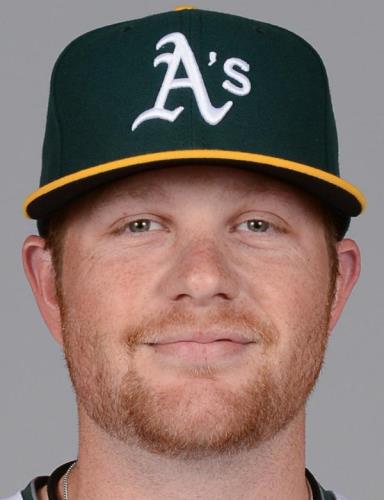
ANDERSON, BRETT  
 
Image of    Nickname:   N/A Position:   LHP
Home: N/A Team:   Retired
Height: 6' 4" Bats:   L
Weight: 230 Throws:   L
DOB: 2/1/1988 Agent: N/A
Birth City: Midland, TX Draft: D'Backs #2 - 2006 - Out of high school (OK)
Uniform #: 30  
 
YR LEA TEAM SAL(K) G IP H SO BB GS CG SHO SV W L OBA ERA
2007 MWL SILVER HAWKS   14 81.1 76 85 10 14 0 0 0 8 4   2.21
2007 CAL VISALIA OAKS   9 39 50 40 11 9 0 0 0 3 3   4.85
2008 CAL STOCKTON   14 74 68 80 18 13 0 0 0 9 4   4.14
2008 TL MIDLAND   6 31 27 38 9 6 0 0 0 2 1   2.61
2009 AL ATHLETICS $400.00 30 175.1 180 150 45 30 1 1 0 11 11 0.265 4.06
2010 AL ATHLETICS $410.00 19 112.1 112 75 22 19 0 0 0 7 6 0.257 2.80
2010 AZL PHOENIX   2 6 11 6 0 2 0 0 0 0 0   3.00
2010 PCL SACRAMENTO   3 13.1 19 12 3 3 0 0 0 1 0   4.05
2011 AL ATHLETICS $1,250.00 13 83.1 86 61 25 13 1 0 0 3 6 0.27 4.00
2012 AL ATHLETICS   6 35 29 25 7 6 0 0 0 4 2 0.225 2.57
2012 PCL SACRAMENTO   5 23.1 27 18 5 5 0 0 0 1 1   4.24
2012 CAL STOCKTON   1 2 4 0 0 1 0 0 0 0 0   9.00
2013 CAL STOCKTON   1 3.1 5 6 2 1 0 0 0 0 1   13.50
2013 PCL SACRAMENTO   1 2.1 3 2 3 1 0 0 0 0 0   7.71
2013 AL ATHLETICS $5,750.00 16 44.2 51 46 21 5 0 0 3 1 4 0.287 6.04
2013 TL MIDLAND   1 3.2 6 3 4 1 0 0 0 0 1   14.73
2014 PCL COLORADO SPRINGS   2 9.1 8 8 2 2 0 0 0 1 0   0.96
2014 NL ROCKIES   8 43.1 44 29 13 8 0 0 0 1 3 0.267 2.91
2015 NL DODGERS $10,000.00 31 180.1 194 116 46 31 1 0 0 10 9 0.278 3.69
2016 NL DODGERS $15,800.00 4 11.1 25 5 4 3 0 0 0 1 2 0.446 11.91
2016 CAL RANCHO CUCAMONGA   3 9 17 10 2 2 0 0 0 0 1   6.00
2016 PCL OKLAHOMA CITY   1 5 6 2 0 1 0 0 0 0 1   3.60
2017 IL BUFFALO   2 9.2 4 3 2 2 0 0 0 1 1   0.93
2017 AL CUBS   6 22 34 16 12 6 0 0 0 2 2 0.347 8.18
2017 AL BLUE JAYS   7 33.1 39 22 9 7 0 0 0 2 2 0.302 5.13
2017 SL TENNESSEE   6 27.1 34 15 9 5 0 0 0 2 2   4.61
2018 AL ATHLETICS   17 80.1 90 47 13 17 0 0 0 4 5 0.285 4.48
2018 PCL NASHVILLE   7 32.1 32 36 6 7 0 0 0 2 1   2.78
2019 AL ATHLETICS $1,500.00 31 176 181 90 49 31 0 0 0 13 9 0.265 3.89
2020 NL BREWERS $2,000.00 10 47 50 32 10 10 0 0 0 4 4 0.27 4.21
2021 NL BREWERS   24 96 102 58 28 24 0 0 0 4 9 0.276 4.22
  • Anderson is the son of Oklahoma State baseball coach Frank Anderson. Before he became head coach, Frank had  long been one of college baseball's most respected pitching coaches.

  • In 2006, Brett's senior year at Stillwater High School in Oklahoma, he committed to Oklahoma State.

  • In 2006, Anderson got drafted by the D-backs (see Transactions below).
  • In 2007, Baseball America rated Brett as 11th-best prospect in the Diamondbacks' organization. Before 2008 spring training, they had Anderson as the #3 prospect in the Arizona farm system, behind only OF Carlos Gonzalez and P Jarrod Parker.

    Then, in 2009, they moved Anderson up to the #1 prospect in the Oakland A's organization.

  • Brett's Dad is pretty intense, but Brett is not. He is low-key.

  • Anderson needs to take his conditioning more seriously. He has a soft body. But he lost over 30 pounds before 2012 spring training, mostly because he gave up Coca-Cola, starting in August 2011.

    Brett was in the middle of his rehab back from Tommy John surgery, which caused him to miss the first half of the 2012 season. He upped his conditioning efforts and running an average of two to three miles multiple times a week.

    "It's not my favorite thing ever," he said. "Running just to run, I don't think too many people like that, but it's part of the deal and it gets you in shape. I might as well take advantage of this time and get in the best shape of possible. It's frustrating it takes something like this for that to happen, but you have to make the best of it to make sure something like this doesn't happen again."

  • Asked what kind of pre-game ritual or superstitions he might have, Brett said, "I don't really have a pre-game ritual. I am really superstitious, however, from putting Chapstick on a certain way, to my uniform number."

    Anderson reportedly arranges his lip balms in meticulous order in his locker stall, and clings to multiple routines during games that dictate how and when he'll grab a cup of drinking water.

    Brett confesses to having a "full-fledged" case of obsessive compulsive disorder.

  • In August 2008, Anderson was a member of Team USA baseball in the Beijing Olympics.

  • In April 2009, when Brett and teammate Trevor Cahill went apartment hunting in Oakland, they were turned down several times.

    Having been turned down in the East Bay, the pitchers went elsewhere, finding a place in San Francisco, right across the street from the Giants' ballpark.

    "That was our deal, our time to talk about everything," Frank said. "School, life, whatever was going on. I told him, 'I guess you're old enough now. I can teach you how to throw a breaking ball.'

    "I asked him, 'You got any idea how to throw one?' " Brett told his Dad he'd try one out. You know, just to see. So he did—and it broke perfectly.  "It's basically the same slider that he's throwing right now," Frank said.

    Turns out that 14-year-old kid had been messing around with a slider for a while. Anderson now features some of the best breaking stuff in the Majors, along with a mid-90s fastball.

  • Bret's father's résumé spans more than 30 years of coaching experience at the college level. And perhaps no one has learned more from him during that time than his son, who also happens to be his best friend.

    "I was a field rat," Brett said. "It seems like a coach's kid can go one of two ways. They can embrace that life or despise it. I was all in. I was climbing on batting cages, pestering college kids. I was playing catch with anyone who would play catch with me. I'm just a baseball nerd."

    The ballpark was Brett's daycare center. Frank and his wife, Sandra, hired a student-athlete at Texas Tech to babysit Brett, which simply meant taking him to the field every day and locking the gate behind her as he raced off to the diamond during practices.

    Frank formed a deal with each of his employers before he took a job. It was non-negotiable. Brett would be in the dugout during every game.

    It was in one of those dugouts where Brett watched A's draftee Huston Street close out the national championship game for the Longhorns. He watched Street closely, pitcher J.P. Howell, too. And that's how he learned how to throw a baseball.

  • Brett carried a 4.0 GPA and finished eighth in his high school class—en route to scholarship offers from Stanford and Oklahoma State, where Frank was coaching at the time. But the Diamondbacks had a different plan for him; they took him in the second round of the 2006 draft. And Brett signed.

  • "Next thing you know, I have pins in my fingers."

    It was a good time to call his father. Brett is the son of Frank Anderson, a longtime college pitching coach at the University of Houston. But Brett leans on his father for who he is, not what he does.

    Dad was there for his son, who pitched for the Athletics from 2009-2012, after Brett underwent Tommy John surgery on his throwing elbow in 2011, limiting him to 13 starts that year. In 2012, Anderson made only six starts late in the year before suffering a right oblique injury that ended his season on Sept. 19. In 2013, Brett had his father around when foot and ankle injuries limited him to 16 appearances (five starts), forcing him into a relief role by season's end.

    But as hard as the injury bug has bitten Brett, Frank has been there to help with perspective. Frank said players deal with less anxiety directly related to the injury because of modern medicine. But they're still human. They still need their dads to remind them to approach the comeback the right way.

    "There are very few career-ending things, and that's the only way to approach it," Frank said. "There's a lot of hard work to be done, whether it's Tommy John or a shoulder surgery or anything like the one he has. But I tell him, if you don't look back, if you take a positive approach, you've got a chance."

    "He's been around the game long enough where he's dealt with people who have had injuries," Brett said. "If I have a bad day or whatever, I can call him. He's my best friend, too. We can talk about anything, whether it be baseball or life or whatever. It's always good to have that fallback. We talk about what my sister is doing, finishing up her freshman year of high school. Just take your mind off. He's my best friend, so we talk about whatever is going on."

    Rehab can be long and lonely, and Brett said his father helps him lighten up during the heavy moments.

    "He said to stay positive, go out there and do rehab, do what you need to get yourself back as soon as possible, and don't get too down, because there are a lot worse things in the world," Brett said. "At the end of the day, it's not too bad. At the end of the day, a lot of people have it worse than me." (Thomas Harding - MLB.com - 6/13/2014)

  • April 27, 2019: Brett Anderson is 31, so he’s not that old.

    But he made his Major League debut in 2009 at age 21, and has pitched for four different teams. So he has faced his fair amount of batters.

    Recently, when he started against the Blue Jays for the Oakland Athletics, Anderson had the distinct honor of being the first pitcher to face both Vladimir Guerrero and his son, Vladimir Guerrero Jr., who had recently made his much-anticipated big league debut.

    The elder Guerrero retired from the league in 2011. (Yahoo Sports)

  • Anderson's childhood nickname was "Noon."

    TRANSACTIONS

  • June 2006: The D'Backs chose Anderson in the second round, out of Stillwater High School in Oklahoma.

    September 7, 2006: Anderson finally signed, turning pro rather than go play for his father at Oklahoma State. His bonus was $950,000, with Joe Robinson being the scout who signed him.

  • December 14, 2007: The A's sent pitchers Dan Haren and Connor Robertson to the Diamondbacks; acquiring Anderson, pitchers Dana Eveland and Greg Smith, outfielders Aaron Cunningham and Carlos Gonzalez, and infielder Chris Carter.

  • April 16, 2010: The A's and Anderson agreed to a four-year, $12.5 million guaranteed contract. The max, including the two option years, could bring it to $31 million.

    Brett got a $1 million signing bonus and salaries of $500,000 in 2010, $1 million in 2011, $3 million in 2012, and $5.5 million in 2013. The club option for 2014 is for $8 million and $12 million for 2015. If the A's don't exercise either option, they'd pay a $1.5 million buyout.

  • November 1, 2013, the A's exercised their $8 million option on Anderson for 2014.

  • December 10, 2013: The Rockies sent LHP Drew Pomeranz and Chris Jensen to the A's, acquiring Anderson and $2 million.

  • November 1, 2014: The Rockies declined Anderson's $12 million option for 2015, instead paying a $1.5 million buyout.

  • December 31, 2014: Brett and the Dodgers agreed on a one-year, $10 million contract for 2015.

  • November 13, 2015: Anderson accepted the Dodgers qualifying offer of $15.8 million, becoming the third player in 2015 to accept it. All 34 qualifying offers were turned down in the first three years of baseball's current collective bargaining agreement. When a player lets the deadline pass to test the market, his former team receives an additional high selection in the June draft if he signs somewhere else.

  • Nov 3, 2016: Brett chose free agency.

  • January 24, 2017: Anderson signed a one-year, $3.5 million deal with the Cubs.

  • July 31, 2017: The Cubs released Anderson.

  • August 15, 2017: The Blue Jays signed Anderson to a minor league contract.

  • Nov 2, 2017: Anderson elected free agency.

  • March 20, 2018: The Athletics signed Anderson to a minor league contract.

  • Oct 29, 2018: Brett chose free agency.

  • Feb. 11, 2019: The A's signed Anderson.

  • Oct 31, 2019: Brett chose free agency.

  • Dec 13, 2019:  The Brewers finalized a one-year deal for Brett Anderson. Anderson will earn $5 million, with a chance to make $2 million more in incentives.

  • Oct 28, 2020: Brett elected free agency.

  • Feb 16, 2021: The Brewers signed free agent Anderson to a one-year contract for $2.5 million.

  • Nov 3, 2021: Brett chose free agency.

PERSONAL:
 
  • Anderson has an 88-92 mph two-seam sinker and a 90-95 mph four-seam FASTBALL that he commands well to both sides of the plate. He also has a 78-80 mph slow CURVEBALL with two-plane break that is a good strikeout pitch, a hard 81-84 mph late-breaking SLIDER and an excellent 82-85 mph CHANGEUP. It is another pitch to throw to righthanders early in the count.

    Brett also has a slower version of his curve. His fastball has good tailing action. The hitters react like his heater is 5 mph faster than it actually is.  

  • 2015 Season Pitch Usage: 4-seam Fastball: 34.7% of the time; Sinker 17.1% of the time; Change 7.6%; Slider 31.7%; CURVE 8.9% of the time; and Cutter .1% of the time.

  • 2016 Season Pitch Usage: 4-seam Fastball: 33.2% of the time; Sinker 25.4%; Change 8.8%; Slider 16.6%; his Curve 15.6%; and Split less than 1% of the time. Average velocity: 4-seam 91.5 mph, Sinker 92.2, Change 83.4, Slider 83.7, Curve 77.7, and Split 81.2 mph.

  • 2017 Season Pitch Usage: 4-seam Fastball: 19.5% of the time; Sinker 33.7%; Change 13.5%; Slider 21.5%; and his Curve 11.9% of the time. Average velocity: 4-seam 91.5 mph, Sinker 90.6, Change 83.9, Slider 82.7, and Curve 75.6 mph.
  • 2018 Season Pitch Usage: 4-seam Fastball: 18.2% of the time; Sinker 31.3%; Change 19%; Slider 24.6%; his Curve 6.8%; and knuckler less than 1% of the time. Average velocity: 4-seam 91.4 mph, Sinker 90.2, Change 83.7, Slider 82.3, Curve 76.1 mph, and Knuckler 90.9 mph.
  • 2019 Season Pitch Usage: 4-seam Fastball: 7% of the time; Sinker 43.1%; Change 13.8%; Slider 18.6%; his Curve 5.6%; and Cutter 11.9% of the time. Average velocity: 4-seam 91.4 mph, Sinker 91, Change 82.8, Slider 82.2, Curve 76, and Cutter 88.9 mph.

  • 2020 Season Pitch Usage: 4-seam Fastball:  3.2% of the time; Sinker 40%; Change 24.1%; Slider 11.7%; his Curve 10%; and Cutter 11% of the time. Average velocity: 4-seam 90.1 mph, Sinker 90.1, Change 83.2, Slider 82.4, Curve 76.4, and Cutter 87.8 mph.

  • "When you see the righthanded batter flinch, that's an indication of how good it really is," A's  farm director Keith Lieppman said. "Usually you see that with a righthanded pitcher on a righthanded hitter, or lefties on lefties, but rarely do you see it with a lefty pitcher on a righty hitter. You see that with him, where the hitter will start to swing, then flinch. Guys don't take real good swings against him."

  • His command is nearly perfect. He places the ball on either corner of the plate with incredible consistency.

    He has a fine, polished delivery that he repeats well.

  • Brett has a very impressive feel for the pitching craft. He pitches with a plan. And he repeats his delivery and arm slot very consistently. He is polished and he gets the most out of his quality physical skills.

    "He's very witted on the mound. One of the first things you notice is how polished he is," Diamondbacks farm director A.J. Hinch said in 2007. "He keeps the game under control. He knows what he is trying to do in every situation. He's very advanced. First of all, he throws strikes. He knows how to pitch inside. He knows how to disrupt the timing of a hitter by putting something on or taking something off while featuring a four-pitch repertoire."

  • Brett is laid back, but works at a very quick pace. He doesn't waste time, just getting the sign from the catcher and firing the ball. "He reminds me of Kenny Rogers in the sense that he plays catch with the mitt," Beloit manager Jeff Smith said in 2007. "He has three pitches he can throw for strikes at any time."  (Jim Callis-Baseball America-9/28/07)

  • Anderson should be a #3 or #4 starter for a long time in a big league rotation—he's a workhorse.

  • Asked what his best quality is as a pitcher, Brett said, "My ability to throw strikes and being able to stay even-keeled on the mound."

  • Anderson talks about his slider: 

    “My go-to has always been my slider. I’ve evolved into more of a sinker guy now, but at the same time, my slider has kind of been my bread and butter for however long I can imagine. It’s what I get my swings-and-misses with. “I knew I had a chance to pitch on the varsity team as a freshman [in high school]. I wasn’t going to go in there with a fastball and a changeup only, so I started throwing a curveball. It was a spiked curveball, because I have huge palms and short fingers. I’ve never really been able to throw a conventional breaking ball because of that; everything just kind of slipped out.

    “I started off with that get-me-over curveball, just to have something that spun against varsity kids. It was like a 12-6. Then I started throwing one that was straighter and it cut a little bit. I kind of morphed that one into a slider. It’s the same grip essentially, but two different pitches. I get on top for a curveball, usually just to get ahead, or to get back in the count; it’s to steal strikes. The slider is more of my put-away. I spike both pitches, the slider and the curveball.

    “My dad was a college coach, and we used to play catch in front of the house and at the field. I threw [the curveball] one day, and it was straighter, but then kind of went this way. Again, it kind of cut. I was like, ‘All right, I kind of like that.’ That turned into getting on the side of it and making it a little bigger. It kind of evolved into what I call my slider, although ‘slurve’ might be a better definition. It’s just harder than a curveball. Regardless, it’s what I’ve been throwing for 15 years now.” (David Laurila- Fangraphs- June 17, 2019)

  • In 2020, Anderson made $5 million dollars for the Brewers. A blister on his finger that was a constant nuisance ended his season. Let’s take a deeper look at his pitching offerings.

    According to Baseball Savant, Anderson threw six different pitches in 2020.  A sinker, changeup, cutter, slider, curveball, and a four-seamer. What it appears, the cutter was a new pitch for him in 2020.

    Of these, he relies mainly on a sinker, slider, changeup, and curve. Interesting to note and you have to consider sample size in 2020, his slider usage dropped to around 11%. Normally, it hovers around 21% to 25%. The four-seam fastball usage went down significantly, compared to previous seasons.

    Two things that could be considered “red flags” were his hard hit contact, which was the highest it has ever been at 48.1%, and his walk rate. Again, this is based on a short season and he had the blister. (Roger Castillo - Jan. 17, 2021)

  • 2021 Season: Anderson earned a 4.22 ERA across 96 innings pitched. This brought his career ERA to 4.07 across a total of 1140.1 innings in 13 seasons. This season, Anderson both started and pitched middle innings as needed. Throughout the season, Anderson battled a number of injuries and spent time on the 10-day injured list and in the minor leagues. 

     While it wasn’t always pretty, Anderson typically got the job done, save a couple of painful starts. He seemed to find his groove later in the season after returning from his September 2 shoulder injury and finished out the season strong. The stats don’t tell the whole story for this 4-9 pitcher. A common theme for the pitcher this year was finding himself with multiple men on base and no outs. Anderson developed a knack for working his way out of tricky situations, albeit those he got himself into.  (Grace Gierach - January 9, 2022)

  • As of the start of the 2022 season, Brett has a career record of 67-74 with 4.07 ERA, having allowed 115 home runs and 1,217 hits in 1,140 innings.
PITCHING:
 
  • Anderson has an excellent pickoff move to first base.
FIELDING:
 
  • 2005: Anderson's junior year of high school, he was limited to 46 innings because of a tender arm.

  • July 2007: Brett and six teammates were in a car accident. Anderson sustained a concussion and pitched only four more innings that season.

  • May–June 2008: Anderson was on the D.L. with a strained left thumb that prevented him from gripping his breaking pitch.

  • April 25-May 29, 2010: Brett was on the D.L. with a left flexor musculotendinous junction strain. That means the strain is partly in the flexor tendon, partly in the muscle.

  • June 4-July 30, 2010: Anderson was back on the D.L., this time with elbow tendinitis. The A's and Brett were thankful there was no structural damage.
  • June 7, 2011: Brett was on the D.L. with a sore left elbow. On June 13, he received a platelet rich plasma injection in his pitching elbow and then underwent six weeks of rehab. This was relatively good news that puts to rest the feared possibility that the A's No. 2 starter would have to undergo season-ending surgery. But it didn't fix the problem, and on:

    July 14, 2011: Anderson underwent reconstructive surgery on his elbow via Dr. James Andrews, who rebuilt the ulnar collateral ligament—Tommy John surgery. The operation involved the removal of the gracilis tendon in Anderson's hamstring, which was transplanted to the elbow and used as a graft on top of the ligament.

    During his time on the D.L., Brett got in excellent condition, losing over 20 pounds and stopping consumption of any carbonated beverages.

  • August 20, 2012: Anderson was activated off the D.L. by the A's. He had spent the first four months of the season rehabbing from Tommy John surgery.

  • September 19, 2012: Brett suffered a Grade 2 strain of the right oblique and was on the D.L. the rest of the season.

  • April 29-August 28, 2013: Anderson was on the D.L. all summer after aggravating his right ankle trying to field a ball in the 18th inning of the A's 19-inning win over the Angels.

    May 17 was originally circled as the day that Anderson might be able to return from the 15-day disabled list. Instead, the A's announced Anderson was diagnosed with a navicular stress fracture in his right foot that would keep him sidelined for longer. Anderson was on a rehab assignment with Double-A Midland before experiencing more pain during fielding drills.

    He finally was back in action at the end of August—three months later.

  • April 13-July 12, 2014: An X-ray revealed that Anderson suffered a broken left index finger.

    April 17, 2014: Brett had four small pins inserted into his left index finger to help speed the healing a broken bone. The pins, which will stay in Anderson's finger for about six weeks, allowed him to move the finger in a way a splint would not. After healing, Anderson will rehab.

  • August 5, 2014: Anderson was again on the D.L.,  with a lower back strain he suffered after just one pitch in the 4th inning of a game.

    August 14, 2014:  Anderson underwent surgery to repair a disk in his lower back.

  • March 3-Aug 14, 2016: Brett announced he was going to have surgery for a bulging disc in his back and be sidelined for three to five months.

    Anderson felt discomfort after a live batting-practice session and an MRI was performed on his back revealing the injury. Anderson previously had back surgery in 2014 as a member of the Rockies to repair a herniated disc. Surgery will take place in Phoenix and be performed by doctor Chris Yeung.

  • Aug 21-Sept 22, 2016: Brett was on the DL with a left index finger blister.

  • May 7, 2017: Anderson was on the DL with low back strain.

  • May 19-July 8, 2018: Brett was on the DL with left shoulder strain.

  • August 28-Sept 13, 2018: Anderson was on the DL with a strained left forearm.

  • May 1, 2019: Anderson was pulled with discomfort in his right oblique.

  • July 20-Aug 3, 2020: The Brewers placed left-hander Brett Anderson on the 10-day injured list with a blister.

    July 29, 2920: Anderson has received regular treatment since developing a blister on his left index finger during Summer Camp that landed him on the Brewers’ 10-day injured list. The humidity was a factor, Anderson said, compared to the dry air in Arizona that typically allows him to build up resistance to blisters during a normal Spring Training. But after navigating a simulated game at the Brewers’ Alternate Training Site and a bullpen session, he was confident that the issue was behind him.

  • April 24-May 9, 2021: Brett was on the IL with strained right hammy.

  • June 21, 2021: Anderson suffered a bone bruise while legging out a double-play grounder and then allowed five straight D-backs singles to begin the bottom of that inning. Then he left the game. 

    June 22-July 6, 2021: Brett was on the IL with right knee contusion.

  • Sept 2-22, 2021: Brett was on the IL with left shoulder contusion.
CAREER INJURY REPORT:
 
 
Last Updated 10/7/2022 4:12:00 PM. All contents © 2000 by Player Profiles. All rights reserved.