
|

|

|

|

|
| |
|
|
| |
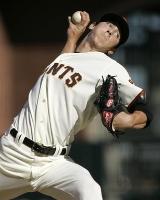 |
Nickname: |
N/A |
Position: |
RHP |
| Home: |
N/A |
Team: |
Retired |
| Height: |
6' 0" |
Bats: |
L |
| Weight: |
165 |
Throws: |
R |
| DOB: |
6/15/1984 |
Agent: |
Rick Thurman-Beverly Hills Sprts Council |
| Birth City: |
Bellevue, WA |
Draft: |
Giants #1 - 2006 - Out of Univ. of Washington |
| Uniform #: |
N/A |
|
|
| |
| YR |
LEA |
TEAM |
SAL(K) |
G |
IP |
H |
SO |
BB |
GS |
CG |
SHO |
SV |
W |
L |
OBA |
ERA |
| 2006 |
NWL |
SALEM-KEIZER |
|
2 |
4 |
1 |
10 |
0 |
2 |
0 |
0 |
0 |
0 |
0 |
0.071 |
0.00 |
| 2006 |
CAL |
SAN JOSE |
|
6 |
27.2 |
13 |
48 |
12 |
6 |
0 |
0 |
0 |
2 |
0 |
0.135 |
1.95 |
| 2007 |
PCL |
GRIZZLIES |
|
5 |
31 |
12 |
46 |
11 |
5 |
0 |
0 |
0 |
4 |
0 |
|
0.29 |
| 2007 |
NL |
GIANTS |
$400.00 |
24 |
146.1 |
122 |
150 |
65 |
24 |
0 |
0 |
0 |
7 |
5 |
0.226 |
4.00 |
| 2008 |
NL |
GIANTS |
$405.00 |
34 |
227 |
182 |
265 |
84 |
33 |
2 |
1 |
0 |
18 |
5 |
0.221 |
2.62 |
| 2009 |
NL |
GIANTS |
$650.00 |
32 |
225.1 |
168 |
261 |
68 |
32 |
4 |
2 |
0 |
15 |
7 |
0.206 |
2.48 |
| 2010 |
NL |
GIANTS |
$9,000.00 |
33 |
212.1 |
194 |
231 |
76 |
33 |
1 |
1 |
0 |
16 |
10 |
0.242 |
3.43 |
| 2011 |
NL |
GIANTS |
$14,000.00 |
33 |
217 |
176 |
220 |
86 |
33 |
1 |
1 |
0 |
13 |
14 |
0.222 |
2.74 |
| 2012 |
NL |
GIANTS |
$18,250.00 |
33 |
186 |
183 |
190 |
90 |
33 |
0 |
0 |
0 |
10 |
15 |
0.257 |
5.18 |
| 2013 |
NL |
GIANTS |
$22,250.00 |
32 |
197.2 |
184 |
193 |
76 |
32 |
1 |
1 |
0 |
10 |
14 |
0.248 |
4.37 |
| 2014 |
NL |
GIANTS |
$17,000.00 |
33 |
155.2 |
154 |
134 |
63 |
26 |
1 |
1 |
1 |
12 |
9 |
0.258 |
4.74 |
| 2015 |
NL |
GIANTS |
$18,000.00 |
15 |
76.1 |
75 |
60 |
38 |
15 |
0 |
0 |
0 |
7 |
4 |
0.26 |
4.13 |
| 2016 |
PCL |
SALT LAKE |
|
7 |
38.1 |
30 |
37 |
14 |
7 |
0 |
0 |
0 |
0 |
3 |
|
3.76 |
| 2016 |
AL |
ANGELS |
|
9 |
38.1 |
68 |
32 |
23 |
9 |
0 |
0 |
0 |
2 |
6 |
0.395 |
9.16 |
| 2018 |
PCL |
ROUND ROCK |
|
10 |
12.2 |
14 |
10 |
9 |
0 |
0 |
0 |
0 |
1 |
1 |
|
5.68 |
|
|
PERSONAL:
|
-
Lincecum weighed only 7 pounds and measured 21 and a half inches at birth, pretty small.
-
At Liberty High School in Renton, Washington, Tim pitched as a freshman at 4' 11" and 85 pounds. As a sophomore he was 5' 2" and 100 pounds. He hit a growth spurt in his junior year, all the way to 5' 7" and 125 lbs.
-
By the time he entered college, fresh off a senior season in which he was named Washington's 2003 Gatorade High School Player of the Year and drafted by the Chicago Cubs in the 48th round (he turned down their offer), Lincecum stood all of 5' 9", 135 pounds.
Yet he was named the state's 3A MVP and first-team All-State. He put up a 12-1 record in 2003, his senior year, with a 0.70 earned run average and 183 strikeouts in 91.2 innings. As a junior, in 2002, Tim went 4-2 with a 0.73 ERA and 86 Ks in 49 innings. Tim then accepted a baseball scholarship to the University of Washington.
UNIVERSITY OF WASHINGTON
-
In 2004, Lincecum's freshman year at the University of Washington, he went 10-3 with a 3.53 ERA and 161 strikeouts in just 112 innings. That 12.9 strikeouts per nine innings ranked second in the NCAA to Long Beach State's Jered Weaver (13.3), who was the Angels' #1 pick in the 2004 draft. Tim was a Baseball America Freshman All-American.
-
If you had looked under the bill of Lincecum’s cap when he pitched for the University of Washington, you would've seen a peek at how focused and businesslike he can be. There were 161 slash marks there, neatly tallied in rows with horizontal lines indicating groups of five. They represent every strikeout he recorded in 112 innings as a freshman at Washington.
His total set a single-season school record, led the Pacific-10 Conference and ranked behind only Long Beach State’s Jered Weaver and Texas’s J.P. Howell nationally. He added a 10-3, 3.53 record to earn Pac-10 pitcher of the year honors and freshman All-America status.
Lincecum’s been counting his K’s this way since his junior year at Liberty High in Renton, Washington.
-
In his freshman year, Lincecum broke Jeff Heaverlo's season record of 131 strikeouts at the University of Washington. And Tim set a baseball team record with 40 pull-ups while at the University of Washington.
-
Tim was a very active youngster. "I had a lot of energy," he recalled. "My metabolism was through the roof. I wanted to do everything. My parents gave me the freedom to do a lot of things, plus I had an older brother to follow who played all sports: basketball, football, baseball. I did the same. And I also had a job as a waiter. I just tried to fill my time and do stuff. I always liked being part of a team."
-
Tim's father, Chris Lincecum, works at the Boeing plant in Everett, Washington. He began working there in 1969. He is a vibrant, fast-talking man. He is only 5-feet-11 and 170 pounds himself.
Chris pitched as a youth and claims to have thrown 88 mph at age 52. He was teaching son Sean, four years older than Tim, on a backyard mound in Bellevue, Wash., when Tim, at five, began piggybacking on those lessons. The mechanics Tim employs now are the same he used then, the same as Chris used as a boy himself.
"My Dad and I aren't very large guys, so it's about efficiency and getting the most out of my body that I can," Tim says. "He learned that, and I'm a modified version of that. He was the prototype, and I'm version 2.0." Before Tim accepted a full ride at Washington, Chris made the Huskies' coaches promise they wouldn't change his mechanics.
Chris designed a weight-training program for Tim and videotaped all his amateur games—the two of them would critically review them the next day—except for road games when Tim was in college. By then Chris knew his younger son's mechanics so well that even while listening to those games on the radio, he could "see" what Tim was doing wrong. "Watch the angle of your shoulders!" he might yell, for example, at the radio when his son's location was particularly off.
In the stands Chris would sit behind home plate and flash signals to Tim, who knew exactly what to correct. If, for instance, Chris slapped his thighs, Tim knew to "sit down on my legs" through his delivery, to use the lower half of his body more. "His Dad obviously did a very good job with Timmy," says Giants pitching coach Dave Righetti. "I treat Timmy differently from most pitchers: I leave him alone."
"I used to hear from him every night, even when he played in the Cape Cod League," Chris says. "As soon as he got to the Majors, I hear from him about once a week. But I understand. It's his life. I'm here for him.
"You know, I'm built almost identical to Timmy. He's kind of like my soul mate. I pray for only one thing, and it's for my sons, and it's not about the most wins or getting rich. It's one little prayer. I pray my kids are safe and healthy." (Tom Verducci-Sports Illustrated-7/2/08)
-
Lincecum has a freakishly resilient arm. There were reports he was throwing long toss the day after a 190-pitch outing, while at Washington. Despite his heavy workload and the fact he doesn't even ice his arm (which is unheard of), he's never had an arm injury.
-
Even with all of his success, there was a feeling in most scouting offices that Lincecum was not physical enough and would break down mechanically—that there was too much stress on his arm, elbow, and shoulder.
-
Tim does a dead-on impression of Gollum from the “Lord of the Rings” movies and has sung verses of Bobby Brown’s “My Prerogative” on a Seattle-area sports radio program. Lincecum also does a perfect imitation of nearly every character from TV cartoon "Family Guy."
- Tim adheres to a special workout regimen to maintain the flexibility required for his mechanics. He does regular lifts with the other pitchers, but also has a vast assortment of stretches and other postures such as a back bridge (with his hands and feet touching the ground and his stomach to the sky) to keep him limber. His natural flexibility—Lincecum nearly gravitated toward gymnastics as a preteen who could perform splits and backflips from a standstill—also helps in this regard.
This routine, which includes stretching not only before workouts and games but also after, again comes from his father, whose teachings were validated to an extent when he saw Ichiro Suzuki performing similar stretches before games for the hometown Mariners. (Will Kimmey-Baseball America-2/16/05)
-
In 2005, as a draft-eligible sophomore, the Indians chose him in the 42nd round, but didn't offer the big money Tim said he would need to sign. Instead, Lincecum went to the Cape Cod League.
-
During the summer of 2005, Linecum led the Cape Cod League in ERA (0.69). Opponents hit .104 while whiffing in more than half their at-bats (68 of 134). He struck out 68 in 39 innings and allowed just 14 hits.
-
In the spring of 2007, Baseball America rated Lincecum as the #1 prospect in the Giants' organization.
-
Late in 2007 spring training, Lincecum was selected as Harry S. Jordan Award winner in a vote by his teammates. The award, named for a long-time minor league trainer, recognizes the player in his first big-league camp whose performance and dedication best exemplifies the Giants spirit.
-
As far as music, Tim, who hails from Washington, said, "I don't like grunge. I love the Beatles." Lincecum was born in 1984, 3 1/2 years after John Lennon's assassination, yet he counts the Beatles among his favorite groups. He likes Frank Sinatra, too. When the Giants did "American Idol" last spring, Lincecum dressed as Old Blue Eyes and sang, "Fly Me to the Moon."
-
Tim Lincecum's favorite music is from bygone eras, led by the Beatles, Frank Sinatra and Fleetwood Mac. His favorite Beatles songs:
"Revolution"
"Strawberry Fields Forever"
"Lucy in the Sky with Diamonds"
Tim says his Dad, Chris, turned him on to music at an early age. His parents always played musiic in the car when he was young. He filed away the lyrics to all the songs. To this day, he can listen to a song two or three times and have the lyrics memorized. It's not unusual to catch Tim signing a classic rock song. His teammates call him "the human juke box."
-
One of the few subjects Lincecum will side-step is his Mom, Rebecca, who split with his Dad around 2002. Asked how his Mom shaped him, Tim talked briefly about her taking him to practices as a kid and offering encouragement. Then he politely declined further comment. (Ron Kroichick-SF Chronicle-August 2008)
-
Tim is very meticulous in everything he does, from arranging trophies on a shelf when he was a youngster, to making sure his baseball sleeves, even today, don't extend past a certain point near his elbow.
-
Tim's Dad, Chris, sums up the younger of his two sons like this: "Timmy's a little goofy, but he's a little goofy because he's a kid. You look at him and you'd swear he's 16, but put him on the mound and you'd swear he's 35."
During the 2008 season, Tim was walking through the clubhouse and suddenly did a complete backflop, sticking a perfect landing. Centerfielder Aaron Rowand, one of the crustier Giants, took Lincecum to task immediately, telling him he was too valuable to endanger himself with such frivolity. The pitcher didn't argue, but as his father says, "They don't understand what kind of athlete he is. He's not going to hurt himself doing that."
-
November 5, 2009: Lincecum was charged with a misdemeanor marijuana charge following a traffic stop. The next day Lincecum paid a $250 fine for the marijuana pipe possession with the 3.3 grams of marijuana charge being dropped. Tim also had to pay a $122 fine for speeding.
This was a standard first-time offender charge for a misdemeanor pot possession who cooperates with police. Tim also paid $513 to resolve the marijuana charges.
-
Tim has worn the ratty-looking cap in every Major League game he has ever pitched in. It is a superstition he has held for many years.
"It's just something I always did," Lincecum said. "In high school, I got a cap and I stuck with it all year. In college, I wore the same hat until I had to change hats because they changed brands. I like keeping the old hat. I like the worn look. Plus, it means something to me. I don't want to throw it away.
"If I had one superstition," he said, holding the cap that he takes home for the winter, "it would be this guy."
Surprisingly, the hat does not stink even though it has not been washed. Lincecum allowed an investigative reporter to sniff it as proof. He is a rare young man who knows what Febreze is for. (Henry Schulman-S.F. Chronicle-4/07/10)
-
Tim can jump higher than anybody on the team. He can also walk on his hands. He is so flexible it is like he is built out of rubber. He's like a gymnist. And he can do a great back-flip.
When he was in the minors, at San Jose, the Latin guys would always ask him to do his back-flip. Most people bend their knees and spring up, but Lincecum can be standing there one second and next second he was flipping.
- During the 2010 season, Giants fans showed up at games in Tim Lincecum wigs and "Let Timmy Smoke" T-shirts. They think of him as a free-spirited little guy.During 2011 spring training, Lincecum reallly endeavored to pig out in an effort to add weight. And he put on a little over 10 pounds (to almost 170). His anticipated eating line after the game at In-N-Out Burger: three double-doubles, two orders of fries, and a half-chocolate, half-strawberry shake—or what would feed a small family.It seems as though Tim is somewhat of a music genius. No matter what is on your I-Pod, he knows the words to it: broadway songs, classic rock, pop, new or old, Lincecum knows it.
-
During the winter before 2012 spring training, Tim quit eating fast food and lost the 20 pounds that he'd gained in 2011 in a misguided attempt to equate heft with velocity and endurance.
"His velocity comes from his hips," Giants TV announcer Mike Krukow says. "He wasn't as quick with extra weight. He knows that now."
-
May 2, 2013: "I just love baseball and I enjoy being out there," Lincecum said recently. "I'm a competitive person by nature so when you put me out on the mound it's kind of where I feel like I belong. Most people think about getting to the World Series and winning that ring. When you have a taste of that it's not about getting there anymore, it's about winning and when you don't it's kind of a sad note."
"The biggest thing is approaching it as if each batter is your last," Lincecum said. "You don't go out there as a starter and say the first batter is going to be my last, but you have to approach it that way and have that kind of conviction in your pitches. That'll get you through a long game and you'll be able to draw something when you're in jams. Last postseason gave me the confidence that I can do that, although tonight I didn't do that."
- As of the start of the 2014 season, Tim had won two World Series titles, two National League Cy Young Awards, and had thrown a no-hitter in his career.Tim's father played minor league baseball, and older brother Sean was a former college baseball player.
-
There were times in the winter before 2015 spring training when the father had to step outside for a cigarette, figuring it better to rip a heater than to let an argument with his son get too heated. And in those moments, the son would air out his own frustration by firing fastballs at an empty net.
This was how the Lincecum men -- father Chris and son Tim -- learned how to let their differences dissolve as quickly as they'd arise. A quick smoke break for dad, and then it was back to the business of repairing a two-time Cy Young Award winner who had lost his way.
"We both like to butt heads,"Timsaid. "And we both like to argue. My dad's always right, and I can't ever convince him that he's wrong. So I'm not going to take that away from him."
What the son instead took away from his offseason was a renewed appreciation for his father -- the man who essentially crafted the unorthodox mechanics that made Tim a "Freak" in both name and numbers -- and a renewed confidence in his mechanics and mindset.
What the father took away from 2 1/2 months' worth of work (49 throwing sessions in all) with his prodigal son was a sense that we're going to see a much different Tim Lincecum in 2015 than we did in 2014.
"This is the most he's ever worked in the offseason since he's been in the Majors," Chris said. "I love the fact that he was so diligent about being there. He wanted to be there, even when he didn't want to be there, when he was tired or sleepy or whatever. This is the first time I've seen him with that chip on his shoulder."
Yet the father-son element -- a sort of Springsteenian repairing of relations between two men who were "too much of the same kind" -- adds nuance and substance to the story.
Shortly after Tim opened up to a group of reporters on the afternoon of the defending champs' pitchers and catchers report date, his dad sat in the grass outside the stadium, chain-smoking and talking about those throwing sessions at N-S Performance in Seattle.
Some people -- mostly professional pitching coaches -- will shiver at the thought of a guy throwing 49 times in the wake of a full-season slate, but the elder Lincecum has always believed in throwing more, not less. Certainly, his thoughts on pitching have long been considered unorthodox (he likes to say he believes only in icing his Bourbon and Sevens, not the throwing arm), but who among us could possibly argue with where those philosophies took young Timmy? (Castrovince - mlb.com - 2/19/15)
-
Tim made No. 55 an iconic number while playing for the Giants. He will wear uniform No. 44 with the Rangers in 2018, and that has deep significance for him.
It was one of the numbers that his older brother Sean wore. Lincecum idolized his brother, who passed away on Feb. 22 after going through some personal struggles. Lincecum attended the funeral in early March 2018.
The No. 44 was graciously given up by outfielder Destin Hood. "The [story] behind that is, that was my brother's number as he became a coach, and was around kids a lot, so ..." Lincecum said. "He was a big part of my life, and I don't know, I just want to feel like I can carry him out there, and honor him, in a way, and have him close.
"It's been tough," Lincecum said. "But I think I have the right people around me. I have a good support group. My family has been closer than ever, recently, so with that ... they've helped me out, and vice versa, so I think it's a ... I don't know ... that's probably all I've got right there." (Sullivan - mlb.com - 3/7/18)
TRANSACTIONS
-
June 2006: Tim signed with the Giants after they chose him in the first round (#10 overall) out of the University of Washington. His bonus was $2.025 million—the biggest the Giants had ever given an amateur. Matt Underwood is the scout who signed him.
Lincecum fell to No. 10, apparently the victim of concerns about his size and unorthodox delivery and training methods. The Giants snapped him up, planning to make him a starter. And Lincecum became the first UW player in history to be picked in the first round.
-
February 12, 2010: Lincecum and the Giants agreed on a $23 million, two-year contract, avoiding an arbitration hearing. Tim had been asking for an arbitration-record $13 million for 2010. He got a $2 million signing bonus plus $8 million for 2010, and $13 million in 2011, plus additional performance and award bonuses.
-
January 17, 2012: Tim and the Giants couldn't agree on a contract and signed on for salary arbitration. Lincecum asked for $21.5 million in salary arbitration and was offered $17 million by the club.
The two-time N.L. Cy Young Award winner's request neared the record amount sought in arbitration. Houston pitcher Roger Clemens asked for $22 million in 2005.
Then, on January 24, 2012: Lincecum and the Giants agreed on a two-year, $40.5 million contract which avoided salary arbitration. The deal includes a $500,000 signing bonus and salaries of $18 million for 2012 and $22 million in 2013.
-
October 22, 2013: In a surprising move, the Giants agreed with Lincecum on a two-year contract, preventing him from entering free agency.
Lincecum was fully expected to gauge his value on the open market, though he never ruled out re-signing with the Giants. CBS's Jon Heyman reported the deal is believed to be worth $35 million.
-
May 19, 2016: The Angels signed Lincecum with a base salary of $2 million for the remainder of the season.
-
Nov 3, 2016: Lincecum chose free agency.
-
Feb. 27, 2018: The Rangers agreed to a contract with Lincecum.
- June 5, 2018 : The Rangers released Lincecum.
| |
|
|
PITCHING:
|
-
Lincecum had an 88-92 mph two-seam sinker, a 90-98 mph four-seam FASTBALL and a true hammer CURVEBALL that breaks early and keeps on breaking. He also has a shorter 10-to-5 curve and a 12-to-6 bender. In 2006, he added a SLIDER and CHANGEUP to his repertoire. The grip on his changeup took him three years to master.Tim also has a KNUCKLEBALL, but hasn't really used it much since his high school days.
Tim did not throw a baseball as much as he launches 98 mph baseballs from his rather tiny 5-foot-10, 170 pound sinewy fast-twitch muscle packed body.
But when Lincecum started losing velocity in 2012 and 2013, he knew he had to re-invent himself as a finesse artist. Now, instead of a "K," Timmy wants to hitters to make "crappy contact."
-
2015 Season Pitch Usage: 4-seam Fastball: 32% of the time; Sinker 22.3% of the time; Slider 14.6%; CURVE 10.8% of the time; Cutter .1%; and Split 20.1% of the time.
- He still is a rare blend of power and precision.
-
He has had to fight the "too small" labels. But he has a body a lot like Pedro Martinez. And his stuff is outstanding. Old time baseball people say Tim reminds them of a righthanded Sandy Koufax or a Bob Feller, because of his delivery.
Lincecum is able to throw downhill, despite being rather short, because of his mechanics.
"I feel like I get down the mound pretty well because I've got a long stride. My arm angle is between three-quarters and straight over the top, so that keeps it from being flat, too. For the most part, it's the way I was taught that helps me get the action down the mound quickly," Tim said.
UNUSUAL DELIVERY
- Tim has a resilient right arm. And an unusual delivery. He creates force by sort of pin-wheeling the ball toward the plate. He spins off his front foot, takes a huge stride and wraps his right hand behind his right leg, and has a whipping motion to the plate, but has smoothed his motion up and has pretty consistent mechanics.
The delivery worked for Lincecum’s father, Chris, whom scouts deemed too small to sign despite a standout career at Sammamish High (Wash.) in the 1960s. Chris played semi-pro baseball and said he nearly reached 90 mph two years ago—at age 55—while throwing batting practice. He played minor league baseball.
Tim Lincecum drops the ball straight down behind him. "The coaches said I dig into my (butt) because I get the ball so far back,” he says—leans back and lets his lead arm extend straight as it rises to the sky. Then his lead arm circles down while his throwing arm rises, and he resembles a pinwheel as each arm works in unison. It’s reminiscent of some of the more fluid deliveries from baseball’s past, such as Sandy Koufax, Chris’s favorite player.
That’s the key, Chris said, creating torque with a whip-like arm motion (similar to that of Pedro Martinez) by using the body’s joints—specifically the wrist, elbow, shoulder, lower back, groin and knees—as hinges. (Will Kimmey-Baseball America-2/16/05)
-
Tim's throwing motion creates a lot of debate. Scouts equated his body speed with violence, But Lincecum generates outrageous rotational power—the key element to velocity—only because his legs, hips, and torso work in such harmony.
His mechanics are very efficient. Extremely efficient. You don't see wasted energy. When he's done, he's not exhausted. One key to Lincecum's delivery is to keep his left side, especially his left shoulder, aimed toward his target for as long as possible.
Where Lincecum truly separates himself from most pitchers is the length of his stride. It is ridiculously long as it relates to his height. And just as his left foot, the landing foot, appears to be nearing the ground at the end of his stride, he lifts it as if stepping over a banana peel—extending his stride even more. The normal stride length for a pitcher is 77% to 87% of his height. Lincecum's stride is 129%, or roughly 7 1/2 feet.
"That just came naturally," Tim says. "My Dad always told me to sit down on my back leg as long as I could and push off as much as I could. I'm trying to get as much out of my body as possible. I've got to use my ankles, my legs, my hips, my back. . . . That's why I'm so contorted and it looks like I'm giving it full effort when it's not exactly full effort."
As for the "step-over" move near the end of his stride, Lincecum explains, "That's from my hips. I'm getting everything toward the target, and my hips want to go. My hips can't just go and open up. I'm trying to create torque. That's when everything kind of explodes. My body comes, and [my arm] is just kind of along for the ride."
Once the landing foot hits the ground, every pitcher must have the ball in the loaded position; that is, the ball is raised behind him, ready to come forward and be delivered. Think of the cocking of a gun before it fires.
As he reaches the loaded position, Lincecum's hips have just opened so that his belt buckle is facing the batter. His torso, however, has not yet begun to rotate toward the plate. The GIANTS on his home jersey is facing third base and his left shoulder remains pointed directly at the target. Only then, with his body essentially twisted against itself, does the torso fire, creating more rotational power as, at last, after this symphonic whipsaw action of his body, his arm simply "comes along for the ride."
Once the baseball leaves his hand, Lincecum isn't done. An abrupt stop of the shoulder will lead to back and shoulder injuries, so to keep his right shoulder moving after the ball is gone Lincecum must keep his torso moving over his front leg. To create this sustained momentum, Chris invented a drill in which he placed a dollar bill on the ground to the left and in front of the landing spot of Tim's left foot. Tim would have to pick up the dollar in the same motion after releasing the ball.
"My Dad's always stressing, 'Pick up the frickin' dollar! If I put down a hundred dollar bill, you'd pick it up every time!' " Tim says. "If I get out there and get myself over [the front leg], my follow-through should be the tail end of when you whiplash a whip. That's what it is for me. Like Tiger Woods finishing his swing." (Sports Illustrated-7/02/08)
-
Throwing a baseball is an act of violence that has been graphically defined by Dr. James Andrews, Dr. Glenn Fleisig and the other doctors and clinicians at the American Sports Medicine Institute (ASMI) in Birmingham. From the loaded position, the shoulder, at its peak speed, rotates forward at 7,000 degrees per second. "That," Fleisig says, "is the fastest measured human motion of any human activity."
While in the loaded position, the shoulder and elbow bear the equivalent of about 40 pounds of force pushing down. When the ASMI biomechanists wanted to know how much more force an arm could take, they brought cadavers into the lab and pulled and pushed upon the elbow joint to find the breaking point. The cadavers's ligaments blew apart just after 40 pounds of force. "So a pitcher is just about at the maximum," Fleisig says.
From the loaded position, when the ball has come to a stop, it is accelerated from zero mph to 90 mph in 3/10 of a second. Rick Peterson, the former New York Mets pitching coach who has worked with ASMI since 1993 and is the acknowledged expert on pitching biomechanics among his peers, once referred to that measurement in a speech he gave to college coaches. A doctor of physics who was in the audience approached him after the talk.
"Rick, do you know what that means in g-forces?" the doctor asked.
"I have no idea."
"If your entire body was accelerated at that rate of speed for over 60 seconds, you would die." (Tom Verducci-Sports Illustrated-7/02/08)(Editor's note: All this and he still manages to avoid the D.L. year after year.)
-
Lincecum learned his mechanics from his father, Chris.
"My Dad taught me my mechanics since I can remember," Lincecum said. "It's worked really well with my body. It's kept me from getting hurt and lets me be as effective as I can be for my frame."
-
Tim's lightning-quick over-the-top delivery focuses on his lower body and legs. His arm just goes along for the ride. His stride is so long the ball seemingly leaves his hand very close to home plate.
That delivery requires incredible focus because he takes his eye off the target during his Kevin Brown-style turn. It also requires Cirque du Soleil-style athleticism and coordination to keep him on center to the plate. He can suffer through bouts with his command because of all the moving parts in his delivery.
- Lincecum's comination of deception and stuff make him nearly unhittable. He does a good job of mixing up speeds, messing up the hitter's timing.
- Tim is a flyball pitcher.
- Cubs broadcaster Bob Brenly, the ex-Giants catcher and former Arizona Diamondbacks manager, had these observations when viewing Lincecum pitch in 2007: "The velocity catches your eye first," Brenly said Tuesday. "But he has a lot of deception in his delivery. He seemed to have great body language on the mound. He looked like he was very sure of himself."
As others have done, Brenly enlightened his audience by comparing Lincecum to Roy Oswalt, another wiry, hard-throwing and mildly undersized righthander.
"Lincecum's mechanics are a little different from Roy's. But they both kind of jump at you," Brenly said. "I talked about the mental aspect as a hitter. When you see a pitcher kind of jump off the mound at you, you subconsciously feel like you have to speed up. And it looked like he had our guys off-balance most of the night."
Brenly was noncommittal about Lincecum's unusual pitching delivery.
"I've seen guys with better mechanics than him come down with bad arms, and I've seen guys with a lot worse mechanics than him come down with bad arms," he said. "Major League Baseball is all about making adjustments anyway. At some point in the future, if he starts to have problems, I'm sure Rags [pitching coach Dave Righetti] and other people will get him back on the beam." (Chris Haft-MLB.com-7/17/07)
-
In 2008, Lincecum won the National League Cy Young Award.
Tim received 23 of 32 first-place votes, seven second-place votes and one third-place vote for 137 points, which were assigned on a 5-3-1 basis. He outdistanced Arizona's Brandon Webb (73 points), the New York Mets' Johan Santana (55), Philadelphia's Brad Lidge (10), Milwaukee's CC Sabathia (9), and the Chicago Cubs' Ryan Dempster (4).
Lincecum became only the second Giant to capture the Cy Young, joining 1967 winner Mike McCormick, and the first second-year player to earn the distinction since righthanders Dwight Gooden of the Mets and Bret Saberhagen of Kansas City secured the 1985 awards in their respective leagues.
-
In 2009, Tim won the Cy Young Award for the second year in a row. Lincecum is the first pitcher to win consecutive Cy Young Awards since Randy Johnson, a Giant in 2009, won four in a row with the Arizona Diamondbacks from 1999-2002. Other back-to-back winners include Pedro Martinez (1999-2000), Roger Clemens (1997-98 and 1986-87), Greg Maddux (1992-95), Jim Palmer (1975-76), Denny McLain (1968-69; he shared the honor in the latter year with Mike Cuellar), and Sandy Koufax (1965-66).
-
Tim is not real big on warming up in the bullpen.
"I don't know; it's just the way my body works. I just go with it. That's why so many people thought I could be a good closer. It doesn't take me long."
Lincecum subscribes to no solemn throwing program. He doesn't really stretch, never ices and swears he has never felt so much as the slightest twinge in his right arm. (Tim Keown-ESPN the Magazine-3/09/09)
-
In 2011, Lincecum received the Major Leagues' lowest run support, an average of 2.94 per outing that also happened to be the third-lowest figure for any starting pitcher since 2000. That offset Lincecum's 2.74 ERA, which was the NL's fifth-best.
The Giants scored no runs behind Lincecum in seven of his 33 starts, one or less in 6 more of his outings and two runs or fewer in another seven. Of his 14 defeats, 13 occurred when San Francisco scored one run or less behind him. The numbers suggest that one more run here or there would have made a huge difference for Lincecum, who was 12-3 when he received two runs or more.
-
Tim hasn't forgotten the words of Randy Johnson when the Big Unit came to San Francisco in 2009 at the tail end of his magnificent career.
"You're always questioning how to sustain what you're doing, or how to get better," Lincecum said late in August 2012. "You're always trying to get up to a higher level. One thing Randy Johnson said when he got here was to never get complacent. Never get content. You're never good enough until the next day, until you put your work in and do everything you can to get better."
TWO NO-HITTERS
-
July 13, 2013: Tim pitched his very first no-hitter. It came vs. the Padres at Petco Park. It required 148 pitches, was the 15th in Giants history, and the seventh since the franchise moved to San Francisco in 1958. He had plenty of help from his defense, including Hunter Pence's diving catch to end the eighth.
-
June 25, 2014: Lincecum became the second Giant to pitch two no-hitters, silencing the San Diego Padres before an AT&T Park audience that was anything but silent in San Francisco's 4-0 triumph.
What he accomplished was achieved by only one other Giant more than a century ago.The great Christy Mathewson no-hit the St. Louis Cardinals and Chicago Cubs on July 15, 1901 and June 13, 1905, respectively. Lincecum joined the "Big Six," as Mathewson was nicknamed, by bookending the 16th no-hitter in Giants history with his epic 148-pitch effort at San Diego last July 13.
-
With the Giants having exhausted their bullpen, in terms of manpower and energy, Lincecum stepped forward to record the final two outs and earn his first Major League save, a 14-inning victory over the Philadelphia Phillies.
Lincecum became the first pitcher to record a save and pitch a no-hitter in the same season since Matt Garza pulled off the combo for the Rays in 2010. (7/22/14)
-
On August 25, 2014: The Giants sent Tim to the bullpen after struggling for six straight starts: 1-3, 9.49 ERA, 2.27 WHIP and a .380 opponents average against.
His first 21 appearances in 2014: 9-6, 3.65 ERA and 1.23 WHIP and .228 opponents batting average.
-
As of the start of the 2018 season, Lincecum had a career record of 110-89 with a 3.74 ERA, having allowed 147 home runs and 1,506 hits in 1,682 innings.
| |
|
|
FIELDING:
|
- Many pitchers are poor athletes who happen to be blessed with one very specific skill. Lincecum has the body of a gymnast and can rip off a backflip or walk on his hands to prove it. Chris likes to tell the story of how Tim came home one day during his junior year of high school and said, "Dad, I want to try out for the golf team."
Chris pointed out that Tim had played 27 holes in his life and didn't even own golf clubs. No matter. Playing with a borrowed set, Tim needed to shoot 40 on the last of three nine-hole rounds to make the team. He shot a 39.
| |
|
|
CAREER INJURY REPORT:
|
-
August 12, 2008: Lincecum sustained a bone bruise when a line drive struck him on the side of his right knee during the fifth inning.
X-rays taken at a hospital near Minute Maid Park revealed no fracture, and Lincecum was said to be walking freely upon returning to the stadium late in the game.
-
October 22, 2014: Timmy had to leave the mound pitching in Game 2 of the 2014 World Series at the Royals. He retired all five of the hitters he faced, striking out two before leaving.
But good news: He was listed as day-to-day with tightness in his lower back.
"The pitch before the last one, I felt something tighten up in my lower back," Lincecum said, adding that it was more stiffness than pain. "I just decided not to go any further."
-
June 28, 2015: A line drive to his pitching elbow put Lincecum on the D.L. for the first time in his career. Colorado's D.J. LeMahieu lined a drive off Timmy's elbow in the 2nd inning, and he had to leave the game.
-
July 19, 2015: Giants skipper Bruce Bochy said the Lincecum received cortisone shots in both hips to treat a degenerative condition. It's not considered career-threatening.But Timmy required surgery on his left hip in Vail, Colorado, by Dr. Marc Phiippon. He repaired Lincecum's torn left hip labrum during the arthroscopic procedure and addressed a hip impingement or bone build-up that had occurred over time and was the biggest source of discomfort for the pitcher.
"I'm glad we did something," Giants manager Bruce Bochy said. "It's going to give Timmy a little peace of mind to get this behind him."
-
September 3, 2015: Tim went on the 60-day DL as he underwent season-ending arthroscopic surgery on his left hip. The surgery was performed by Dr. Marc Philippon at the Steadman Clinic in Vail, Colo.
- March 25, 2018: Tim was on the DL with a blister on his right middle finger.
| |
|
| |
| Last Updated 5/9/2019 8:37:00 PM. All contents © 2000 by Player Profiles. All rights reserved. |
|