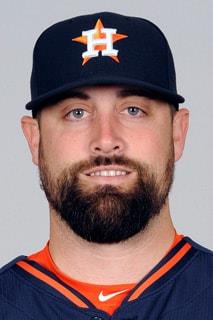
|
PERSONAL:
|
-
Neshek is pronounced knee-sheck.
-
Pat grew up in Brooklyn Park, Minnesota, playing in yards and sandlots with kids who would go to the Little League World Series.
"We had a sandlot-type yard, a corner lot, and we played every day after school," he said. "Our yard was so beat up, before we sold the house, we had to re-sod the whole thing.
"That was the year they went to the Little League World Series, and eight kids from our neighborhood were on that team, so I think it had a big impact on their skills. We kept stats, on a computer. I was the stat-keeper, and we had an All-Star game. We even had nicknames.
"You'd have ghost runners, and you'd shut down an outfield, so you could play with any number of people. I think just playing every day was a big key to developing athletic ability, because all the kids who played with us were good in other sports, too.
"Our neighbor's house was the Blue Monster," Neshek said. "We knocked windows out. We had to go to rag balls, but we still broke windows." (Jim Souhan-Minneapolis Star Tribune-3/28/08)
LOCAL BOY MAKES TWINS
-
In 1998, the Twins drafted him in the 45th round, out of high school. But he went to Butler University instead.
-
At Butler University, Pat set school records for single-game strikeouts (18), season strikeouts (118), and career strikeouts (280).
-
In 2002, the Twins drafted him again, in the sixth round, out of Butler. This time, he signed.
-
He grew up and went to high school in a Minneapolis suburb, where he was an all-state player at Brooklyn Park High, not far from the Metrodome.
Pat moved to Brooklyn Park, Minn. when he was five years old. His family still lives there. A huge Twins fan as a child, Neshek grew up in a family that held season tickets at the Metrodome for seven years. His house is about a 10-minute drive from the park.
"I've probably been to the Metrodome about 400 times," Neshek said with a laugh. "I practically lived there while I was in high school."
-
In 2001, Pat was a Cape Cod League all-star.
-
Neshek maintains his own website, which reflects the true baseball fan he is. He is an avid autograph collector. Pat calls the site, "On the Road With Pat Neshek" which is at patneshek.com. It was probably the first site offering fans a glimpse of daily life in the minor leagues.
And Pat, who is an avid autograph collector, communicates with other collectors and "graphers."
-
The essence of Pat Neshek can be summarized in this post from his web site: "I wake up each day and can't believe how I got here and am thankful to even touch the uniform! If I wasn't playing baseball, I would probably be the guy who was coming home from work and planning a night around baseball—what games to go to, which minor league games to get autographs, which guy to take on my fantasy team . . . "
-
Pat and his wife Stephanee were married in December 2006.
BECOMES A VEGAN
-
Neshek isn’t shy about crediting much of his success, staring in 2006, to his girlfriend/now wife Stephanee’s suggestion he monitor his nutrition. As a result, Neshek has become perhaps baseball’s biggest juicer—of vegetables, that is.
“I think the biggest thing about it is that my energy level is always high,” he said. “My first couple years I would tire out, and the season seemed to never end. I would get tired out and really jittery not knowing it was caused by eating McDonald’s and drinking soda. And I would pound down seven Whopper Juniors and she'd be like, 'What the heck are you doing?' and she would tell me why it's so bad.
“When I cleaned up all that and focused on more natural foods, I started getting results from my body. My velocity started going up in big jumps and I know that it was from juicing vegetables and eating fruits, mixed in with a workout program during the season.” (Matt Eddy-Baseball America-5/22/06)
-
On being a vegan: "It started four years ago when I first met [wife] Stephanee," said Neshek, who got married in December 2006. "I would pound down seven Whopper Juniors and she'd be like, 'What the heck are you doing?' and she would tell me why it's so bad."
Neshek finally took his wife's message to heart and is trying life as a vegan, which means he no longer eats meat of any kind or any animal byproducts.
"Stephanee is a real excellent cook, probably the only reason I could do it," said Neshek, who has been in the Majors with the Twins since July 2006. "If she wasn't, I would have no chance. The food is not convenient to find and it's tough, but she makes it better tasting than what she used to make."
The results have been noticeable to him. Neshek took a blood test in January during TwinsFest and saw a drop in his cholesterol level.
"I've maintained my weight, and my energy is awesome," he said.
-
Neshek's challenge will be to maintain his diet during road trips because his wife can't travel on all of them. He might have to have some food packaged or find out which restaurants match up with his diet goals.
"We'll see where it is in June," he said.
The other key for Neshek is the in-season conditioning program that pitchers rely on to maintain arm strength throughout the year. The Twins believed Neshek could have pitched more the previous season had he stuck with the program.
-
Pat likes Chinese and Vietnamese restaurants.
-
In 2007, Baseball America rated Neshek as being the 6th-best player in the Twins organization.
-
Neshek says if he weren't playing baseball he probably would be a financial adviser.
-
His favorite TV shows: The Simpsons and Beavis and Butt-Head.
-
October 3, 2012: Pat missed the A's last regular season game of the season to be with his wife, Stephanee, who was delivering their first child. But the baby, a boy they named Gehrig John, died at just one-day-old.
"It was tough. We were locked up in the house, and you can sit there all day, but it was kind of what I imagine hell is like. But seeing a lot of support from the guys and other players around baseball and guys I've played with and fans of baseball was really helping us. If nothing else, we kind of wanted to do it in my son's honor, to come here and do this (be with the A's at the start of the AL Division Series on October 6, 2012)."
Neshek received a different kind of call from his wife while watching the fifth inning of Oakland's eventual AL West-clinching victory. Gehrig had unexpectedly and, with no explanation, stopped breathing.
"We sat all night," Neshek said. "We didn't know what to do, because people were sending us texts of congratulations and stuff and that really hurt. But then I put it up on Twitter and Facebook, and it was pretty amazing, just what talking with friends and talking with complete strangers, how much of that helps the grieving process. I don't think we'll ever get over it. This really helps. It's a good way to start putting the pieces back together."
"That was probably the best day I ever had, the one day," Neshek said. "I'd go through it all again just for that one day. It was pretty awesome."
Then, just days after Gehrig John died, Pat gave the A's two crucial outs in Detroit in an emotional outing during the American League Division Series.
-
Good news! Nearly 18 months after the death of his first son, Neshek has been bedside with his wife, Stephanee, who delivered a 7-pound, 11-ounce baby boy in an Orlando-area hospital on. Hoyt Robert Neshek, aptly named to include "HR" in the initials, and after knuckleballer Hoyt Wilhelm, has been in the neonatal intensive care unit with respiratory issues since arriving 10 days before Stephanee Neshek's planned C-section.
The Nesheks received good news on March 16, 2014 when doctors informed them that an air pocket putting pressure on Hoyt's lung had reduced substantially and that they hoped he would be released in a week. The baby has also been receiving medication to help him fight pneumonia.
The Nesheks were never able to take their first son home. Gehrig John stopped breathing 23 hours after he was born on Oct. 2, 2012. The day he died was the same day the A's defeated the Rangers to win the American League West. Neshek rejoined his Oakland teammates a few days later for the AL Division Series. He found himself having to mourn in the public eye.
The death of their first son, Neshek said, was later determined to be caused by an infection that came as a result of the hospital providing the newborn with the wrong antibiotic. That hospital did not have a NICU, which is why the Nesheks opted to commute about 90 minutes from their Melbourne, Fla., home to deliver Hoyt in a hospital that has one of the best such facilities in Florida.
"I feel like [Gehrig] probably would have been fine if he had been at this place," Neshek said. "There were a lot of similarities to that [birth], which scares the heck out of us. It sucks seeing [Stephanee] have to go through that. We have to just be strong. There was a time that first day, it was tough on both of us. I wasn't in too good of a mood. When we saw him, it brought a lot of joy.
"The first time she held him, it brought back a lot of flashbacks; she actually starting crying. I'm really proud of her to be that brave, even to attempt to have another baby."
Stephanee Neshek was discharged from the hospital and stayed in a nearby Ronald McDonald House until the baby was released to go home. Neshek spent his evenings there, too, after finishing his spring training work each day.
-
Paul Neshek, the brother of Pat, may not be the one who was winning the baseball games at home all the time when the two were growing up. While Pat made it to the Major Leagues, Paul has stayed in the game, acting as a ballboy for the Minnesota Twins in 2013.
-
Pat is an avid baseball card collector. He started when he was a kid, collecting and trading cards until he turned 13.
"You go to junior high, and you start listening to rap and doing other things," Neshek said. But he picked the hobby back up while he was in college at Butler University in Indianapolis, and has been an avid collector ever since.
-
Neshek's brother, Paul, was working on the grounds-crew for the Twins in 2014, when his brother, Pat, pitched in the season's All Star Game for the NL. And Neshek pitched the 5th inning for the NL, and he pitched two-thirds of an inning, allowing two runs.
-
In August 2014, Pat went home with a Babe Ruth autographed baseball. Neshek, an avid baseball card and memorabilia collector, grudgingly passed his No. 41 to John Lackey when the veteran was acquired from Boston in a Trade Deadline deal.
He had no longtime attachment to the number, but it did hold significance as being the number he donned for his first All-Star Game. His mother was so upset with him that she hung up the phone when he informed her of the jersey trade.
Lackey had worn No. 41 in 11 of his 12 Major League seasons, the lone exception being in 2010, when Victor Martinez wore it in his last year with the Red Sox.
Lackey planned to present Neshek with a watch as a gesture of gratitude. However, when Neshek heard of those plans, he mentioned to his new teammate that he would prefer something that could go into his extensive memorabilia collection. He first considered a baseball card, then settled on a Babe Ruth ball that he had been eyeing for some time. When Pat received his gift, he was elated while showing it off to awestruck teammates in the clubhouse.
"It's pretty awesome," Neshek said. "It's something I've always wanted. It's the best autograph I have in my collection. Man, what a gift."
Before finalizing the purchase, Neshek had a friend authenticate the baseball, which features a signature with Babe in quotation marks. That, Neshek explained, is an indication that it was signed when Ruth was still playing, likely around 1926.
Neshek told Lackey he would help cover part of the cost, an offer that Lackey declined. While Lackey was prepared to spend about $10,000 on a Breitling watch for Neshek, this gift went for more than two times that amount.
"I think he was really happy with it, and I appreciate him giving up the number with him having such a great year," Lackey said. "I wanted to do something cool for him."
For Neshek, the autograph instantly became the best in his collection, topping the Napoleon Bonaparte-signed battle plans that Neshek had previously procured. It also has helped him grow content with his new number, 37.
"You know what? I've gotten a lot of strikeouts since with No. 37, and things have been going pretty well," Neshek said. "It was a great trade." (By Jenifer Langosch / MLB.com | 8/20/2014)
-
A lot of Major League players answer fan mail, but Cardinals reliever Pat Neshek takes it to a level few -- if any -- players have ever attempted. Dating back to his rookie year with the Twins, in 2006, Neshek has had a deal with the fans: Send him a card of anyone who has played in the history of Major League Baseball, and he'll send back a Pat Neshek card.
The practice went on for years, picking up a lot of steam when he signed with the A's in 2012. He was a feel-good story at the 2014 All-Star Game in Minneapolis, where the story re-emerged, and as a result the amount of fan mail also increased.
As of the end of the 2014 season, Neshek estimated that he has obtained 10,000 to 20,000 cards, just by trading them with others, from the time this whole exercise started eight years ago.
This isn't just a way to engage with the fans. An avid collector, Neshek obtains as many autographs as he can from players whose cards he has. In 2013, he worked on the entire 1985 set, obtaining most of those cards through exchanges from fans. In 2014 he targeted the 1970 set.
As for why he has chosen this as a hobby, Neshek laughed and said, "I'm a nerd."
Maybe so, but he does have an added advantage in that because of what he does for a living, he's more likely to run into players from the 1970 season who may be willing to sign the cards.
"I need a Juan Marichal really bad, so maybe we'll play the Giants," Neshek said before the Giants clinched their Division Series over the Nationals. "That would be nice. I need [Bruce] Bochy, too. ... I could finish a lot of this." (Alyson Footer is a national correspondent for MLB.com./ 2014)
-
Neshek appeases other collectors and fans interested in getting his signature by returning any cards they send him—as long as they include a self-addressed stamped envelope for the return. "I get about 10 [letters] a day, sometimes more, sometimes less," he said. "It's a pretty solid 75-100 letters a week. I try to get them turned around as quickly as I can."Neshek posts a mailing address at his Web site, Neshek.com, which also contains some posts about his quest to obtain certain pieces of baseball history. One of his projects is an attempt to assemble complete Topps Baseball Card sets that are signed by everyone in the set, which gets us back to the letters he receives. Fans send him autographed cards to help him complete his sets in exchange for his signature. "That's probably my favorite thing to do," said Neshek, who has a completed signed 1985 card set and is working to finish the 1970, 1974, and 1979 sets as well. (Brian McTaggart)
- February 2017: Neshek committed to play for the USA in the World Baseball Classic.
-
April 19-21, 2017: Pat was on the paternity list.
-
Harry Kalas once wrote Neshek a card wishing him luck the next season. He cherishes that along with his large autograph collection.
-
Pat seems to have a case of seller's remorse. While in New York, after an April 2, 2018, game against the Mets got postponed because of snow, Neshek bought a few boxes of 2018 Topps Heritage baseball cards to open in his hotel room. Neshek, who is an avid baseball card and autograph collector, pulled a lottery ticket from one of the packs: a Shohei Ohtani card signed in red ink, one of just 69 in existence.
Neshek had the first card in the series, making it even more valuable. "It was the best card I've ever pulled in my life," Neshek said. "It kind of blew my mind. I knew somebody would cherish it a lot more than I did, so I was like, I'm going to list this so I can get something I want or go buy another case [of cards]. That's kind of how the hobby works. Yeah, so I put it up, it was pretty fierce bidding there."
The card sold for $6,100 on eBay. Of course, almost on cue, Ohtani homered in three consecutive games last week, before he struck out 12 batters in seven scoreless innings in a one-hitter against the A's. Ohtani is the biggest story in baseball, meaning the card might have already appreciated in value.
"Yeah," Neshek said with a smile, asked if he regrets selling it. "I mean, back in the day I sold an Aaron Rodgers card about his second year in [the NFL]. I think I got like $40 and they were going for like, two or three grand a couple years ago. That was a dumb one. That's kind of the name of the game. You see it with the Aaron Judge stuff. His stuff wasn't selling, then when he blew up last year, it kind of revitalized the whole baseball card industry. They had their best year in 20 years last year. It's nice to see people doing that. Hopefully Ohtani does the same thing, and more people will get into the hobby."
Neshek said he will use the money to buy another case of cards. He knows he has little chance of finding another Ohtani. "You're not going to get that card again," he said. "It's got to be one in a couple thousand cases." (Zolecki - mlb.com - 4/10/18)
-
Aug. 2022: Neshek chose to participate in the 2023 WBC for the U.S.
TRANSACTIONS
-
June 2002: The Twins chose Pat in the 6th round, out of Butler University in Indianapolis.
-
January 19, 2010: Neshek and the Twins avoided salary arbitration, agreeing on a $625,000 contract for 2010.
-
March 20, 2011: The Padres claimed Pat off waivers from the Padres.
-
January 30, 2012: Neshek signed with the Orioles organization.
-
August 3, 2012: The A's sent cash to the Orioles, acquiring Pat.
-
February 7, 2014: Neshek signed with the Cardinals.
-
December 10, 2014: Pat signed a two-year, $12.5 million contract.
-
November 4, 2016: The Astros traded Pat to the Phillies for PTBNL.
-
July 26, 2017: The Phillies traded Neshek to the Rockies for RHP Alejandro Requena, RHP J.D. Hammer and SS Jose Gomez.
-
Nov 2, 2017: Pat chose free agency.
-
December 11, 2017: Neshek signed a two-year, $16.2 million pact with the Phillies.
- Nov 4, 2019, Pat chose free agency.
| |
|
|
PITCHING:
|
-
Pat has a sinking two-seam FASTBALL that is in the 87-93 mph range. That sinker has good cutting action. He also has a good, hard 88-90 mph SLIDER that has lift and plenty of turn, but not classic late-plane break. His CHANGEUP was much improved in 2007, enabling him to retire lefthanded hitters more effectively.
-
2016 Season Pitch Usage: Sinker 39.7% of the time; Change 7.1%; and Slider 53.2% of the time.
-
2017 Season Pitch Usage: Sinker 44.9% of the time; Change 3.2%; and Slider 51.9% of the time.
-
2018 Season Pitch Usage: his Sinker 39.5%; Change less than 1%; and Slider 59.7% of the time. Average velocity: Sinker 89.4, Changeup 63.5, and Slider 81.5 mph.
- 2019 Season Pitch Usage: his Sinker 37.4%; Change less than 1%; and Slider 62.2% of the time. Average velocity: Sinker 88.9, Changeup 63.5, and Slider 81.9 mph.
-
Pat is a cerebral pitcher.
FUNKY DELIVERY
-
While Neshek was batting in his final high school game, the switch-hitter blocked a pitch with his right arm. The impact left a lump on the inside of his forearm—a lump he still has to this day. It caused searing pain in his wrist whenever he threw. Even a specialist was not sure what was wrong.
But, while playing for a summer league team in Kansas City, Pat discovered he could throw sidearm without pain—and with more movement and deception. He went on to Butler University where he was very successful.
-
Neshek has a herky-jerky sidearm delivery that fools a lot of hitters. He throws strikes from his three-quarters motion. Pat's sidearm release point is what is tricky for hitters. It is an unusual double-pump move that is deceptive—especially to righthanded batters. His first move resembles that of a submarine pitcher, bending low, but he finishes higher and delivers the ball sidearm. Picking up the ball out of the blur of his arms and legs is tough for hitters—and even for his catcher.
He is very tough for righthanded batters to read. But as is the case for most sidearming righthanders, Pat was susceptible to lefthanded batters. That was true until 2007, when Neshek much improved his changeup that he throws from the same four-seam grip.
-
“He’s got a funky motion, very unorthodox,” Rochester manager Stan Cliburn said. “It’s not submarine, but then it’s not three-quarters or sidearm, either.”
What it has been is effective. As Neshek strides toward the plate, he bends and crouches as a submariner would, but then straightens and delivers sidearm to the plate. But the deception was not by design.
“I used to throw over the top, but I got hit by a pitch (by Royals’ farmhand C.J. Woodrow) in my last high school game,” Neshek said. “I had trouble gripping a baseball, and couldn’t throw all summer. When I played shortstop (in summer ball) I threw from the side when I made plays.”
In 1999, Neshek, who attended high school in Brooklyn Park, Minn., not far from the Metrodome, was the 45th-round pick of the Twins. He was drafted the same day he was struck by Woodrow’s pitch. He turned down his hometown team for a chance to better himself as a pitcher at Butler University in Indianapolis. By the time Neshek got to campus, his forearm had healed. The only problem was, his body had gotten used to throwing sidearm.
“When I went to college, my coach Steve Farley wondered why I was throwing that way, and I told him I didn’t know I was throwing weird,” Neshek said. “He got me on tape and I was in disbelief at how I was throwing from the side. We tried to work it out, but he told me it worked and not to change anything. It turned out to be a blessing in disguise and is the key to getting me up to this level.” (Matt Eddy-Baseball America-5/22/06)
-
Another oddity: When working from his windup, Neshek slides his plant foot from the third base side of the rubber to the first base side before he releases the ball—defying just about every rule of balance and mechanics.
Until July 2007, Pat didn't even realize he does this until he heard Yankees announcers on YES Network talking about it on a replay telecast. From the stretch, Neshek's foot hugs the first base side.
-
In the spring of 2014, Pat believed that in order to extend his career as a Major Leaguer, something had to be fixed. Self-discovery has since led him to find his fastball.
"When your job depends on it, you're going to try to be the best pitcher you want to be," Neshek said. "I needed to get my fastball back."
The Cardinals knew that he had become slider dependent in recent years. The club's radar gun has registered a fastball as high as 92 mph for Neshek, who said he doesn't think he's shown that sort of velocity since his early years (2006-08) with the Twins.
"It looks good to me," manager Mike Matheny said of the right-on-right specialist. "The ball is jumping out of his hand. You can tell it's an uncomfortable at-bat. The lefties look just as uncomfortable as the righties do. I know those numbers have always been skewed the other way. He's got plenty of life on the ball, no question."
Neshek kids about how the A's will probably forever label him the "slider guy," because of how reliant he became on that pitch during his two-year stint in Oakland. That's a label he vowed to dissolve in 2014.
From 2006-11, Neshek had never thrown sliders more than 50 percent of the time. In 2013, more than three-fourths of the pitches he threw were sliders. That cost him the element of surprise, something his father also pointed out to him during a candid offseason conversation. It was all enough urging for Neshek to commit to throwing the fastball more often this spring. Even he has so far been surprised with the results.
Neshek is also throwing the pitch out of the windup now, too, in order to add deception. Neshek pitched almost entirely out of the stretch in 2013, he said, because he never felt comfortable otherwise. (Langosch - mlb.com - 3/13/14)
-
As of the start of the 2020 season, Neshek had a career record of: 36-25 with a 2.82 ERA, with 471 strike outs, having allowed 57 home runs and 375 hits in 488 innings.
| |
|