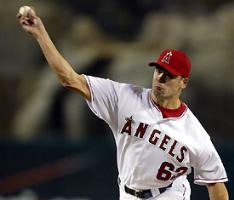
|
PERSONAL:
|
- At Corvallis High in Oregon, Kevin was an all-state pitcher with an 8-3 record, which followed an 11-0, 1.75 ERA season for his American Legion team.
- One of Gregg's older brothers, Mark, played football for the University of Oregon and appeared in the Rose Bowl.
- Gregg spent his youth going to Dodger Stadium.
"Since I was 8 years old," he said. "I'd been going to games there. My grandparents live in Glendale (about 15 minutes away) and my Mom and Dad grew up there. So between the ages of 8 and 14 I saw a ton of games in Chavez Ravine. I watched Sciosc (Angels manager Mike Scioscia) and Hatch (Angels hitting coach Mickey Hatcher) when they were Dodgers."
- Gregg committed himself to his weight program and seriously works on conditioning.
-
Midway through the 2003 season, Gregg set a Salt Lake (PCL) record by pitching 27 1/3 consecutive scoreless innings.
- On August 8, 2003, Gregg made his first Major League start that day, going six innings for Anaheim, giving up four hits and one earned run, and getting no decision as the Angels lost to the Indians in 13 innings.
- Kevin and his wife, Nicole, have a daughter, Ryann, who was born in 2001, and a son, Max, who was born in 2004.
Nicole and Kevin were high school sweethearts.
- In March 2004, Gregg made the Angels' Opening Day roster with a 3-0 spring record and 3.06 ERA in 10 appearances, with 16 strikeouts, two walks and 17 hits allowed in 17.2 innings pitched.
- In 2006, while Kevin was with the Angels, he had a bit of mishap in the Dodger Stadium visitors' clubhouse. The roof sprung a leak over Gregg's locker, or more specifically, over his game glove. When Gregg picked it up it felt like a 20-pound weight.
"It dried out eventually, but it never returned to what it was," Gregg said.
- Kevin wears sunglasses for night games. Though they don't enhance his vision, they help shield the glare from lights and allow him to better pick up the catcher's signs.
- Gregg owns a Christmas tree farm in Oregon. He has between 3,000 and 4,000 tress on his property.
"We have Nobles and pine and Douglas fir—a little bit of everything," Kevin said.
- Kevin's loves to go fishing.
"I fish a lot, especially salmon and steelhead trout," he said from his offseason home in Corvalis, Oregon. But he also like to go deep sea fishing in Baja, California; and fishing for red fish in Tampa, Florida.
- Those glasses Gregg wears while pitching are titanium Oakley prescription glasses. They are protective and tinted, but are not technically sunglasses. He also wears them when he plays golf.
-
Kevin is mild-mannered off the field, but his demeanor is tough on the mound.
-
Shawn Camp dubbed the Cubs' closer "Kevin Gregg Maddux," which is an appropriate moniker for a pitcher who relies on his command.
-
On July 8, 2011, when trailing the Boston Red Sox by seven runs in the eighth inning, Gregg threw three consecutive inside pitches to designated hitter David Ortiz. Ortiz took exception after the third pitch, accusing Gregg of trying to hit him with a pitch, leading to home plate umpire Mike Estabrook warning both benches.
On the next pitch, Ortiz swung at a fastball strike, sending a shallow fly into left-center field. As the ball was in the air, Gregg shouted at Ortiz, and was ejected by Estabrook. Ortiz then charged Gregg, who had taken a couple steps off the mound towards home plate.
The two began to fight and, after Adam Jones caught the ball in play, both benches cleared. Gregg and Ortiz were ejected. Gregg was unapologetic about the incident, saying that the Red Sox "think they're better than everyone else." On July 14, Major League Baseball suspended Gregg and Ortiz for four games each for their roles in inciting the brawl.
TRANSACTIONS
- June 1996: The A's chose Kevin in the 15th round, out of Corvallis High School in Oregon.
- November 2002: Kevin signed with the Angels' organization. Before signing, Gregg was working out at Oregon State in his native Corvallis. Then football coach Dennis Erickson happened to see him messing around with a football.
"He was watching me throw and said, 'Hey, what are you doing now?' I was 24 and thought I was too old to be going back to college," Kevin said.
Gregg's older brother, Mark, was an offensive lineman at Oregon.
- November 20, 2006: The Marlins sent pitcher Chris Resop to the Angels, acquiring Kevin.
- February 13, 2007: Gregg lost his salary arbitration. So his contract for 2007 called for $575,000 instead of his request for $700,000. Arbitrators Jack Clarke, Stephen Goldberg, and Elizabeth Neumeier decided.
- January 18, 2008: Kevin and the Marlins avoided salary arbitration, agreeing on a $2.5 million contract plus incentives.
- November 13, 2008: The Cubs sent P Jose Ceda to the Marlins, acquiring Gregg.
- January 19, 2009: Gregg signed a one-year, $4.2 million contract with the Cubs, avoiding arbitration.
- November 6, 2009: Kevin filed for free agency.
- February 3, 2010: Gregg signed with the Blue Jays, receiving $2.75 million for the 2010 season.
- November 4, 2010: The Blue Jays declined the one-year club option worth $5.25 million or a two-year club option worth $9.5 million for both the 2011 and 2012 seasons. So Kevin became a free agent.
- January 4, 2011: Gregg signed a $10 million, two-year contract with the Orioles.
- September 11, 2012: The Orioles designated Kevin for assignment. Then they released him three days later.
- February 10, 2013: Gregg signed with the Dodgers organization. his contract calls for $1.75 million, only if he's in the Major Leagues. In the Minors, it's $15,000 a month.
- April 14, 2013: The Cubs signed Kevin to a minor league contract.
- November 4, 2013: The Cubs did not make the $4.1 million qualifying offer to Gregg making him a free agent.
- June 3, 2014: Gregg agreed to a minor league contract with the Marlins.
- February 7, 2015: Kevin signed with the Reds' organization.
| |
|
|
PITCHING:
|
- Gregg throws his FASTBALL in the 92-93 mph range, and his SLIDER and CHANGEUP are effective pitches.
- What separates Kevin from the pack is his work ethic.
- Gregg's control has improved. "I've learned a lot about my body and how to use it to my advantage," Kevin said. "Since I signed, I've put on 40 pounds and grown an inch and a half."
- Gregg has a rather funky delivery, similar to the motion Brendan Donnelly has. He stands on the rubber with his right foot facing home plate and, unlike most pitchers, does not turn it to the side as he goes through his delivery and completes his follow-through.
Kevin has been doing this since early in his pro career, and it is comfortable for him. Gregg also believes this helps him stay balanced and more in line with home plate.
- Kevin changes speeds well.
- He pitches quickly, so his defense stays on their toes.
- Gregg has a somewhat different approach to toeing the rubber when he takes the mound. His right foot basically points in the direction of the batter when it is on the rubber. Unlike just about all other pitchers, he doesn't turn the foot when he goes into his delivery.
"Umpires have said that I have to be in contact with the rubber," Gregg said.
Gregg responds that he indeed is on the rubber, and he is. "It's within the rules," he adds.
To minimize any doubts, he makes sure he cleans dirt off the rubber before getting ready to pitch.
"My toe is a little more toward home plate, and my heel is more on the rubber," he said. "In pitching, you don't really push off [the rubber], you kind of just glide down."
Gregg adopted his style by tinkering with his delivery years ago as he was making his way to the Major Leagues. He feels it helps him stay more aligned with home plate than if he turned his foot more horizontal to the rubber. (Joe Frisaro-MLB.com-9/19/07)
-
Kevin was very effective as the Marlins' closer. But it takes him a lot of pitches-per-inning to get the job done. He doesn't consider that a problem in getting to the end of the game.
"As long as I get through an inning and preserve the lead, that's good enough for me. If it takes me 30 pitches one day and eight pitches the next, it doesn't matter. My job is to preserve the lead. If I have to throw 30 to get a zero, so be it. It's not going to do me any good to throw 11 pitches and give up the lead," Gregg said. (June 28, 2008)
-
During 2009 spring training, then-Cubs manager Lou Piniella named Gregg as the club's closer, keeping Carlos Marmol in the same setup role as in 2008.
But on August 17, 2009, Gregg lost the job as closer for the Cubs when he gave up his 12th home run of the season and blew his 6th save. Manager Lou Piniella switched to Carlos Marmol to close out games.
-
Shawn Camp dubbed the Cubs' closer "Kevin Gregg Maddux," which is an appropriate moniker for a pitcher who relies on his command.
-
As of the start of the 2013 season, Gregg had career numbers of: 30-44 with a 4.07 ERA and 73 home runs and 649 hits in 700 innings.
| |
|