|
PERSONAL:
|
- Darren is the son of former Major League outfielder Bob Oliver, who played for the Pirates, Royals, Orioles, Yankees, and Angels.
Both father and son have had Jack McKeon as their manager—Bob with the Royals and Darren with the Marlins.
- Darren, despite ending up as a pitcher rather than a hitter, listened to Bob. When your dad is a power-hitting first baseman, you listen closely and there is much remembered on Father's Day that Darren learned from Bob they he can pass on to his own sons, Brock and Maxwell.
"The biggest thing he ever taught me that really stuck with me is treat people the way you want to be treated," Darren said. "That's a great life lesson. How do you like to be treated? You like to be treated with respect regardless of what you do for a living or who you are.
"He also taught me just be humble. Don't get too high or too low. When I was in the Minor Leagues, he said, 'If you're in A-ball, just do what you have to do to get to the next level. Play hard, work hard, pay attention and listen to your coaches.'"
- Darren's brother, Tony, pushed Darren, not allowing the opportunity of pitching in the Major Leagues pass.
"Every time I started feeling sorry for myself or getting frustrated, he would get on me," Darren said. "He would say, 'Look at me. I'm working 9 to 5 every day. Is that what you want to do?'"
- September 1, 1993: Oliver's first career box-score line read: one pitch, one walk. How? He threw the first pitch off the screen. Then he issued an intentional walk. So the last three balls didn't count as official pitches.
- After the 1993 season, Darren began taking lessons in the Oriental discipline of Tae Kwon Do, to improve his flexibility.
- In November 1999, Darren married the former Melissa Welch.
On August 27, 2000, they celebrated the birth of their first child, a son named Brock Christopher. And two years later, his little brother Maxwell was born.
- During 2006 spring training, Darren's mother, Hazel, was diagnosed with breast cancer and later had two surgeries. He is doing fine now.
- Oliver is a real good guy. He keeps his teammates loose and is fun to be around. They respect him.
- One afternoon in July 2008 Darren watched as his two sons, Brock and Maxwell, wrestled with fellow reliever Justin Speier.
Oliver is no stranger to being a child in a Major League clubhouse, as his father, Bob, played eight seasons in the big leagues as an outfielder and first baseman. But Bob Oliver's career ended during the 1975 season, when Darren was just four years old.
That's why the best part about Oliver's 15-year Major League career is easy for him to answer. For him, it's not about the wins or the accolades that come with a career in baseball, but about his two children.
"The best part about playing baseball a long time is that they get to come around and remember it," Oliver said. "I was kinda little. They're a little older than I was."
Oliver has been around baseball long enough—or as he says, "forever"—that he knows there's much more than just what happens on the field. That's why he's become the go-to guy in the Angels' clubhouse when players have off-the-field questions.
"Most of the time, they'll ask me questions and I tell them, 'I don't know if it's the right answer, but I'm speaking from past experience,'" Oliver said. "We've got off-the-field problems just like everybody else. We got to do the same things everybody else does—pay bills, put gas in the car, go grocery shopping—and we have girlfriends or wives."
Rookie reliever Darren O'Day, who was 10 years old when Oliver made his Major League debut in 1993, said Oliver has helped him get situated with becoming a big leaguer.
"When I first got here, he was very helpful from Day 1," O'Day said. "He always shares his experiences. He's told us about his mistakes and how to avoid them." (Rhett Bolinger)
-
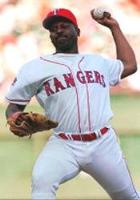
On September 10, 2010, the Texas Rangers set a record by using 11 pitchers in the game. Darren Oliver was one of them. The Rangers broke the record set on Sept. 1, 1993, when they used 10 pitchers in a game against the Red Sox.
Oliver, then making his Major League debut, was one of the pitchers used in that game also, a 9-7 win. Oliver entered the game in the bottom of the 10th inning with two out and Billy Hatcher on first base. He was brought in by manager Kevin Kennedy to face Mike Greenwell in a lefty vs. lefty matchup.
Hatcher broke for second on the first pitch, and the ball sailed high and wide all the way to the backstop. Kennedy then had Oliver intentionally walk Greenwell before bringing in right-hander Mike Schooler.
"I think Kennedy saw that things weren't going to work out," Oliver said. "I probably would have hit Greenwell in the head. A few years later, I talked to Billy Hatcher about it. He said he saw my knees were shaking and no way was I paying any attention to him."
Oliver overcame that first game. Seventeen years later, Darren was still pitching. (T.R. Sullivan-MLB.com-9/11/10)
-
September 28, 2013: Oliver announced he was retiring when the '13 season ends on September 29. The only reminiscing: He mentioned that the World Series and hitting in the National League were some of his more memorable moments, and that he'll miss the camaraderie in the clubhouse and all the friends he's made over the years.
"It's a lot fun. We have a good time," Oliver said. "It's like when you go home in the offseason, all the things that we say in here, the little sayings that we have, your friends don't understand it, but they understand it, because you're with them every day.
"It was fun," Oliver said of his 20-year ride in the Majors. "It definitely lasted a little bit longer than I ever thought it would, so I feel blessed for that part. I never thought I was going to play that long. So I definitely say my prayers at night for that. It was lot of fun. I definitely don't have any regrets. I can definitely look in the mirror and be happy with what I'm seeing in return."
TRANSACTIONS
- July 1998: The Cardinals sent P Todd Stottlemyre and INF Royce Clayton to the Rangers for Darren and INF Fernando Tatis.
- January 2000: Oliver signed a three-year contract with the Texas Rangers.
- December 2001: The Red Sox sent OF Carl Everett and a substantial amount of money to the Rangers to acquire Oliver.
- June 2002: The Red Sox released Darren after he posted a record of 4-5 with a 4.66 ERA over nine starts and five relief appearances.
- July 2002: Oliver signed with the Cardinals. But they released him near the end of August.
- January 28, 2003: Darren was invited to spring training with the Rockies.
- January 29, 2004: Oliver signed a one-year contract with the Marlins.
- July 22, 2004: The Astros sent a player to be named (or cash) to the Marlins, acquiring Darren.
- January 11, 2005: Oliver signed with the Rockies again. It was a $600,000 nonguaranteed minor-league deal that permits him to become a free agent if he fails to make the team.
April 1, 2005: The Rockies released Darren.
- April 12, 2005: The Diamondbacks signed Oliver to a minor league contract.
But on May 5, they released him, after just three games.
- May 6, 2005: Darren signed with the Cubs organization.
- December 19, 2005: Oliver signed with the Mets' organization.
- December 11, 2006: Darren signed a one-year contract with the Angels for $1.75 million , with a team option for 2008. The pact called for $1.5 million for the 2007 season and $2 million in 2008, with a $250,000 buyout if the Angels decide not to keep him beyond 2007.
- October 31, 2008: Oliver filed for free agency.
- January 16, 2009: Darren signed with the Angels again, for one-year and $3.655 million.
- February 5, 2009: Oliver filed for free agency.
- December 22, 2009: Darren signed with the Rangers, a one-year $3.5 million contract.
- December 30, 2011: Oliver signed a one-year, $4 million contract with the Blue Jays, with a $3 million club option for 2013.
And the Blue Jays exercised that $3 million option for 2013, on October 31, 2012.
- January 16, 2013: Darren returned to the Blue Jays for his 20th big league season.
- November 1, 2013: Oliver became a free agent.
| |
|
|
PITCHING:
|
- Though Oliver is pretty inconsistent, he has developed into one of the better lefthanded starters in the game. He can still be when he stays aggressive in his approach.
His FASTBALL is 86-89 mph. But he can also cut his fastball. When that CUTTER is working, he has a good day.
His best pitch is his CHANGEUP—one of the better ones in the game. Darren throws it both across the seams and with the seams, giving him two different off-speed pitches, one that gets downward movement, and another with a sharp break. He also has a SLIDER, that is really more of a slurve. He has a hard-breaking CURVE, too, that has regained its snap, and that CUT FASTBALL. - Darren gives up a lot of home runs because he throws so many strikes.
- He is not as effective as he once was against lefthanded hitters. And righthanded batters have always hit him pretty hard.
- Oliver has a silky-smooth delivery.
- If Darren's changeup is working early in the game, he usually has a good outing. But he also throws his off-speed stuff too often. And he tends to nibble at times, which allows the hitter to go deep into the count. He won't challenge hitters with his average fastball, and his curveball can become sloppy.
- In May 2001, Darren sat in the radio booth with Rangers broadcaster Eric Nadel and got a new perspective. When Oliver talked about how the game was dragging, Nadel suggested Darren remember that the next time he was on the mound. And Oliver did, working faster so that his defense stays sharper.
- Pitching in Coors Field, as Darren did in 2003, normally tends to raise the ol' ERA. But oddly, in 2003, Oliver's numbers were better at Coors Field (7-3, 4.50) than away from Coors (6-8, 5.45).
- Oliver entered the 2014 season with a career record of 118-98 and a 4.51 ERA. He had allowed 216 home runs and 2,037 hits in 1,915 innings in the Majors.
| |
|