-
In Abilene, Texas, Lackey was the consummate athlete. He was the starting quarterback and captain of the football team, the starting center on the basketball team, and all-state at first base for the baseball team. He never had time to sit back and learn how to pitch and not just whip the ball as hard as he could toward the plate.
"I pitched about 14 innings or so in high school," Lackey says. "The football coach didn't want me to hurt my arm."
- John's father is friends with Ronnie Dunn of perennial award-winning country duo Brooks & Dunn.
-
In 1999, John transferred from University of Texas-Arlington to Grayson County Community College in Texas. At Texas-Arlington, he had been an outfielder, hitting .440 with 16 home runs. At Grayson, he moved to the mound and impressed scouts. He went 10-3, 4.23 ERA, walking 54 and striking out 88 in 100 innings. He led the team to the Junior College World Series title. He was offered a scholarship to Texas Tech, and planned on going there, but the Angels drafted him in the second round.
-
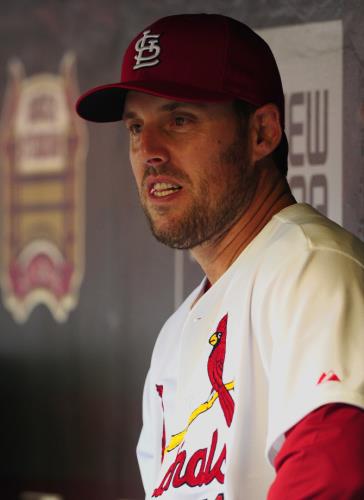
Lackey is tall, strong, soft-spoken, and startlingly confident.
WORLD SERIES WINNER
-
In 2002, Lackey became the first rookie pitcher to start and win a seventh game of the World Series since Pittsburgh's Babe Adams in 1909. His Angels beat the Giants.
- When he pitched Game 7, he was not nervous at all. "To tell you the truth, I was pretty cool the whole time," John said. "I don't mean to underplay the significance of it, but I played quarterback in high school in East Texas where football is everything. You'd have 15,000 to 20,000 people at those games. The town would shut down just to watch us play. Now that was pressure," Lackey said.
-
Maybe the coolest thing during the offseason after the Angels won the World Championship was when Sports Illustrated came out and Lackey was on the cover. He has been saving Sports Illustrated covers since he could read. He still has several covers on his bedroom wall from the glory days of the Dallas Cowboys of the 1990s. Now, he was on the cover himself! He hung it on the wall of his Dad's office. Derran Lackey was John's high school baseball coach.
- In 2013, John again won the final game of the World Series—Game 6 for the Red Sox against the Cardinals.
-
John is the only Major League pitcher who has won the final game in two World Series for two different teams—the Angels and the Red Sox.
-
In an April 2, 2006 bench-clearing fracas, Lackey was fined $2,500 and Oakland A's Jason Kendall was suspended four games. John said the money was donated to charity.
"I knew I was going to get something, but I didn't think I should have been suspended," Lackey said. "I didn't originally think it was right for him to come out and fight. These things happen in the heat of the battle. Guys are fired up."
During the sixth inning of the A's 10-3 win over the Angels, Lackey threw a breaking ball that did not hit Kendall. But while receiving the throw back from catcher Jeff Mathis, Lackey told Kendall to move off the plate and Kendall charged the mound. Both players were ejected, while manager Mike Scioscia was later ejected in the ninth inning after Robb Quinlan was hit on the left elbow by Chad Gaudin.
Scioscia said he spoke with baseball's vice president of discipline, Bob Watson, to explain the Angels' version of what happened.
"He didn't do anything to be suspended, we're glad the league saw it that way," Scioscia said. "I wanted to be sure that Bob grasped the situation and give him some feedback."
-
Lackey is mentally tough. He almost defines the phrase. Remarkably durable, Lackey never has missed a start (as of June 2007) because of injury—partly because of sound mechanics, but also owing to his tough-minded attitude.
At 6-foot-6 and 245 pounds, he's an athlete who pitches for a living, having excelled in football and basketball at Abilene High School in Texas. Like a quarterback driving for a first down, Lackey keeps pushing through physical issues.
-
In 2008 spring training, Angels mnager Mike Scioscia procured John's transcript from the pitcher's final semester at Grayson Community College in Denison, Texas, and posted it on a clubhouse wall.
The Angels' ace, not surprisingly, aced varsity baseball, and got another A in a class called Country Pop and Rock.
"We'd go in, listen to 10 songs, say whether we liked them or not, and why . . . it was beautiful," Lackey said. "Pretty much the whole baseball team was in there."
There was one glaring mark, though, an F in algebra.
"I didn't show up for the final," Lackey said. "It was five days before the [1999] draft."
Scioscia got Lackey's mother, a teacher, on a speaker phone and told her Lackey had failed his last math class. Lackey's mother was upset.
"Don't worry," Scioscia assured her. "We're going to rectify it." Scioscia arranged for an Arizona State graduate student "in some kind of quantum physics" to walk into the team meeting and give Lackey a college sophomore-level algebra test.
The laughter from the clubhouse was so loud it could be heard through closed doors and all the way down the hall. Scioscia told Lackey he would have to take the test Monday night, but to expand the prank, he pitted Lackey's math skills against the University of Minnesota (Robb Quinlan), the University of Oklahoma (Reggie Willits) and the state of Florida (Jeff Mathis).
"Four people are taking it," Scioscia said. "The test is 25 questions, and they give you a half an hour. We're giving them an hour, and they have to return it Tuesday."
Lackey seemed genuinely perplexed when asked what kind of message it might send to kids that he blew off his algebra final. Then, remembering the three-year, $17-million contract he signed two years ago, Lackey broke out in an impish grin.
"I'm doing OK without it," he said. (Mike DiGiovanna-LA Times-2/25/08)
-
Lackey spends his offseason watching football and going to football games. He also loves to play golf and is in a couple of fantasy football leagues.
-
John credits his father for having the most influence on his career.
"My dad stressed playing several sports and thought that would help me. He was a high school baseball coach when I was growing up," Lackey said.
-
Lackey's favorites:
Actor: Kevin Costner, Movie: "Bull Durham," TV Show: SportsCenter, Music: Country, Food: Mexican, Three people John would like to invite to dinner: Tiger Woods, Michael Jordan and Nolan Ryan. (Rick Sorci-Baseball Digest-July 2009)
-
Lackey said that after he retires from the game, he will probably live on a ranch, do a lot of fishing, and hang out with his family.
He also will watch a whole lot of football, just like he does now during the offseason. Football—college, pro, even high school—is still a huge part of his life.
Inside this pitcher, there is a quarterback with a football mentality that he brings to the mound every time out there, intensity in his eyes, performing at his best in the biggest of games, with a fire that makes him never want to leave.
-
Off the mound, John is easy-going and California-casual, laid-back and relaxed.
-
Lackey is not a big fan of the computer.
"I get some emails on the phone. We have a computer at the house, but I don't have a laptop," John said. I've got my little iPad that's got movies on it. That's all. Action, comedies, stuff like that. I like a lot of comedies."
-
Lackey's wife was battling breast cancer throughout 2011, undergoing chemotherapy.
-
John lost quite a bit of weight and reshaped his body before 2013 Spring Training, and it clearly allowed him to be more free and loose and athletic on the mound in 2013.
-
On August 30, 2011, Lackey filed for divorce from his wife of almost three years, Krista. She had been battling cancer, having undergone a double mastectomy in March and chemotherapy through June. The divorce was finalized by February 2012.
-
August 19, 2014: Pat Neshek went home with a Babe Ruth autographed baseball. Neshek, an avid baseball card and memorabilia collector, grudgingly passed his No. 41 to John Lackey when the veteran right-hander was acquired from Boston in a Trade Deadline deal. He had no longtime attachment to the number, but it did hold significance as being the number he donned for his first All-Star Game. His mother was so upset with him that she hung up the phone when he informed her of the jersey trade.
Lackey had worn No. 41 in 11 of his 12 Major League seasons, the lone exception being in 2010, when Victor Martinez wore it in his last year with the Red Sox.
Lackey planned to present Neshek with a watch as a gesture of gratitude. However, when Neshek heard of those plans, he mentioned to his new teammate that he would prefer something that could go into his extensive memorabilia collection. He first considered a baseball card, then settled on a Babe Ruth ball that he had been eyeing for some time.
He received the ball in the mail a few days later, showing it off to awestruck teammates in the clubhouse.
"It's pretty awesome," Neshek said. "It's something I've always wanted. It's the best autograph I have in my collection. Man, what a gift."
Before finalizing the purchase, Neshek had a friend authenticate the baseball, which features a signature with Babe in quotation marks. That, Neshek explained, is an indication that it was signed when Ruth was still playing, likely around 1926.
Neshek told Lackey he would help cover part of the cost, an offer that Lackey declined. While Lackey was prepared to spend about $10,000 on a Breitling watch for Neshek, this gift went for more than two times that amount.
"I think he was really happy with it, and I appreciate him giving up the number with him having such a great year," Lackey said. "I wanted to do something cool for him."
Other teammates have since joked with Lackey that they, too, would gladly exchange their number with him.
For Neshek, the autograph instantly became the best in his collection, topping the Napoleon Bonaparte-signed battle plans that Neshek had previously procured. It also has helped him grow content with his new number, 37.
"You know what? I've gotten a lot of strikeouts since with No. 37, and things have been going pretty well," Neshek said. "It was a great trade." (By Jenifer Langosch / MLB.com | 8/20/2014)
-
2009: In manager Tom Kotchman's 31-year tenure in the Minor Leagues, he has only seen two pitchers so competitive that they have refused to come out of the game.
The first time was in 1983 when rookie Roger Clemens, playing for the Winter Haven Red Sox, told Kotchman if he left him in the game Clemens could end the contest in three pitches. And the future seven-time Cy Young award winner did just that, a testament not only to his talent, but to his competitive nature.
It was 16 years before Kotchman witnessed that same fire on the hill, this time from 20-year-old rookie John Lackey.
The Angels' second-round pick in 1999, Lackey's first stop was with Kotchman's Boise Hawks. The veteran manager still remembers one particular game when he tried to replace Lackey only to have the tall Texan tell him otherwise. Sure enough, Kotchman trotted back to the dugout and Lackey kept dominating, as if to say, "See? I'm not done yet."
Point taken for Kotchman, who never signaled to the bullpen first when Lackey was on the mound that season, a rare display of assurance from a Minor League manager with more than 1,500 career wins.
"One important trait that [Clemens and Lackey] have in common is that they are competitors," Kotchman said. "It's probably an overused word. [On my report on] one of the players I drafted last year, it says, 'He competes like John Lackey.'" (Brittany Ghiroli - Special to MLB.com - Feb. 16, 2015)
-
Jon Lester first met Lackey when the two pitched for the Red Sox in 2010. They'd had their battles in the postseason before that. "I'll be the first one to tell you nobody in that dugout liked him, just because of how competitive he is and all the emotions he has on the field," Lester said.
"When he's on the mound, he's a bully," said Jason Heyward, who has played against Lackey and was his teammate with the Cardinals in 2015.
However, Maddon said Lackey may have mellowed. Lackey scoffed at that.
"Not every five days, probably not," the righthander said. "Four out of five days, I'm pretty laid back and having a good time. When you only get 30 some times to help your team, I take it pretty dang serious and go get after it."
Lackey downplays the edginess element. "It's not going anywhere," he said. "It's just there."
Rizzo and Bryant were happy not to have to face Lackey any more, and both relayed that to the new Cubs pitcher.
"I don't think I want a hitter to want to face me," Lackey said. "Obviously, I compete on the field and I get after it, and I know how that can be perceived sometimes. I think people find out I'm a lot different than they think I am, which is fine. In between the lines, I don't care what the other team thinks about me. I'm there to win."
And that's what the Cubs need. Lackey will be slotted behind Jake Arrieta and Lester in the rotation, and arrives possibly in better shape now than he was when he pitched for the Red Sox. .
"You hate playing against him," Arrieta said. "You see his emotions on the mound. It just shows this guy wants to win and he cares about winning. He's not intentionally trying to show his teammates up. It's his competitive nature on display. We all have that to a certain extent. This guy has been around for 14 years. That's his game is winning." (Muskat - MLB.com - 3/29/16)
-
May 6, 2016: Lackey struck out the Nationals' Jayson Werth in the fourth inning of the Cubs' 8-6 win for his 2,000th career strikeout. Lackey got Werth looking at an 81-mph cutter for the first out of the frame.
"Honestly, I didn't even know I was that close [to the milestone]," Lackey said. "I had a runner at first and was trying to get out of the inning. I guess [2,000 K's] means I'm old and I've been around a while and have done a few things." (C Muskat - MLB.com - May 6, 2016)
TRANSACTIONS
-
June 1999: The Angels chose Lackey in the second round, out of Grayson County Community College in Texas.
-
April 4, 2006: Lackey signed a three-year, $17 million contract with the Angels. The deal included a fourth-year option that could push the value of the package to more than $27 million.
The pact called for $4.01 million in 2006, $5.5 million in 2007 and $7 million in 2008, and the deal will buy out his remaining two years of arbitration. The option, covering Lackey's first year of free agency, would be worth a minimum of $9 million and a maximum of $10.5 million and can be bought out by the Angels for $500,000.
-
December 15, 2009: John signed a five-year, $82.8 million contract with the Red Sox.
Note that the Red Sox have a built-in "conditional club option’’ at the minimum salary for the 2015 season into Lackey's contract to protect them in case John gets hurt.
Lackey’s five-year, $82,791,426 deal includes an $18 million salary in 2010, followed by yearly salaries of $15.25 million from 2011-14. Lackey also received a signing bonus of $3.5 million.
The conditional option in 2015 would have Lackey play for the Major League minimum (currently $400,000) if an old elbow injury forced him to miss significant time because of surgery at any time during the deal.
For incentives, Lackey receives $50,000 for being named an All Star; $75,000 for MVP of the League Championship Series; $100,000 for World Series MVP; $50,000 for winning a Gold Glove; and $500,000 for American League MVP ($100,000 for finishing second through fifth in the voting). If he’s traded, he receives $500,000.
-
July 31, 2014: The Cardinals sent OF Allen Craig and RHP Joe Kelly to the Red Sox, acquiring Lackey, LHP Corey Littrell, and cash.
August 2, 2014: Though he'll be doing so at the Major League minimum, Lackey is "absolutely" going to honor the remainder of his contract and pitch for the Cardinals in 2015.
The guaranteed portion of the five-year, $82.5 million deal that Lackey signed with the Red Sox in 2009 is set to expire at the end of the 2014 season. Written into the contract, though, was a club-friendly option that triggered because he missed extensive time with an elbow injury. It was included as protection for the Red Sox, who knew the right-hander had a pre-existing issue with his elbow.
As a result the Cardinals can retain Lackey for 2015 for a salary that should be just a bit over $500,000. There were reports earlier this season that Lackey would consider retiring if that club option wasn't nullified with an extension. Upon reporting to Busch Stadium, he said that wouldn't be the case.
"I'm absolutely going to [pitch]," Lackey said. "As long as I stay healthy, I'm going to."
The fact that he was dealt plays a role in that decision.
"Obviously, it was case by case," he said. "It would have been a harder decision other places, for sure, but this is definitely somewhere I wanted to be, and I'm excited about it." (Jenifer Langosch - MLB.com - 8/1/2014)
-
October 30, 2014: The Cards exercised their 2015 contract option on Lackey. He had agreed to an $82.5 million, five-year contract with Boston in December 2009, which contained a provision for a conditional team option at the minimum if he missed a season due to specified injury. Lackey did not pitch in 2012 after reconstructive elbow surgery.
The Major League minimum in 2015 was $500,000 plus a cost-of-living adjustment to be determined, which is likely to be $9,000 to $10,000.