
|

|

|

|

|
| |
|
|
| |
 |
Nickname: |
B.K. |
Position: |
P |
| Home: |
San Diego, California |
Team: |
Retired |
| Height: |
5' 9" |
Bats: |
R |
| Weight: |
180 |
Throws: |
R |
| DOB: |
1/21/1979 |
Agent: |
Jeff Borris |
| Birth City: |
Kwangju, South Korea |
Draft: |
1999 - Diamondbacks - Free agent - Out of So. Korea |
| Uniform #: |
N/A |
|
|
| |
| YR |
LEA |
TEAM |
SAL(K) |
G |
IP |
H |
SO |
BB |
GS |
CG |
SHO |
SV |
W |
L |
OBA |
ERA |
| 1999 |
NL |
DIAMONDBACKS |
$200.00 |
25 |
27.1 |
20 |
31 |
20 |
0 |
0 |
0 |
1 |
1 |
2 |
0.211 |
4.61 |
| 1999 |
TL |
EL PASO |
|
10 |
21 |
6 |
32 |
9 |
0 |
0 |
0 |
0 |
2 |
0 |
|
2.11 |
| 1999 |
PCL |
TUCSON |
|
11 |
30 |
21 |
40 |
15 |
3 |
0 |
0 |
1 |
4 |
0 |
|
2.40 |
| 2000 |
PCL |
TUCSON |
|
2 |
8 |
1 |
13 |
4 |
2 |
0 |
0 |
0 |
0 |
0 |
|
0.00 |
| 2000 |
NL |
DIAMONDBACKS |
$562.00 |
61 |
70.2 |
52 |
111 |
46 |
1 |
0 |
0 |
14 |
6 |
6 |
0.2 |
4.46 |
| 2001 |
NL |
DIAMONDBACKS |
$763.00 |
78 |
98 |
58 |
113 |
44 |
0 |
0 |
0 |
19 |
5 |
6 |
0.173 |
2.94 |
| 2002 |
NL |
DIAMONDBACKS |
$763.00 |
72 |
84 |
64 |
92 |
26 |
0 |
0 |
0 |
36 |
8 |
3 |
0.208 |
2.04 |
| 2003 |
AL |
DIAMONDBACKS |
|
7 |
43 |
34 |
33 |
15 |
7 |
0 |
0 |
0 |
1 |
5 |
0.214 |
3.56 |
| 2003 |
AL |
RED SOX |
|
49 |
79.1 |
70 |
69 |
18 |
5 |
0 |
0 |
16 |
8 |
5 |
0.23 |
3.18 |
| 2004 |
AL |
RED SOX |
$4,000.00 |
7 |
17.1 |
17 |
6 |
7 |
3 |
0 |
0 |
0 |
2 |
1 |
0.258 |
6.23 |
| 2004 |
IL |
PAWTUCKET |
|
22 |
61 |
71 |
39 |
12 |
19 |
0 |
0 |
0 |
2 |
6 |
|
5.34 |
| 2005 |
NL |
ROCKIES |
$6,575.00 |
40 |
148 |
156 |
115 |
71 |
22 |
0 |
0 |
0 |
5 |
12 |
0.275 |
4.86 |
| 2006 |
NL |
ROCKIES |
$2,500.00 |
27 |
155 |
179 |
129 |
61 |
27 |
0 |
0 |
0 |
8 |
12 |
0.295 |
5.57 |
| 2006 |
PCL |
COLORADO SPRINGS |
|
3 |
13 |
18 |
11 |
4 |
3 |
0 |
0 |
0 |
0 |
1 |
18 |
6.23 |
| 2007 |
PCL |
COLORADO SPRING |
|
5 |
24.1 |
21 |
31 |
11 |
5 |
0 |
0 |
0 |
1 |
1 |
|
2.96 |
| 2007 |
NL |
DIAMONDBACKS |
|
2 |
2.2 |
11 |
3 |
2 |
2 |
0 |
0 |
0 |
0 |
1 |
0.611 |
23.63 |
| 2007 |
NL |
ROCKIES |
|
3 |
6 |
6 |
2 |
4 |
1 |
0 |
0 |
0 |
1 |
2 |
0.286 |
10.50 |
| 2007 |
NL |
MARLINS |
|
23 |
109.2 |
114 |
102 |
62 |
19 |
0 |
0 |
0 |
9 |
5 |
0.266 |
5.42 |
| 2008 |
- |
- |
|
|
|
|
|
|
|
|
|
|
|
|
|
|
| 2009 |
- |
- |
|
|
|
|
|
|
|
|
|
|
|
|
|
|
|
|
PERSONAL:
|
- Byung-Hyun has been dubbed "B.K."
- Kim is the son of a martial arts teacher. In fact, BK's deceptively sturdy legs are the result of his training. He is a black belt in tae kwon do and his father is a master. BK also does constant work on his twisting pitching motion.
He practices in front of the mirrors in the training room and during much of the time he spends in the bullpen. Even after a game, he has been known to head for the bullpen and throw a bucket of balls.
LANGUAGE BARRIER
- In April 1999, Kim arrived in America and couldn't speak English. He spoke through an interpreter, Min Soo Kim. BK still doesn't speak English very well, so the language barrier is still there.
- In 1999, Kim had trouble adjusting to American culture and the baseball lifestyle, until a family that owns a Korean restaurant in El Paso took him in. That helped diminish some of his homesickness.
-
He loves McDonald's hamburgers, but his favorite dish is kim chee soup, with extra spice in it. For American-made food, he likes chicken, but doesn't like steak. He wants to know every ingredient that goes into making chicken
-
He is loose in the clubhouse, laughing with teammates, even though he sometimes doesn't know what he is laughing at.
-
He enjoys playing PlayStation.
LEARNING ENGLISH
- Kim picks up more English every day. He has even picked up some cuss words in Spanish, which he will spring on a Latin player occasionally.
- Along with a basketball, Kim keeps an English translation book in his locker stall.
- In 2000, when Kim was introduced to veteran pitcher Mike Morgan during spring training, he was informed that Morgan was then entering his 22nd season in the Major Leagues. But Kim misunderstood, and innocently said, "You look old for 22." Morgan laughed, but Kim was so bothered by his mistake that he later asked a clubhouse attendant to take him by golf cart to Morgan's practice field. "I apologize," B.K. told Morgan. "I should have said you look young for 22 years in the Big Leagues."
- In 2001, Kim's English had improved a lot by the time he showed up for spring training.
- Byung-Hyun's exercise routine is continual. He throws daily, is always on the bike or treadmill. He also lifts weights or runs around the ballpark. Diamondbacks minor and Major League coaches have slowed his pace down some. But they pretty much have let him go, knowing the regimen works for him.
- He is confident and soft-spoken, easy-going and pleasant. But he is not married, and is not a party person. He says, "I like to be alone. I don't like many people around me, just one or two good friends."
- In the 1998 Asian Games, Kim pitched his Korean team to the gold medal. A loss would've meant at least two years of military service, so he can handle pressure when he pitches!
- In November 1999, a four-week military training stint was required for Byung-Hyun.
- During the offseason before the 2000 season, Byung-Hyun was busy. He colored his hair brown, spent a mandatory 28 days in military service for his native Korea, took a crash course in English, and got his driver's license when he returned to the United States.
- Kim spends half of his life sleeping. He usually gets 12 hours of sleep a night, goes to the clubhouse, and then takes a nap. He sleeps so soundly on the team's rides to the airport that his teammates often have to jostle him awake so he's not left behind.
"One day during the 1999 season we couldn't find him," says OF Luis Gonzalez. "We looked all over. We finally found him in the laundry room, on a flat wood board on top of the laundry baskets, totally racked out." Gonzo says Kim's favorite resting spot is the team bus. "A couple of times, we all sneaked off and left him there. I'm usually one of the last guys off, so I tell the driver, 'Go up the block, then wake him up, make him panic a little bit."
Another day, D'Backs P Dan Plesac recalled, "Everybody's wondering, 'OK, where is he now?' Turns out, he was in the bathroom, door locked, lights out, sleeping."
- In August 2000, when he returned from a short trip to Triple-A, he had a new platinum look, dying his hair. "I did it for my mind and my body," he said. A week later, Kim changed his color to auburn.
Teammate Greg Swindell teased him, saying that he resembled a chameleon. "You're going to look like Barney (the purple dinosaur) when we get back to Phoenix," Swindell said. Kim jokingly pulled his hat as far as he could down on his head.
- B.K. spent more time in the United States than he did in Korea during the off-season before 2001 spring camp. He bought a new home in San Diego. "I like it here in the United States. Korea is too crowded," Byung-Hyun said.
- Most days when he was with the Diamondbacks, Kim spent an hour or so throwing balls from a bag against a wall under the stands at The BOB.
ALMOST THE GOAT
- In 2001, Kim was reduced to tears when he came within one out of recording saves in Games Four and Five of the World Series, only to serve up game-tying, two-run home runs to Tino Martinez and Scott Brosius, respectively, in successive Diamondbacks defeats.
When Arizona rebounded to win the series at home, however, the magnitude of the failures was reduced to a footnote. "I heard many times about the curse of Babe Ruth and when I gave up those two home runs in the World Series, I felt there was something spiritual hanging over Yankee Stadium,'' Kim said. "But we won the World Series and it turned out all right.''
- He didn't let the World Series disaster drag him down. Instead, he pitched so well for Arizona that he was named to the National League All-Star team in 2002.
- June 12, 2002: Kim extracted his first bit of revenge when he pitched two scoreless innings of an interleague game in the Bronx to nail down a 9-5 Diamondbacks victory. When he got Shane Spencer to bounce into a game-ending double play, he retrieved the ball, turned and fired it across the field and over the left field fence toward the bleacher fans who taunted him when he warmed up in the bullpen.
"At the moment, it just happened,'' said Kim, who had received a sarcastic standing ovation when he came into the game. "I think I did it because I was telling the Yankees, if you can hit me again, go ahead and hit it.''
- When B.K. signals for a timeout, he will cross his arms in front of his body as if warding off vampires.
-
When he got to Boston, B.K.'s previous uniform number (49, worn by pitcher Tim Wakefield) was unavailable, so he asked for #51, in honor of former teammate Randy Johnson.
- Throughout baseball, there remain questions about Byung-Hyun Kim's toughness. Diamondbacks GM Joe Garagiola Jr. acknowledged that he characterizes Kim as "sensitive,'' but he also stresses that Kim is only 24, and that as a native Korean, he is still adjusting to a new life and culture.
"He wants to be perceived as a good teammate,'' said Garagiola. "He kind of goes back on forth on the issue of having an interpreter. I think he feels he sometimes needs someone to help him with the media, but at the same time he doesn't want something there which could be perceived as a barrier between him and his teammates. He's a very likable guy. He really is. He's very friendly. It's hard to say he's open because of the language issues, but he is open.''
As for Kim's makeup -- a baseball euphemism for heart and guts -- Garagiola believes the Red Sox have acquired a pitcher who is far more competitive than some may realize. Said Garagiola: "I have never doubted his competitiveness. To me, he's a competitor. He loves to compete.''
- October 4, 2003: Before Game 3 of the American League Division Series and while with the Red Sox, Kim stuck his middle finger up briefly when fans booed him during pregame introductions. He was introduced by public address announcer Carl Beane along with the rest of the Sox backups and pitchers. Reliever Mike Timlin was announced just before Kim, received a warm reception, which carried into the former Arizona closer's introduction.
Kim initially tugged on the bill of his cap to acknowledge the crowd before boos overtook the cheers. Kim dropped his right hand to his side but quickly brought it back up, this time to flip the bird. A replay of the incident clearly showed a smiling Kim holding up just his middle finger. The flip was so quick that it didn't spur a further reaction from the capacity crowd.
Kim declined to meet with reporters but issued the following statement: "I apologize to the fans of the Red Sox, the people of New England, and baseball fans throughout the world. It was an instant, reflexive reaction that I regret. I appreciate the passion our fans have for baseball in Boston. All of us depend on them and their support. I am very sorry."
GM Theo Epstein said Kim's apology served as enough punishment and he likely will not be disciplined. "I talked with him and he regrets the incident,'' Epstein said. "He knows he was wrong and he'll learn from it. He's going through a frustrating time and he let his emotions get the best of him.''
-
Kim may be one of the most selfish players in the game. He is immature. When he was in Arizona, the Diamondbacks did everything they could to make him comfortable. Kim had his own routine and came and went on his own schedule. He was given interpreters and used his language barrier as a reason to avoid the media, although those in the clubhouse knew that Kim spoke English well. He followed his own rules, not that of the team, and that caused some dissension in the clubhouse. Players on the Diamondbacks spoke to him regularly, trying to make him understand that they were a team and he was acting as an individual. Kim believed he could draw on his experience of pitching in Korea to do better in America and failed to adjust his game.
To the players, he was a phony. Most found it ironic that Kim told the Diamondbacks on the way to a series in Colorado that his arm hurt and yet on the plane ride back, the arm was miraculously better. They believed that Kim didn't want to pitch in Colorado, not wanting to damage his numbers in a hitter-friendly park.
-
November 2003: According to Korean newspaper accounts, a complaint was filed against Kim for scuffling with a newspaper photographer. The photographer snapped a picture of Kim exiting a health club in Yoksom, in southern Seoul, after which, according to the complaint, "Kim forcefully took away my 13 million-won camera and broke it. He also inflicted injuries to my right ribs, which will require two weeks of medical treatment.''
-
May 2004: Many in the Red Sox organization believed Kim was sent to Triple-A Pawtucket because he worked too hard. His intense workout habits may have been the cause for his loss of velocity -- he was just too tired. His focus is on baseball 24/7. Teammates feel he needs to loosen up. But he won't listen to fellow pitchers who try to help. He has his mind made up.
-
B.K. is a bit of an introvert. He is rather complicated. With the Red Sox in 2004, Kim resisted efforts to help him assimilate into the life of a Major Leaguer in Boston.
-
Asked if he had addressed Kim about his unwillingness to adjust his training regimen, pitching coach Dave Wallace said, "Yes, we did. But I understand the culture as well. I've had a number of different guys from Japan and Korea. Their work ethic is ingrained. I had Chan Ho Park talk to him about it. But you know what? It's like raising kids. Some kids have to learn the hard way. The bottom line is to learn the lesson. Hopefully he'll get there."
-
When released by the Pirates, Kim, he changed agents, switching from Scott Boras to Jeff Borris of the Beverly Hills Sports Council.
TRANSACTION REPORT
-
1999: The Diamondbacks signed Byung-Hyun for a $2.25 million bonus.
-
May 29, 2003: The Red Sox sent 3B Shea Hillenbrand to the Diamondbacks to acquire Kim. "A lot of people in Korea were happy when I joined the Red Sox because I will be able to face the Yankees again and win a game for the Red Sox,'' B.K. said through translator Chang Lee, Boston's assistant trainer. "They're expecting me to beat the Yankees.''
-
January 20, 2004: Kim signed a two-year, $10-million contract with the Red Sox.
-
March 30, 2005: The Rockies sent P Chris Narveson and C Charles Johnson to the Red Sox, acquiring Kim. Boston immediately released Johnson.
As part of the trade, Colorado sent Boston about $2.6 million to equalize the salaries. Johnson is owed $9 million and Kim $6 million, part of a $10 million, two-year deal he signed before the 2004 season.
-
May 13, 2007: The Marlins sent P Jorge Julio to the Rockies, acquiring Kim.
-
August 3, 2007: The Diamondbacks claimed Kim off waivers from the Marlins.
-
August 15, 2007: The D'Backs released Kim after two horrible starts.
-
August 25, 2007: Byung-Hyun signed with the Marlins again.
-
February 21, 2008: Kim signed a one-year contract with the Pirates with a ase pay of $850,000 and up to $1 million in performance bonuses.
March 26, 2008: The Pirates relased Kim. So they only had to pay him a $300,000 buyout.
-
February 1, 2010: Byung-Hyun began a comeback, signing a minor league contract with the Giants.
March, 2010: The Giants released Kim.
| |
|
|
PITCHING:
|
- Byung-Hyun is pronounced: "Be-Young He-Yun."
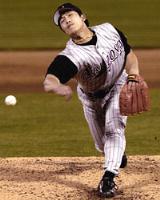
- The righthanded Kim is very impressive with his live arm and interesting pitching style. He has a nasty sidearm -- almost submarine-style delivery. It can be impossible for righty hitters to touch him.
His high velocity and movement separates him from other sidearmers. He will actually come at you from a few angles -- three-quarters, sidearm, and submarine. He has an exaggerated, twirling delivery that reminds people of Hideo Nomo and Luis Tiant.
- He said he began his baseball career throwing overhand, but didn't have the control he needed. He tried sidearm and near underhanded back in 1994, while in high school. "My overhand was very hard, but I had no control," Byung-Hyun said. "My manager said to try sidearm. It went up, down, to the side. It was very good."
- His 90-93 mph 4-seam FASTBALL is powered by his muscular legs. He actually has both a two-seam and a four-seam fastball. His sinker has tremendous sink at 90 mph, and when you see that from the right side, it is very tough. But in 2007 spring training Kim worked on adding a better CHANGEUP to the mix.
He has a CURVEBALL and also has four different SLIDERS -- one that sinks and one that actually rises. His lateral slider is also known as a Frisbee slider. The one that rises, he calls it an upshoot, he flings from inches above the dirt and sends rising through the strike zone.
"You think that pitch is going to sink," said OF Eric Owens, "but the ball rises, and he has that other slider to set it up."
- When asked to comment on said rising slider, Diamondbacks pitching coach Mark Connor said, "It's like a Frisbee-type slider, but it's hard. A lot of guys who throw from under there, their breaking balls are slow and soft. His is quick." Connor said, "I mean, he can't throw the ball straight. Everything moves! And he's right around the plate with everything."
Former D'Backs catcher Damian Miller called it a "Nintendo slider -- like the ones you see in the video games with the huge bend in them."
- That upshoot pitch is similar to some thrown several years ago by Mark Eichhorn and Dan Quisenberry, but never at such speed.
- When Kim throws strikes, people don't hit him -- or they hit weak grounders or popups. But he doesn't always throw strikes; mostly because of his delivery. He messes around too much with his delivery. You never know when he's going to throw a strike.
He jumps around, puts the hesitation move in there and tinkers around. Most scouts say that he needs to get just one delivery and stay with it for every pitch. B.K. has frustrated coaches with his ever-changing delivery, but delighted fans with his pitch-finishing, karate-style kicks.
- Kim can throw his breaking ball on the outside corner -- like a backdoor slider that lefty hitters basically give up on -- it breaks so far. That has become a real good pitch for him against lefthanded batters
- In 2000, Byung-Hyun was the D'Backs closer early in season while Matt Mantei was building up arm strength. When he was on the hill, Arizona fans chanted "B.K!, B.K!, B.K!" over and over.
- In August 2000, he was sent to Triple-A to speed up his delivery time and get confidence back. He is a better pitcher than he thinks he is. He needs more confidence.
- In 2001, his game improved. He became much more effective at retiring lefthanded batters.
- In 2001, Kim threw more pitches in relief (1,593) than anyone in theMajors except Matt Herges (1,605) and Scott Sullivan (1,603). But that was regular season innings, and does not include the 79 pitches Kim threw in the Division Series and LCS, or the 76 pitches he threw in the World Series.
- Because of his sidearm delivery, Kim can be used more frequently and for more innings without as much sign of wear.
- Kim's emotions and sensitivity make him far too inconsistent. In 2002, he lost the overall confidence of his Diamondbacks' teammates, who often rolled their eyes wondering which Kim would appear when he was called into games.
- It seems any unorthodox pitcher, even one with as varied a repertoire as the side-arming Kim, still does not get the respect and instilled confidence as more conventional pitchers.
WANTS TO START
- B.K. would really like to be a starting pitcher. There's no doubt he has the prowess and energy to be a starter.
- In 2003, Kim endeavored to make a smooth transition from late-inning reliever to starting pitcher. He had not started a game since September 26, 2000, when he lasted just 2 1/3 innings. Before then, he hadn't started on a regular basis since pitching for the Korean National Team in 1998. His longest relief outing is three innings, last accomplished May 11, 2002, when he struck out four but allowed a game-tying home run to Philadelphia's Tomas Perez.
But on July 1, 2003, the Red Sox pulled Byung-Hyun from the starting rotation, moving him to the bullpen, bumping Brandon Lyon from his ninth inning role back to the seventh and eighth innings as setup for Kim.
While Kim said he wasn't disappointed in the move, his desire to be a starter has been with him since he was a child. "Ever since I was little, I pictured the starting pitcher as someone who led the team to victory, carried the team and had a big, important role," Kim said. "I want to be in that role." At the time, then-Boston manager Grady Little said he was sure that would happen down the road.
- Kim works at a quick pace, which his defensive teammates are happy about.
- Because he has an unorthodox style of throwing, Byung-Hyun Kim needs several factors to fall in place to be successful. With his submarine arm action, he says keeping his balance on the mound is crucial. The other factor is staying healthy, so that he can work six or even seven innings, when he's used as a starter.
Kim insists he can pitch well over 120 pitches in a game, when healthy.
"I can go more, 150," Kim said. "It doesn't matter to me. With our five-man rotation, they're a little bit worried [about pushing starters too far]. The season is long, but I can pitch. In high school, I threw 200. Then one day off, and another 150. Then I'd get one day off, and I'd throw like 100. If I have good balance, I use my body more than my arm. It's no problem."
- During 2004 Spring Training, Red Sox catcher Doug Mirabelli suggested that the language barrier has made for fundamental difficulties in working with Kim, including the ability to digest scouting reports.
"Communication is definitely an issue. We've got to get him to open up and listen to scouting reports more," Mirabelli said. "Sometimes, it's hard for him to focus on and talk to the catcher during a game. He's used to doing things his own way on the mound."
- When the Red Sox sent Kim to Triple-A Pawtucket in May 2004, they prescribed an unusual starting regimen. He started every third day, but only pitched two innings. By giving him short outings at the start of games, the team hoped Byung-Hyun would regain the zip on his pitches.
- In 2007, with the Marlins, Kim's catcher was Matt Treanor. Because of Kim's unique delivery, it is tough to catch the right-hander.
"B.K. has got a lot of command, so it makes it a lot easier, knowing he is going to be around the area," Treanor said. "It's not the easiest thing to do. You kind of have an idea of where the ball is going to be coming from, and you kind of zero in on that area. With the command, you have a good idea of what the ball is going to do, and where it is going to go."
Treanor admits that he tries not to dwell on Kim's style of throwing because, "If you think about it, it might mess you up. I try not to think about how funky he is. Nobody wants to get hit with a baseball. I've seen a lot of lefties the past few times that don't feel too comfortable with him in there. He will come in there with a fastball that looks like it's going to hit you, but it runs back in over the plate."
(Joe Frisaro-MLB.com-5/28/07)
BREAKDOWN OF LEFTIES VS. RIGHTIES
-
In 2001, Byung-Hyun allowed Major League batters only a .173 average off him. Righthanded hitters hit just .151, while lefties hit .199 -- though they did nail him for eight home runs in 156 at-bats.
-
Entering the 2004 season, Byung-Hyun had pitched only a bit better against righthanded batters (.190 average, 17 home runs in 225 innings) than lefthanded hitters (.221, 21 homers in 177 innings). His career ERA was 3.24, with a 29-27 won-lost record.
- In 2005, Byung-Hyun, a righty pitcher, allowed a .308 average with 8 home runs in 276 at-bats vs. lefthanded batters, while holding righthanded hitters to a .244 average with 9 home runs in 291 at-bats.
- In 2006, Kim allowed a .325 average and 13 home runs in 305 at-bats vs. lefthanded hitters, but held righthanded batters to a .265 mark with only 5 home runs in 302 at-bats.
In 2007, Byung-Hyun allowed lefthanded hitters a .316 average with 14 home runs in 237 at-bats, but held righthanded batters to a .242 average with 6 home runs in 231 at-bats.
- Entering the 2008 season, Kim had a career record of 54-60 with a 4.42 ERA, having allowed 94 home runs and 781 hits in 841 innings.
| |
|
|
FIELDING:
|
- In 2000, the D'Backs worked on Kim being quicker to the plate, because his delivery was long, allowing base thieves plenty of time to steal.
He dropped the time of his delivery from 1.8 seconds to 1.5. Tucson (PCL) pitching coach Chuck Kniffin helped him accomplish that. In 2002, he quickened his delivery even more, though fast runners can still nab a base with Byung-Hyun on the hill.
- He is good on defense, helping himself with his glove.
| |
|
|
CAREER INJURY REPORT:
|
- August 3, 1999: Kim went on the D.L. with a stiff neck. He was reactivated September 10.
- July 13, 2000: Byung-Hyun had a gangleon cyst removed from his right wrist.
- April 30-May 27, 2003: Kim was on the D.L. with a right ankle contusion.
- March 12-April 29, 2004: The Red Sox shut Kim down for the second half of spring training, and he started the season on the D.L. with a sore shoulder caused by muscle weakness in the back of the shoulder, and muscle imbalance in his upper body. He was put on a new strengthening program for his entire body. An MRI showed the rotator cuff and shoulder joint were very good.
"I think this winter he did some different work and there's some imbalances in his body that the medical staff wants to get in balance, so he's strong and can do what he needs to do,'' Red Sox Manager Terry Francona said.
-
The Red Sox granted Kim permission to return to South Korea for five to seven days to be examined and treated for a "slight imbalance" of strength in his legs.
-
March 28, 2006: Kim snagged his right hamstring sprinting to third base during an exhibition game. He started the season on the D.L.
-
April 16-May 13, 2007: Byung-Hyun was on the D.L. with a thumb injury. He bruised it while batting during a game against Arizona the day before.
| |
|
| |
| Last Updated 5/9/2019 7:17:00 PM. All contents © 2000 by Player Profiles. All rights reserved. |
|