|
PERSONAL:
|
- Orlando got the "El Duque" nickname from his father, who was known as a flashy dresser in Cuba.
- Orlando is the brother of the Marlins' Livan Hernandez, who was the MVP of the 1997 World Serie.
- In Cuba, Hernandez was the star righthander for the Indusriales Capitals. That was pitching under pressure, with the watchful eye of Fidel Castro looking on. With management like that, his first boss in the United States, George Steinbrenner, seemed like a lamb.
"In Cuba, it's the same. Everyday we played hard with the Capitals. It was like being with the Yankees. It's the same with Cuba. They were the best team in Cubas and everybody wanted to beat them," Orlando said.
CUBAN DEFECTOR
- Until Orlando defected to the United States in December 1997, he was making $10 a month as a sports trainer in a Havana mental hospital.
He hadn't pitched in a game situation in over a year. He had been banned for life from the Cuban National Team after helping other players, including his brother Livan, defect to the United States.
-
When a Cuban secret service agent appeared at Hernandez' door on December 15, 1997, with a threatening message, Orlando knew it was time to stop trying to live within the system. He had to get out of Cuba.
"The agent said, 'The Pope is coming. Don't do anything to expose yourself, or you will be arrested. If there is another rumor that you want to leave the country, we will lock you up,'" Hernandez says.
Eleven days later, he left, using a compass made from household magnets. Orlando has a common-law wife, Noris Bosch, who also escaped from Cuba with him. They and 6 others escaped Cuba on December 26, 1997, in a small boat.
They brought four cans of Spam, some stale bread, three pounds of brown sugar and a tank of fresh water. Orlando's uncle, Ocilio Cruz, organized the defection.
They were on a 30-foot boat with a 480-horsepower engine. They were picked up four days later by the United States Coast Guard on a remote Bahamian island and handed over to Bahamian authorities. On that deserted Bahamian island, they ate seaweed and whatever conch crawled up on shore, cooking it on wood from other beached boats.
- Orlando left behind two daughters in Cuba: Yahumara, age 7 at the time, and Steffi, age 2. They were from his first wife, Norma Manso. The children have since come to the United States with their mother, Norma. And so has Orlando's mother, Maria Pedroso.
- Hernandez became a citizen of Costa Rica.
- On March 6, 1998, Orlando signed a 4-year, $6.6 million contract with the Yankees. He passed up over $5 million and a movie deal with Disney from the Angels.
- In 1999, that first wife, Norma Manso, sued Orlando for an increase in child support payments. She wanted $9,500 a month, up from $2,000. She arrived in the USA from Cuba in October 1998. In Cuba, he had to pay the equivalent of $3 a month. He bought a $260,000 home in Miami for Manso and their two daughters, and a car worth $20,000 for her. He also pays for the private school tuition for his kids and covers their health and dental insurance.
- Orlando pulls his socks way up and his hat down low.
- He is always laughing and joking around with his teammates.
- His flexibility allows him to stand and lift his leg over the head of 6-foot-6 Darryl Strawberry.
- Orlando smokes a pack of cigarettes a day. But he is trying to stop. He appeared on the cover of Cigar Afficianado magazine in March 1999.
- Talk about car trouble . . . While Orlando was driving from his Miami home to St. Petersburg June 21, 1999 for a game vs. the Devil Rays, he hit an animal that he thought to be either a panther or a bobcat. His silver BMW was badly damaged, and while he took that in for repairs, he rented a Ford Explorer. During the game the next night, in which he blanked the Rays on three hits, the Explorer was hit in the passenger's side while parked in the player's lot.
- Until late in 1999, Hernadez listed his birthday as being in 1969. But court documents filed in Havana in connection with his divorce say he was born in 1965. The divorce decree was filed in 1997. He and ex-wife Norma ended their 7 1/2 year marriage 10 months before Orlando fled Cuba in 1997.
- He has admitted that he is several years older than listed in the media guides (and by Player Profiles).
-
El Duque and Norris Bosch, the girlfriend who accompanied him when he fled Cuba in 1997, were married February 14, 2000 in Coral Gables, Florida, where they reside in the $770,000 house Hernandez bought in October 1999.
Olrando and Norris have one child, Orlando Arnaldo, born December 28, 2001. Hernandez has two children from his first marriage: Yahumara (3/15/90) and Steffi (7/15/95)
PLAYED BASEBALL IN CUBA
- El Duque relates that when he pitched for the Cuban National Team, there had been no defections by any players for three decades after the revolution. At home the players were well-paid and well-respected. It was not until after the fall of the Soviet Union, which cost Cuba billions of dollars in aid and trade concessions -- and cost Cuban athletes perks such as cars and bonuses.
- El Duque recalls that when the members of Cuba's baseball team descended on an Amsterdam department store several years ago, they stole everything that was not nailed down. "That was how you tried to survive," Orlando recalls.
During a tournament in Mexico, he says he once stole two pair of patent leather shoes for his daughters.
- In April 2001, Hernandez learned his father, Arnaldo, was seriously ill in Havana. From sporadic reports, it appeared Arnaldo Hernandez, who earned the nickname "El Duque" as a professional player in Cuba and handed it to his son, was stricken with lung cancer. Livan said his father inspired he and his brother to play baseball. Arnaldo was a fine pitcher in Cuba who had a 26-24 record and once played all 9 positions in a game for the Villa Clara Azucareros.
- Livan's constant mood changes wore thin with the Yankees in 2001.
- Midway through the 2002 season, the Yankees told Hernandez that they expected him to learn English and would no longer provide him with an interpreter. Most Hispanic players (on other teams) were not happy about that decision. "Interpreters are provided for Japanese and Korean players," Marlins third-base coach Ozzie Guillen said. "Are they better than Latin players? They're telling the Latin guys to suck it up."
FIGHT WITH POSADA
- Hernandez and Yankee catcher Jorge Posada had a little tiff in the clubhouse before a game on September 14, 2002.
According to eyewitnesses, Hernandez and Posada were engaged in a heated conversation at the far end of the clubhouse when tempers exploded. Hernandez, who was carrying a pair of hand weights, threw them to the floor and lunged at Posada, throwing a looping right hand at his teammate that apparently caught Posada on the side of his face.
At that moment, Robin Ventura restrained Posada, and a few players blocked El Duque's path, with Hernandez yelling in Spanish to Posada, "You have to respect my mother! You're lucky! You're so lucky!"
If anyone in the clubhouse knew what had precipitated the fight, they weren't talking about it. The incident could very well have major implications for Hernandez beyond the fight itself. His 2002 season with the Yankees showed dwindling support within the club brass, and fighting with a teammate - especially one as important and influential as Posada - could very well spell his end as a Yankee. (Bingo!)
However, sources also said over the course of the 2002 season, Posada had been involved in a few confrontations with teammates.
- March 5, 2014: Hernandez has re-joined the Yankees' organization as a Minor League pitching instructor.
- January 15, 2003: The Expos sent P Bartolo Colon and INF Jorge Nunez to the White Sox as part of a three-team deal in which Montreal acquired Orlando Hernandez, P Rocky Biddle and OF Jeff Liefer, plus cash from the White Sox. Chicago sent pitchers Antonio Osuna and Delvis Lantigua to the Yankees.
Orlando showed exemplary work habits with the Expos, becoming a leader on the team. But he also misses pitching for the Yankees, to a degree. "That was my dream team, the Yankees," he said. "I miss Yankee ball. But it's more important for me now to play baseball." He loves the competitition.
- Even at the end of his career, El Duque would get up every morning at six and work out. He is very professional in his approach.
- December 19, 2003: The Expos didn't tender Orlando a contract for the 2004 season, making him a free agent.
- March 6, 2004: El Duque signed with the Yankees, again. He was listed as 34, but most believe him to be 38 years old. Yankee Owner George Steinbrenner said, "I've always liked El Duque ... He's got courage, and I'm not afraid to take a chance with him."
In five years with the Yankees, Hernandez was 53-38 with a 4.04 ERA but shined in the postseason, compiling a 9-3 record with a 2.51 ERA.
- December 22, 2004: El Duque signed a two-year, $8 million contract, plus incentives, with the White Sox. It called for $3.5 million in 2005 and $4.5 million in 2006.
- December 14, 2005: The Diamondbacks sent P Javier Vazquez to the White Sox, acquiring Hernandez, P Luis Vizcaino and OF Chris Young.
- May 24, 2006: The Mets sent P Jorge Julio to the D'Backs, acquiring El Duque.
- November 14, 2006: Hernandez re-signed with the Mets -- a two-year, $12 million contract. His contract called for a $1 million signing bonus, $4.5 million for 2007 and $6.5 million in 2008.
- June 11, 2009: The Rangers signed Orlando.
/
- July 17, 2009: The Rangers released Hernandez. The club had no plans to add Hernandez to their major league roster by July 29, when the pitcher would have been able to opt out of the contract.
- July 2, 2010: El Duque signed with the Nationals organization.
Late in August, 2010: Hernandez was released by the Nats.
| |
|
|
PITCHING:
|
- El Duque was once a righthander who feasted on righthanded batters in his top years. Hernandez now features a slower changeup to complement his slower fastball. "It's just one more weapon for him," catcher Sal Fasano said midway through the 2004 season. "He already has four weapons: overhand curveball, sidearm curveball, slider and sidearm slider. Now you add a changeup into your repertoire and that's a lot of toys to play with." Jim Baumbach, Arthur Staple-Newsday-7/11/04)
- Hernandez has an average FASTBALL that is in the 85-89 mph range, with good movement. It sinks, bearing in on righthanded hitters. Rarely does it hit 90 mph, his top speed anymore (He used to hit 92 or 93 mph). But his high leg kick (which reminds you of Juan Marichal) and deliberate delivery make his fastball look much quicker than it actually is.
His CURVEBALL is sharp. And it is slow, and fools many hitters. Usually he comes over the top with it. He actually has several curveballs. And he doesn't just throw strikes with his breaking stuff, ht throws it to nasty spots, at will!
He also has a wicked SLIDER. He comes from the side a bit with it. He picked up a CHANGEUP for use against lefty hitters. Orlando knows how to pitch. He changes speeds on his fastball and curve and can spot his pitches. He is a strike machine. And he is very tough mentally. He has a lot of heart and charisma.
- El Duque slows down the hitters' hands by showing them a mid-60s curveball, then busting them inside with an 85-mph heater. He is even more deceptive by coming at the hitter from four different arm angles.
- Hernandez stays around the plate. His delivery is smooth. The most striking part of it is his high leg kick, a distraction for hitters the Orlando said he picked up as a 16-year-old watching Dwight Gooden during Doc's days with the Mets.
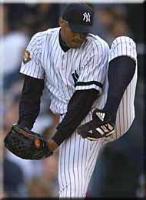
- El Duque comes at you from various arm angles. His fastball isn't very fast, but his quirky delivery -- he lifts his left leg so high during his windup that he could kiss his knee -- and his sharp breaking stuff prevent hitters from sitting on his fastball.
Livan altered his delivery in 2008 spring training with the Mets, only kicking his knee slightly above his waist -- to his chest -- before delivering the ball. But he returned to the high leg kick when his results were poor.
- He will pitch backward in the count, throwing 2-0 curves and 3-1 curves. You never know what he is going to throw you. He has no patern. You can't go to the plate and look for a pitch, because you might not see it. He might throw four sliders in a row, or four changeups in a row.
- El Duque is durable and reliable in the big games.
- He likes pitching deep into the game and is a workhorse on the pitching staff.
- Hernanez is one of those pitchers who can still do real well even when he doesn't have good stuff.
- In 2004, Orlando limited opponents to a .230 (73-for-317) average, including a .194 (25-for-129) mark by right-handers, and averaged 8.9 strikeouts per 9.0 IP. He began the 2004 season with eight consecutive victories, the first Yankee pitcher to accomplish that feat since Bob Wickman also started 8-0 in 1993.
In 2005, Hernandez allowed a .295 average and 9 home runs in 264 at-bats to lefthanded hitters. Righthanded batters hit .259 with 9 home runs in 228 at-bats.
- Mets manager Willie Randolph is a real fan of El Duque: "You don't even look at his age, because Tommy [Glavine] is 40, 41, something like that, so you don't look at age anymore, because Tommy and El Duque are two of the hardest workers on the team." (October 28, 2006)
- In 2006, El Duque allowed a .300 average with 15 home runs in 327 at-bats vs. lefthanded hitters, but held righthanded batters to a miscule .199 mark with 7 home runs in 287 at-bats.
In 2007, lefthanded batters hit .245 with 11 home runs in 265 at-bats vs. Orlando, while he held righthanded hitters to a .167 average with 12 home runs in 263 at-bats.
- Hernandez started the 2008 season with a career record of 90-65 with a 4.19 ERA. He had allowed 154 home runs in 1,167 innings and a .243 batting average.
| |
|
|
CAREER INJURY REPORT:
|
- July 2000, El Duque went on the D.L. with a sprained right elbow. He was reactivated August 6.
- June 1, 2001: He went on the D.L. with an irritation in the second toe of his left foot, the one he lands on after releasing a pitch. The toe had bothered him most of the season, but it was very tough for him to tell Manager Joe Torre, "I can't pitch."
He underwent surgery on the second toe of his left foot in mid-June. He was reactivated August 21. It was a surgery many thought was not necessary, but which Hernandez demanded.
- May 16, 2002: Hernandez went on the D.L. with an uper back strain. He was reactivated June 27.
- March 13, 2003: A case of rotator cuff tendinitis put him on the shelf the last half of spring training. An MRI revealed a crack in the supraspinatus muscle, a delicate part of the rotator cuff. So Orlando stayed in Florida for extra rehab and work at the start of the 2003 season. And then, in May 2003, he underwent arthroscopic surgery to repair a small tear in his rotator cuff.
- April, 2004: Hernandez started the season on the D.L.
- May 21-June 4, 2005: El Duque was on the D.L. with a sore muscle in the back of his shoulder.
- June 14-July 18, 2005: Hernandez was back on the D.L. with tightness between his neck and shoulder.
- October 4, 2006: El Duque suffered a tear in his right calf and could not pitch in the postseason. Hernandez felt his right calf tighten while doing sprints in the outfield.
- February 22, 2007: Orlando left the Mets' spring training camp and returned to New York to have his neck examined.
- April 25-May 28, 2007: Hernandez was on the D.L. with bursitis in his right shoulder.
- August 30-September 11, 2007: El Duque missed a couple of starts with the Mets because of a strained tendon and other problems in his right foot, mostly cause by a huge bunion. It bothered Hernandez the rest of the season. He was fitted with a boot.
October 19, 2007: Orlando underwent surgery to repair a dislocated tendon at the base of his second toe, which is now shorter because of the surgery and causing problems with his balance on the mound.
- February, 2008: Hernandez did not have surgery to remove the huge bunion on his right foot because it would require two years of rehab to return. So he will have the surgery to remove the bunion after he retires, perhaps after the 2008 season.
March 29, 2008: Orlando began the season on the D.L. while still having problems with his right foot -- both the post-op condition and the huge bunion. According to the Mets, the tendon is not the same as the one he had surgically repaired after the 2007 season, but it may be a result of Hernandez tinkering with his windup, or just his age. At 42, things happen to athletes.
- Early in July, 2010: Right after signing with the Nationals organization, Hernandez went on the D.L. for about a month.
| |
|