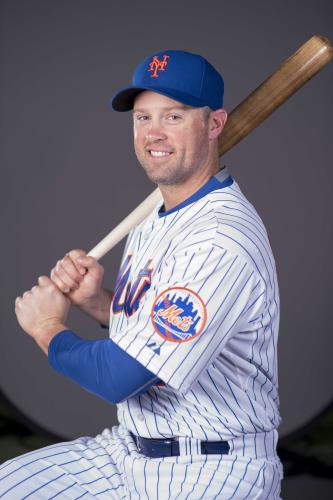
In 1997, Cuddyer was named Virginia's Player of the Year and Gatorade National Baseball Player of the Year.
That year, he was also a member of USA Today's All-Star and the USA Junior National teams.
Michael has excellent work ethic and outstanding intangible makeup. He makes adjustments well and is very coachable. He is a team leader.
You won't find many players who live for the victory more than Cuddyer. He truly loves to win. He is the most optimistic and gregarious personality on his team.
The work ethic, staying power and level-headedness comes from his parents. His father, Henry, held a blue-collar job driving a truck, delivering Little Debbie snacks to stores around Norfolk, Va. His day began at 2 a.m. and ended at 2 p.m.
"In the summer, when there was nobody home to babysit me, I would get up with my dad at two in the morning. He'd let me sleep in the truck," Michael recalled. "In the morning, sometimes I traded snack cakes for Krispy Kreme donuts and some milk."
Cuddyer's mom, Marcia Harris, knew how to put her son in his place.
"When I was in Little League, if I had a good game, I'd say, 'Mom, did you see the game I had today?'" Cuddy said. "She would look back at me and say, 'Look Michael, if you played that well, everybody else is talking about it. You don't have to, too.' That's always stuck with me. That taught me humility and humbleness.
"Back in high school, I never wanted to be labeled as any one thing. I never wanted to be the 'jock' or the 'nerd' or 'the popular person.' I wanted to be everything. I took pride in that and I still take pride in being somebody who can get along with everybody. I think that's helped me with my baseball career."
Cuddy is comfortable in every corner of the clubhouse.
In August 1997, he signed with the Twins for a team-record $1.85 million signing bonus after he led the U.S. junior national team to a bronze medal at the world championships, leading the team in home runs and RBI.
Cuddyer lost the hearing in that left ear at age 11 after suffering a rare viral infection. But you would never know he cannot hear out of that left ear. In fact, when he signed his first contract with the Twins, he checked "no" by the line asking if he had any hearing problems.
"It wasn't a problem," Michael said. "It isn't a problem."
Cuddyer passed up a scholarship to Florida State University.
Michael was a National Honor Society member at Great Bridge High School in Virginia.
In 1999, he led the Florida State League in walks.
He has real enthusiasm for the game and has leadership attributes. He is very disciplined, shows excellent poise and is willing to work hard at the game.
Mike's 2000 Topps baseball card had Mike Restovich's picture on it, and vice versa.
CARD TRICKS
Cuddyer is a clubhouse star, amazing his teammates with card tricks. He began doing sleight-of-hand when he was a kid, and worked in his tricks at baseball camps. He has earned the nickname "The Magician."
When he was 15, he started making up his own card tricks, including the one that still blows away most everyone: "You pick a card from the deck," Cuddyer explains. "While you're holding it in your hand and looking at it, I show you another card in the deck. While you're still holding your card, I take the other card and put it somewhere else in the room. Then you take your card and put it back in the deck. I look through the deck, find your card and show it to you, and while you're holding it, I tap it a few times and when you look at your card again, it's not your card anymore. Now it's the card I had put on the other side of the room. And when someone goes and gets the other care, it's your card!"
Cuddyer considers his specialty to be his showmanship. He has a big smile and a very pleasant disposition, and that comes across when he is doing card tricks. "I'm good at getting people's attention away from what I'm doing so they pay more attention to what I'm saying," he says. "I add a little flair."
Michael enjoys working in the community, making himself available to talk to schools or children's hospitals. "I love doing that sort of thing and have some tricks for younger kids and other ones for older ones. I love the look on people's faces when they're stumped."
A big music and movie buff, Cuddyer said he also continues to shop at used book stores. About four years ago Cuddyer was browsing a book store in the Fort Myers area and found "Carew," the autobiography of Hall of Famer and former Twin Rod Carew.
"I've been meaning to bring it in to camp,'' Cuddyer said.
He finally remembered to bring the book to 2008 spring training, and before a workout Cuddyer was outside the Twins clubhouse asking Carew to autograph it. From near trash to autographed treasure.
In 2001, he was second in the Eastern League in on-base percentage (.395) and extra-base hits (69), was third in homers, and fourth in doubles and slugging percentage (.560).
In 2002, he established himself as the best hitter in the Pacific Coast League before going up to the Twins.
Before 2004 spring training, Cuddyer dropped 15 pounds, mostly in his torso and legs. The strenuous running program increased his agility and quickness.
Michael is deaf in his left ear. "There can be someone right in front of me saying my name, and I'll have no clue where it's coming from," he explained.
After Christmas every year, Cuddyer often takes a little vacation.
"Where I'm from, here in Virginia, is very close to the Outer Banks of North Carolina. It's a popular beach location for tourists in the summer, but with it being cold now, the beach homes get very inexpensive. So usually every year a bunch of my friends and I rent one and go down there. In January 2006, I'm going with my fiancée and a bunch of other couples to ring in the New Year."
After the 2006 season, Michael got married in Jamaica, exchanging vows in front of 150 family members and friends in a beautiful tropical setting, marked a perfect end to an almost perfect year for Cuddyer. Almost.
"Matt LeCroy was in the wedding," Cuddyer said of his former Twins teammate. "You know how he sweats. My wedding pictures are awful."
"Matt can work up a lather just leaning against the batting cage," Cuddyer said. "We had a great time."
Michael is a couch potato.
"I pretty much sit on my couch and watch movies," he said. But he also said, "I don't watch movies as much," since he got married.
Cuddyer has a long list of favorites: "Braveheart," "Shawshank Redemption," "The Natural," and "Goodfellas."
"I'm not afraid of chick flicks. I even like stupid humor. I like the Wayans brothers. I watch 'White Chicks' every time it's on and get a laugh."
In 2008, Michael joined forces with Washington's Ryan Zimmerman, Tampa Bay's B.J. Upton, Arizona's Justin Upton, and former Major Leaguer Tim Hummel—all from Virginia—to build a 30,000-square-foot baseball training facility in Virginia Beach. The facility was expected to open in 2009.
Starting in May 2008, Cuddyer began wearing a mouthpiece to help improve his hitting and fielding.
The way it's been explained to me is it relaxes your jaw, which relaxes your face, which relaxes your shoulders and traps [trapezius muscles], and all of that is a key to athletic performance."
When wearing the PPM—Pure Power Mouthguard, Michael experienced a great increase in range of motion when he rotated his torso. "That would help with hitting and with throwing," he said. "It's fascinating to me. David Ortiz says Manny (Ramirez) loves it, that it's all he talks about. So I figured I'll give it a shot. It can't hurt. And if it does hurt, I'll stop wearing it."
June 2, 2010: Cuddyer's father-in-law, Je Rente, died in his sleep, so Michael left the team for a few days to be with his wife, Claudia, and family in Virginia.
During the winter before the 2011 season, Cuddyer bought a Canon EOS 60D digital SLR camera. He got the picture-taking bug from his brother-in-law who had shown hism beautiful sunrises and sunsets.
Michael then read up on photography and decided to take photos during the season to kind of chronicle the Twins' season. Besides having great access to stadiums and clubhouses all around the game, he took shots around the great cities on the club's itinerary.
"I'm the type that if I'm going to do something, I want to do it the right way. I didn't want to just take snapshots of stuff," Cuddyer said. "I wanted to, first of all, learn how to take pictures, and I'm still learning every day. I wanted to learn how to use a camera and how to make cool effects and stuff like that, and apply it to the stadiums."
Cuddyer has been respected as a clubhouse leader and most years buys T-shirts during spring season with a motivational slogan to inspire his team. Sometimes the slogans cannot become newspaper printable because of it's offensive language.
It is one of the unfortunate evolutions of professional sports. Effort, once expected, is now applauded.
"It is sad about today's game. People that play hard in my opinion are playing the right way, and now they are an oddity. It frustrates me," Cuddyer said. "In the course of a game, you are running for four seconds. It's not that hard. I don't preach it, but you just hope that guys see it, and respect it.
"Growing up, I was a big fan of Pete Rose. He had little-kid appeal because he played like his hair was on fire. But Cuddyer's role model was not a player, but an organization.
"It was really stressed by the Twins: Play hard, run everything out," Cuddyer said. "It was told to us that it was one of the things that would get you to the big leagues, and it always stuck with me." (Troy Renck-Denver Post-5/20/13)
The person Cuddyer is off the field—when he's at home with his wife, Claudia, son, Casey Jonathan (born in 2008), and nearly twin daughters, Chloe and Madeline (born early in 2012)—cannot be separated from his approach on the field.
"People ask me, 'Why do you play the game the way you do? Why do you hustle (so intensely)?' " Cuddyer said. "I go home and I've got a son who gets more excited to play his imaginary baseball game than anybody in this clubhouse to play a Major League Baseball game.
"I get a daily reminder of why I loved this game as a kid. I feel I would be doing my 5-year-old a disrespect if I came here and didn't play hard."
Cuddyer once was so deep into movies he collected nearly 1,000 DVDs. His music tastes range from pop to country to hip-hop, to classical numbers and movie scores.
"I don't define myself by being No. 3," Cuddyer said. "I hate using myself in the third person. I'm not just a baseball player. It's the old cliche. It's my profession, it's not my life. I've got three kids at home. I've got a beautiful, loving wife. There are other things in life than baseball. You have to be well-rounded." (Thomas Harding - MLB.com - July, 2013).
Somewhere in Minnesota's "Land of 10,000 Lakes," there must be a fountain of youth or mysterious elixir explaining how Michael Cuddyer, David Ortiz, and Torii Hunter are laughing in the face of Father Time. At a point when logic dictates their careers ought to fall into some stage of decline, Cuddyer, Ortiz, and Hunter are shining as brightly as ever.
"This is pretty special," Cuddyer, the Rockies' right fielder, said of his second All-Star Game selection. "To be voted in by the players, recognized by my peers, that means a lot." Cuddyer, whose career-best 27-game hitting streak ended in July, appeared to be peaking at age 34 in 2013.
"I think about it a lot," Cuddyer said of his formative years with the Twins. "We had some good teams with some great players. It just shows how hard it is to win."
Respected for his good nature as well as his talent and competitive nature, Cuddyer is thoroughly enjoying his best season. "I'm not supposed to be doing this at my age," he said, beaming. "Right?" (Spencer - mlb.com - 7/11/13)
Growing up in Virginia, Mets' superstar David Wright wanted to be like Mike—Cuddyer, not Jordan.
Michael Cuddyer was the big kid in Wright's neighborhood in Chesapeake, a city of 228,000 with historical roots dating to colonial times. It was Cuddyer, launching his Major League career in 2001 with the Twins, who set in motion a movement that has made the South Hampton Roads region in southeastern Virginia one of the hotbeds of baseball in America.
Following in Cuddyer's footsteps have been such stars as Wright, brothers B.J. and Justin Upton, Ryan Zimmerman, Mark Reynolds and Daniel Hudson. Per capita, you would have a hard time finding a more fertile ground for ballplayers on mainland USA.
"I'm extremely proud of him and all the guys from our area," said Cuddyer. "I'm as big a fan of David as anybody, and of all those guys from home: B.J. and Justin, Mark Reynolds, Ryan Zimmerman, Daniel Hudson, Clay Rapada. I'm extremely proud to be from Chesapeake. Guys who grew up there play hard and do things the right way."
Wright, who is four years younger than Cuddyer, was taken by the Mets with the 38th pick in the first round of the 2001 First-Year Player Draft, out of Hickory High School in Chesapeake. Cuddyer had been the ninth overall pick by the Twins in 1997, out of Chesapeake's Great Bridge High School, before Hickory was built.
"He's a few years older than me, but we grew up a few minutes from each other," Wright said of Cuddyer. "Growing up, everybody kind of strived to be like him. He was kind of the first high draft pick out of our area, and I really credit him for a lot of scouts discovering that area.
"Having John and myself, two high school teammates, drafted in the first round brought attention to our area," Cuddyer said. "David was next, then B.J., Mark and Ryan, Justin. Towny Townsend had a hand in [the development of] every single one of us."
Reynolds, Zimmerman and Hudson are from Virginia Beach, which is part of Hampton Roads. The Uptons, Wright, and Cuddyer call Chesapeake, about half the size of Virginia Beach, home.
"It's not a big town, but it's a huge baseball area with a lot of people who supported us growing up," Cuddyer said. "Nobody ever told us we couldn't be players. I remember a time when Mark Reynolds was the shortstop on the local AAU team; B.J. was the center fielder, and Justin was the batboy. I worked out with them, and my Dad was one of the head coaches."
Manny Upton, father of the two Braves outfielders, is Cuddyer's partner in a training center and hitting school called "7 Cities Sports" in Chesapeake. Cuddyer's father manages the business.
In support of an old friend who had been named the baseball coach at Grassfield High School, Cuddyer was part of a memorable benefit home run derby held at the new school in 2007. It included both Uptons, Zimmerman, Reynolds, and Wright, drawing a crowd Cuddyer estimated at 3,500 to 4,000 fans.
"David and I got to the final round," Cuddyer said, grinning. "I won." (Lyle Spencer - MLB.com - 7/15/13).
No one in Major League Baseball has a neater and more legible autograph than Cuddyer, and he can thank Hall of Famer Harmon Killebrew.
During a visit to the MLB Fan Cave on August 5, 2013 before the Rockies' series vs. the Mets got under way, Cuddyer signed the Rawlings ball wall and explained how his early days with the Twins included an unforgettable admonishment from the Twins legend on treating fans right.
"Before I met Harmon—before Harmon had ever seen my signature—it kind of looked like an EKG," Cuddyer said. "It was kind of zig-zag. People didn't know if it was my heartbeat or if it was my name. So I did a signing with Harmon, balls kept coming through, and he kept looking at this chicken scratch. Finally he asked whose this was. There weren't very many other people signing, so it was pretty easy to decide it was my signature. He told me, 'If I see this come through the line again, I'm going to stop signing. I'm going to get up and walk away, and the only person these thousands of people will be mad at is you.'
"So from that moment forward, I wrote it so that every letter, you could read it. And over the years, I constantly worked on it, worked on it, to the point where it's a pleasure to look at it. I take a lot of pride in that and it's because of Harmon." (Newman - mlb.com - 8/06/13)
Michael spent the morning of August 6, 2013 performing magic tricks with a card deck at Washington Square, part of an MLB Fan Cave visit. During that visit, the right fielder explained that it was a stomach flu outbreak back home in Virginia that led to his two-game hiatus earlier in this road trip.
"Things are well," he told MLB.com. "My wife [Claudia] and our nanny, who also takes care of the kids at times, both got the stomach flu. There was really nobody to turn to. I had to go home for two days and take care of our 5-year-old and twin 20-month-olds, and I was very fortunate that the Rockies allowed me to do that. Once [Claudia] got better in the next 12 to 20 hours, I was able to hop on a flight to Pittsburgh and meet the team."
Cuddyer said people probably don't fully appreciate how challenging those kinds of situations can be for MLB families. On his way to the Fan Cave from the Rockies' team hotel, he received a text from his 5-year-old son Casey.
"My son was up at 6:30 in the morning asking about his pool," Cuddyer said, "and at 7:30 he was already out there playing. You definitely have those situations that come up. Life gets involved, as everybody's does. Sometimes you have to get involved to take care of your family and that was one of the few incidents where that has happened. Like I said, I'm fortunate that the Rockies were understanding."
Cuddyer rejoined the club on Aug. 3, 2013.
Rockies fans know Cuddyer as "Magic Mike," thanks to the regular in-game videos showing his acclaimed sleight of hand. During the taping at nearby Washington Square, he blew people on the street away. One woman finds a card in her purse she wasn't expecting, while another woman finds a card under her shoe that Cuddyer somehow put there.
"I was always enthralled as a little kid in magic, illusions, and people's reactions to magic," Cuddyer said. "I made it a point to start learning tricks, and then I got to a point in high school where I started making up tricks of my own. It really allowed me to have a real icebreaker. First big league camp, I was able to take them into the clubhouse and have established veterans not only know who I am, but talk with me. That's rare as a 20-year-old at your first big league camp." (Newman - mlb.com - 8/06/13)
No matter the variant thrown his way, the veteran Cuddyer finds success through a systematic and efficient approach.
In 2013, Cuddyer missed 14 games with a neck injury. Four games after his return, he began a 27-game hit streak. Early in 2014, he suffered a strained left hamstring on April 17 and missed 25 games.
Cuddyer's way is quiet. He dresses in a corner of the clubhouse, rather than in the middle. While he was part of the inspiration for a new custom of marking each win by having the key player's jersey number painted on the wall above the lockers, he seldom raises his voice enough to be heard. When he goes through his well-developed study for a game, you have to be either looking for it or you have to ask, because it's not done in a flamboyant manner.
But it gets done and it works.
"Each game, in pregame, I'll look at the video of the last time I faced the pitcher, and I tend to look at their last start," Cuddyer said. "I don't necessarily look at what he does in certain counts or things of that nature, I look at velocity, what his breaking balls look like, and what he tries to put guys away with. And I look at what the catcher likes to put guys away with.
"Once I see the video, I try to pull up that at-bat against these guys [the pitcher and the catcher] and what it looked like from the hitting perspective in the batter's box. After that, I just basically go up there and fight, battle, get myself into some good counts. When I get myself in good counts, I take some shots. It's just me against you, a fight."
From the outside, the Cuddyer study guide sounds mundane. But there's an excitement in his voice when he discusses strategy, every bit as much passion as his voice carries when he discusses the personal confrontation.
It's that quiet drive that produces success in a schedule that's six months of almost daily games. Cuddyer is a leader in the attack that Rockies manager Walt Weiss believes is the best.
"That's the way to work these things out," Weiss said. "You get in there, you sweat, you get your hands dirty and you figure it out that way. There are no magic words you can say. It's not like these guys are going up there without focus or intent. It's just one of those cycles of the season." (Thomas Harding MLB.com 5/30/2014)
Michael's wife, Claudia spoke about winning the NL Batting title in 2013.
"Michael would never say this, but I will," she said. "Winning the batting title meant a lot to him. Michael is kind of old school. He always minded his Ps and Qs, and he went through every level of the minors to get here. He sat on the bench; he played whatever position he was asked.
"Ever day he played was like an audition. That's how he felt, even if he'd never say it. For me, to see him with that batting title was sooo... wonderful. I was so proud of him to finally get that national recognition."
Cuddy loves taking photographs.
"I always wanted to be an artist, but I had absolutely zero talent. I couldn't draw. I couldn't color. I barely had enough talent to draw a stickman. So I think photography has allowed me to take the visions I had in my head and put them on paper," Michael said.
On road trips, while teammates are taking naps or watching movies in their hotel rooms, Cuddyer tours cities or goes to the ballpark early to take photos. His pictures of Dodger Stadium, for example, capture the park from the dugout to the Vin Scully Press Box to a panorama of Chavez Ravine.
"I think photography, and all of my other interests, have allowed me to excape, to get away from 'all baseball, all the time.' It's allowed me to be a dad and a better husband, hopefully."
Michael and Claudia have three children: son, Casey, born in June, 2008; and twin daughters, Chloe and Maddie, born early in 2011.
Claudia, a former high school teacher, has helped him form the charity Cheerful Givers, which gives birthday gifts to underprivileged children.
"Having a lot of interests, expanding my world, has allowed me not to take the highs and lows of my profession back to my family. And the thing is, being able to escape the game has made me a better man and a better baseball player," Cuddy said.
Since signing with the Rockies, Cuddyer has worked with charities such as the CAN'd Aid Foundation, a non-profit organization created to help small businesses, individuals and organizations in Lyons, Colo., recover from a major flood in 2013.
"Michael is one of the most philanthropic players in baseball and is always thinking of ways to give back to the community," Jim Kellogg, the Rockies' vice president of community and retail operations said in the Rockies' official announcement. "He's a constant leader on and off the field leading by example." (Harding - mlb.com - 9/16/14)
Michael also says that he loves photography and directs fans to his Flickr page.
Back in 2002, Michael Cuddyer was 23 years old, talented, and full of promise. He was just establishing himself with the Minnesota Twins. The baseball world was at his feet.
He had played in the American League Championship Series and had batted .333 in his first postseason. He was back home, the hometown hero, relaxing in the Hampton Roads area of Southeastern Virginia. And he was bored.
While others would have taken the winter off, watched TV, goofed off, or basked in their newfound success, Cuddyer reached out to Great Bridge High School in Chesapeake, Va., his alma mater, and asked if he could be a substitute teacher.
The answer was a resounding yes. (Tim Rohan - March)
TRANSACTIONS
June 1997: The Twins chose Cuddyer in the first round, out of Great Bridge High School in Chesapeake, Virginia.
February 15, 2007: Michael and the Twins avoided salary arbitration, agreeing to a $3.575 million, one-year contract.
January 25, 2008: Cuddyer and the Twins agreed on a three-year, $24 million contract. It called for a $2.75 million signing bonus and salaries of $5 million for 2008, $6.75 million in 2009 and $8.5 million in 2010. Minnesota has a $10.5 million club option for 2011 with a $1 million buyout.
November 7, 2009: The Twins picked up the $10.5 million option on Mike for 2010.
December 16, 2012: Cuddyer and the Rockies reached agreement on a three-year contract worth $31.5 million. He gets $10.5 million each year. (The Twins reportedly had offered three years for $24 million.)
November 10, 2014: Cuddyer signed a two year, $21 million contract to play for the Mets. He gets $8.5 million in 2015 and $12.5 million in 2016.
December 11, 2015; Cuddyer announced his retirement at age 36, half way through his 2 year $21 million dollar contract, all of which was guaranteed. He played 14 seasons with the Twins, Rockies and Mets.
BATTING:
Cuddyer is pronounced cuh-DIE-er.
He has exceptional power coming from a lively, quick bat. He has strong hands and a quick stroke. His bat covers the entire strike zone. He has good plate discipline. He hits to all fields with power.
Back in 2000, he finished his swing long and high and frequently put topspin on the ball. That cut down on the ball's carry and led to a lot of ground balls and a lot of double plays.
"I couldn't turn on an inside pitch, even if it was an 85 mph fastball," Mike said. But he got the loop out of his swing and now makes much more consistent contact because it is shorter and more compact. He has above-average bat speed.
Now, he can turn around even the best fastball. He has shown good ability to hit offspeed stuff, keeping his hands back. But pitchers with a good slider can get him out.
He is mature and has outstanding makeup. Scouts have compared him to Scott Rolen and Troy Glaus.
Michael hits well in the clutch.
HITTING FOR THE CYCLE
Cuddyer hit for the cycle on May 22, 2009 vs. the Brewers. He began his cycle with a three-run homer in the first inning off Brewers starter Manny Parra.
Michael led off the third inning with a ground-rule double to left-center field off Parra. He came up to bat again in the fourth inning right after Parra had exited and was replaced by righthander Mike DiFelice. Cuddyer added an RBI single to center field, capping a four-run inning for Minnesota.
That left him a triple short of the cycle. And in the sixth inning, in his fourth at-bat of the night, he delivered that triple with a grounder down the left-field line.
And when he hit two home runs in the same inning later in the 2009 season—on August 23, 2009—Cuddyer became the first guy in Major League history to hit for the cycle and hit two homers in the same inning in the same season.
August 17, 2014: Cuddyer became one of just 30 players in Major League history with two career cycles and the first player since Adrian Beltre to notch a pair. Three players (Babe Herman, Bob Meusel and John Reilly) have three cycles, but no one has accomplished that feat since 1933.
Along with John Olerud and Bob Watson, Cuddyer became the third player to hit for the cycle in both the National and American Leagues. Cuddyer also had a cycle for the Twins in 2009.
Michael's excellent 2013 season was due to his ability to forget the massive amount of information he had received in his 13 years in the Majors. Yes, he has seen numerous pitchers, learned from many instructors, and studied piles of scouting reports. The trick he has learned is he needs to forget most of that when he steps into the batter's box.
"You know that a lot of stuff is just wasted thoughts," Cuddyer said. "For me, you get the information you think you need. As you get older, you realize what information you can apply to your game and what you can't.
"As a younger guy, you get the scouting report and study the whole thing. Then you get in the box and you've got this overload of stuff in your head, and it's hard to sift through it all while still worrying about the most important thing. That's putting the bat on the ball."
Rockies hitting coach Dante Bichette said he sees himself in Cuddyer.
"He's been one of the most enjoyable guys to talk to, just on how to go after certain types of pitchers and how to sit on pitches, how to hit with two strikes, how to hit with men in scoring position," Bichette said. "We have a lot of the same views on how to get it done."
The key is versatility.
"He's of the mentality that, 'I might not get you the first at-bat or the second at-bat, but I'm going to get you,' " Bichette said. "Guys who think like that can make adjustments.
"Everybody talks about just one approach, and that's where hitting goes wrong. Everybody sticks to their approach. There's no perfect approach. There's always a hole in a certain approach. When pitchers figure that out, you've got to be able to change that approach." (Thomas Harding-MLB.com-6/23/13)
Cuddyer endeavors to make situational hitting simple.
"The thing I try to do is, if there's a guy in scoring position, I try to knock him in, and if they're not, I try to get in scoring position," Cuddyer said. "If you keep it that simple, it keeps you from trying to do too much."
Michael was chosen by friend David Wright to participate in the 2013 Home Run Derby.
Ironically, back in 2008, several Major Leaguers from the Virginia Beach area held a home-run-hitting contest to raise money for a new high school's baseball program.
David Wright, Ryan Zimmerman, Mark Reynolds, and the Upton brothers—B.J. and Justin—were among the participants, but none could beat Cuddyer.
"I won it. I beat those guys," Cuddyer said of the 2008 contest. "I don't know if that helped David's decision or not. "I'm excited. I can't tell you how excited I am. Being on the All-Star team is awesome and this is just icing on the cake for me."
Cuddyer was the 2013 National League batting champ with his .331 batting average. It was 60 points higher than his career average of .271 at the start of the '13 campaign. (The Braves' Chris Johnson was second, at .321.)
Michael's habit of dashing hard out of the batter's box always puts him in position to reach on infield balls.
"It's more singles—a lot more singles," explained Cuddyer, who had a club-record 27-game hit streak from May 28 to June 30. "I don't know what to attribute that to. It just happened. My approach didn't change. Nothing really changed. For some reason, I got more singles."
Cuddyer became the sixth Rockies player to win a batting title. He joins Andres Galarraga (1993), Larry Walker (1998-99, 2001), Todd Helton (2000), andCarlos Gonzalez(2010).
Born five days apart in 1979,CuddyerandJuan Uribehave played a combined 3,227 games over 30 seasons, their paths rarely meeting until this year. Cuddyer came to the Mets as a free agent last offseason. Uribe, as a trade acquisition days before the non-waiver Trade Deadline.
Since their arrivals, those two have grown into twin pillars of a clubhouse sorely missing David Wright. Cuddyer has led by example, turning heads for his hustle despite a bum knee. Uribe became a mentor for the room's Latin players almost instantly upon arriving, commanding respect for his two World Series rings. So it was only fitting that these two Mets, intertwined by a bizarre thread of baseball fate, each recorded his 1,500th career hit in a 3-0 winover the Rockies -- the only other franchise that Cuddyer and Uribe have in common.
"Three thousand hits," Cuddyer said, chuckling. "We're in the Hall of Fame if we can go in as a tandem."
The Mets would be plenty happy with another few months of this sort of production. In the fourth inning, Uribe doubled home the Mets' first run, then scored on Cuddyer's 1,500th hit, an RBI single. A pitch later, Cuddyer -- bad knee and all, just three days removed from the disabled list -- took second base on a wild pitch, one night after stealing second and scoring on a single.
The Mets were glad to see Cuddyer and Uribe become the 610th and 611th players all time to reach 1,500 hits, but they have beennearly as thrilled to watch the leadership of those two on a daily basis.
Asked about it after the game, manager Terry Collins remarked, when asked how long it took for the veteran infielder's leadership to show, "Minutes. He walked into the clubhouse with personality, with reputation, and the Latin guys flocked to him. They know him. They've heard of him. He's an outgoing guy. He's funny. He's a lot of fun to be around, and that stuff, people gravitate to those kind of guys." (DiComo - mlb.com - 8/13/15)
Cuddyer started the 2016 season with a .277 career average and 197 home runs and 794 RBI in 5,488 at-bats.
FIELDING:
At third base, where he first played after the 1998 season in the Instructional League, Michael displays his good hands and strong arm. He moves better to his left and gets better jumps on slow rollers than he used to.
But in 2005, Cuddyer had 15 errors in 95 games. He is probably better used in the outfield.
Twins farm director Jim Rantz said of Cuddyer: "He's got that approach to the game that you look for. He has fun playing it. He's never really too high or too low. He handles adversity and he's shown he's got a body that's durable."
Mike has become very versatile, picking up a first baseman's mitt, a third baseman's mitt, and an outfielder's glove, and handling them pretty well. He has worked hard on his defense, and it is now paying off.
In 2011 with the Twins, he played first base, second base, and the outfield.
RUNNING:
Michael has only fair speed. It is the only tool that keeps him from being a five-tool player. He is slow out of the batter's box, but a good baserunner once he gets going.
POST-PLAYING CAREER POSITIONS
November, 2016: Cuddyer was a Special Assistant to the Twins.
CAREER INJURY REPORT:
Michael is deaf in his left ear, the result of a childhood virus.
May 2002: Cuddyer went on the D.L. with a pulled oblique muscle in his right rib cage early in May at Edmonton (PCL). He was injured while swinging a bat. He was reactivated May 10.
June 2003: Mike spent time on the D.L. with a hamstring injury. He probably came back to soon, because he was missing games the last couple of weeks of June with the same problem.
October 22, 2003: Cuddyer had minor surgery to remove a bone chips from his right elbow.
September 22, 2004: Michael found out the neck pain that had sidelined him for a few games was caused by a slightly bulging disk between verterbrae in his uppper back.
June 30-July 17, 2005: Cuddyer was on the D.L. with a bruised left hand.
October 4, 2005: Michael had arthroscopic surgery on his right knee to repair damaged lateral meniscus cartilage. Minnesota Wild surgeon Dr. Joel Boyd handled the procedure.
March 2006: Cuddyer suffered a strained oblique muscle near the end of spring training.
July 19-August 3, 2007: Michael was on the D.L. with a sprained right thumb.
April 4-24, 2008: Cuddyer was on the D.L. with a dislocated right index finger. After Michael dived for third base in the third inning of a game that night, he looked up at third base coach Scott Ullger.
"Scotty, look at my hand,'' Cuddyer said.
"Oh no!'' Ullger exclaimed.
The knuckle near the tip of Cuddyer's right index finger was pushed back and the tip of the finger was bent upward. Cuddyer could see his tendon. Five stitches at Hennepin County Medical Center closed the cut.
June 29-September 13, 2008: Michael was on the D.L. with a strained tendon in his left index finger. He was not sure how it happened, and played with it for at least two weeks, but when he was swinging at a pitch it sent him over the edge and onto the D.L.
October 2010: Cuddyer underwent arthroscopic surgery on his right knee, which bothered him the whole season, though he missed only five games. He had the knee cleaned up.
February 26, 2011: A wart on the outer half of Michael's left foot kept him out of the early spring exhibition games. He was given a cream to remove the wart.
"A wart is a virus, without getting too much into the physiology of it," Cuddyer said. "Your antibodies don't see the virus because it is in the skin. You try to irritate the wart so it is in the body, so the antibodies can attack it and fight the virus off.
"The creme is supposed to irritate it enough to where the antibodies will see it and hopefully attack it."
The wart popped up around Thanksgiving in 2010. A dermitologist froze it two times, but it did not leave. It bothers him while trying to round the bases.
Finally, on March 1, Cuddyer had the plantar wart removed, sidelining him for another two weeks.
August 11, 2011: Cuddyer strained his neck during early batting practice and had an epidural to help calm down the herniation in his neck.
August 4-16, 2012: Michael was on the D.L. with a strained right oblique muscle.
August 18, 2012: Cuddyer re-injured the right oblique strain that put him on the disabled list on August 4. So Michael went back on the D.L. and missed the rest of the season.
"This time it was a little higher, and a way worse feeling," Cuddyer said. "This one hurts to breathe. It hurts to talk."
May 9-24, 2013: Cuddyer was on the D.L. with a bulging disk in his neck.
April 21-May 20, 2014: Michael was on the D.L with a strained left hamstring."Extremely frustrating," Cuddyer said of his balky hamstring, something he's never experienced before in his career. "This is nagging more than anything else."
The reigning NL batting champion estimated he could run at about 70 percent before the hamstring begins to act up.
"Obviously, you can't play like that," he said. "I don't know how long it's going to take."
Cuddyer was off to another hot start at the plate, too, hitting .317 with three homers and 10 RBIs.
June 6-August 16, 2014: Michael was on the D.L. with a strained left shoulder. He started by wearing a sling as he recoverd from a non-displaced fracture in his left shoulder socket. The need for rehab kept him out of action until mid-August.
Keith Dugger, the Rockies' head athletic trainer, said the problem can't be repaired surgically because an operation would be too invasive, although he is soliciting various opinions.
August 24-Sept. 8, 2014: Cuddyer was back on the D.L. with a strained left hamstring.
July 23-Aug. 10, 2015: Michael was on the D.L. with an injured left knee he tried to play with. He finally gave in after three weeks.
November 5, 2015: Michael Cuddyer underwent surgery to repair what the team called "a core muscle injury,"