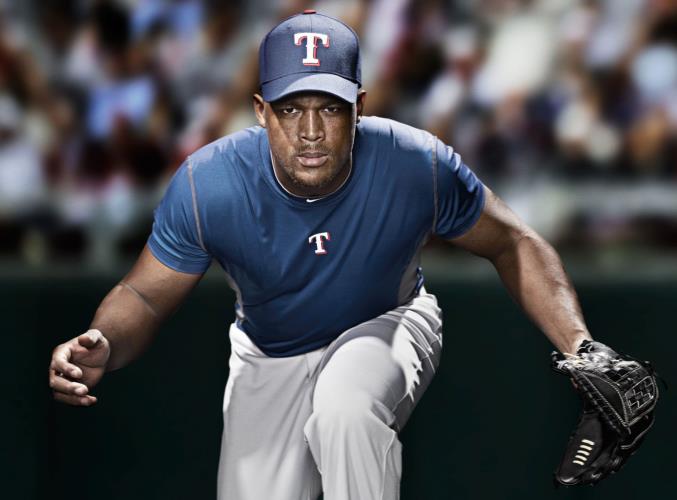
-
Adrian's father was friends with longtime player and manager Felipe Alou. And Alou remembers holding Adrian when he was a baby.
-
Beltre was just as good at basketball and tennis as he was at baseball until he was age 13. Then, one day he found himself watching a baseball game from the United States on TV. The picture wasn't all that sharp and the game wasn't all that memorable. But the Astros third baseman that day made quite an impression on Adrian.
"Ken Caminiti," Adrian said. "I saw how hard he played. I saw the plays he made. And I got serious about baseball."
-
With all his great skills, Adrian also has a burning desire to succeed. He works real hard, wants to learn, accepts constructive criticism well and is just a pleasure to have on a team. He is a perfectionist who wants to do everything the right way.
-
In 1994, Beltre signed with the Dodgers when he was just 15 years old. And he weighed only 130 pounds.
But Commissioner Bud Selig suspended the Dodgers' scouting operations in the Dominican Republic for a year, because signing a player at that age was prevented under MLB rules.
-
Adrian was 19 years and 78 days old when he made his big league debut with the Dodgers on June 24, 1998.
-
He was the Dodgers' best Dominican player since Raul Mondesi.
-
During the 1996 season, the owner of one sports memorabilia firm, Minford's Minors in North Carolina, was so impressed with Beltre's potential that, when he learned the Savannah Sand Gnats were not having a player card set, decided to produce his own.
YOUNG PHENOM
-
In 1996, South Atlantic League managers chose Beltre as the best batting prospect, best power prospect, best defensive third baseman, best infield arm, and most exciting player.
- In 1997, Adrian was the MVP of the Florida State League, after battling for the triple crown with league highs in homers and RBI to go with fourth-best batting average.
-
In 1998, he was rated the top prospect in the Texas League by Baseball America.
-
During the winter after the 1998 season, Beltre became the third player in Dominican League history to reach double figures in home runs and stolen bases in a season. And he was the loop's MVP, of course. Only Alonzo Perry and George Bell had been in the 10-10 club before.
-
November 11, 1999: Beltre's agent, Scott Boras, filed a grievance, claiming Adrian should be granted free agency because the Dodgers violated baseball's rules by signing him before he turned 16. The Dodgers 1999 media guide listed his birthdate as April 7, 1978, but Boras said he was born a year later, meaning he was signed at 15.
Beltre said he was never asked to lie. He said he hadn't even heard of the rule until Boras commented that Adrian had accomplished plenty by the age of 21, and Beltre told him he was only 20.
For their infraction, the Commissioner's Office fined the Dodgers $50,000, ordered the Dodgers to shut down their operations in the Dominican for one year, forbade the team from signing any Dominican players for a year, suspended Pablo Peguero, the scout who signed Beltre, for one year. The Dodgers also paid Beltre $48,500, the estimated amount Beltre would have been worth if he had waited a year to sign, plus interest. Beltre had originally signed for $17,000.
-
Adrian and wife Sandra, were married during the offseason before 2003 spring training. The couple celebrated the birth of their first child, daughter Cassandra, in the spring of 2004.
September 10, 2006: Adrian and Sandra celebrated the birth of their second child, and first son.
October 2, 2010: Adrian's wife, Sandra, delivered their third child, Canila, their second daughter.
-
Some people believe the Dodgers pushed him to the Major Leagues too soon, with no Triple A experience and only 64 games of Double A.
Others think they pampered him too much once he arrived, never forcing him to acquire the work habits that are now required. Because he arrived here in 1998, one could argue he was a victim of the chaos surrounding the changing Dodger regimes, from O'Malley to Fox, a prospect pushed too fast.
"I'd just like to see him become the player he can be," Tracy said early in the 2003 season. "It's about consistency. It's about doing the same things every day."
-
The Dodgers wanted him to spend more time in the batting cage. They didn't think he did that enough. The Dodgers wanted him to focus on hitting as a science instead of a swat meet. They didn't think he did that enough, either. Beltre says all the help can be suffocating.
"I was trying to work on hitting just to right field and it messed me up," he said late in 2003. "I need to stick with trying to hit the ball up the middle. I'll keep trying. I don't care what people upstairs or outside think."
-
Midway through the 2003 season, Beltre's Dodger teammates said he was trying harder, arriving early to watch videotapes of his at-bats and generally displaying better body language.
-
Adrian spends team flights with his nose buried in a laptop computer, creating elaborate playlists for his iPod.
-
Beltre is a regular visitor to the children's ward at L.A.'s White Memorial Medical Center. That compassion has grown out of Adrian's relationship with his younger brother, Elvin, whose meningitis at a young age left him with impaired speech and motor skills. Adrian calls Elvin in the Dominican Republic almost every other day.
-
Adrian hates to have the top of head rubbed, or even touched.
- During the offseason before 2006 spring training, Beltre went on a low-carb diet and lost about 12 pounds. He went back to his home in Los Angeles and started eating "mostly chicken breasts and salads, no carbohydrates."
Beltre also spent a lot of time on a treadmill, and the result was a more chiseled look and fewer pounds his legs have to carry.
-
In March 2006, Beltre hit four homers and drove in nine runs in five World Baseball Classic games for the Dominican Republic.
-
Beltre missed two games while in Mexico attending the funeral of his wife's grandmother.
-
Beltre has become more vocal—more of a leader in the clubhouse and on the bench during games. He brings intensity, leadership, and energy that fit right in with the rest of the team—another natural clubhouse voice for the American League champions.
"A great leader ... and a lot of fun to be around," teammate Ian Kinsler said. "Just the way he is. He likes to play around and mess around, just like the rest of us. But he knows when the right time is to strap it on and play hard every day."
-
Beltre has been thrown out of a game three times in his career. One of those came while going up against Mariners ace Felix Hernandez during one of their trash-talking confrontations.
"He was talking smack," Beltre said. "He said he was going to strike me out three times. Well, he struck me out on a pitch that was in the dirt. Everybody could see it bounce, but the umpire called it a strike. It was a rookie umpire.
"So I yelled at Felix, 'Next time, bring that up and I'll hit it out.' I never turned and faced the umpire. But he thought I was yelling at him, so he threw me out of the game."
The umpire probably didn't realize at the time that he was witnessing one of baseball's longest-running and most-amusing "feuds" in the big leagues. Beltre and Hernandez are close friends, and they have great respect for each other. But they are also over the top when it comes to talking "smack" to each other. They'll do it by phone, by text message, or by yelling at each other during batting practice when both teams are out on the field.
But unlike most opponents, they keep up the steady flow of smack during the course of a game. In 2012 in Seattle, Hernandez yelled that he would "dance on the mound" when he struck out Beltre with his changeup. Beltre responded by screaming from the Rangers dugout he would just "spit" on the pitch. The two former Mariners teammates love it.
Beltre has one home run against Felix (as of July 2013). It came on Sept. 18, 2011, in the Rangers' 3-0 victory.
"Yeah, one home run," Hernandez said. "It was an 0-2 count, I was trying to go in, and he crushed that ball. He was yelling at me the whole way around the bases. I could not look at him, because I was going to start laughing. But when I get him out, I get him back, for sure. If he hits a fly ball, I just yell pretty loud. And he'll say, 'C'mon man.' It's awesome."
Their friendship goes back to 2005. Beltre had just signed a five-year contract to play for the Mariners and Hernandez was an 18-year-old highly regarded rookie. Beltre was coming off his best season with the Dodgers, having led the National League in home runs.
"I first met him at my first spring training in 2005," Hernandez said. "He was a great guy, a great teammate. A tough guy. He's as tough a guy as I've ever seen playing. He could be hurt with anything and he'd still be in the lineup, playing unbelievable defense.
"It was Jose Lopez, Yuni [Betancourt] and I. We just always hung out with Belly. And Belly was always talking to us about what we should do and what we weren't supposed to do."
Said Beltre, "He reminded me of myself. He is a hard worker and wants to be the best. I did everything I could to help him, but he really works hard to be the best."
The "feud" really got started when Beltre left the Mariners to play for the Red Sox, but that was for just one season in limited engagements. Beltre then signed a six-year deal with the Rangers in 2011, putting him in the same division as Hernandez. Now he faces Hernandez several times a year.
-
Adrian refuses to wear a protective cup. He says it is uncomfortable.
-
On June 25, 2014: Beltre became the sixth player since 1900 with 2,500 career hits as primarily a third baseman.
-
Adrian put in a normal day at the ballpark on a Saturday at 2015 Spring Training. He was there for early hitting and conditioning, took a hundred ground balls plus regular batting practice, and then he played a game. When it was over, Beltre went out to the back field and threw batting practice.
No, he wasn't throwing to Prince Fielder or Elvis Andrus. The kid at the plate was Adrian Beltre Jr., eight-year-old son of the Rangers' third baseman. One of Beltre's great joys as he goes through the twilight of a Hall of Fame career is having his son join him on the road or in Spring Training.
"It makes it easier," Beltre said. "It's great. It's a lot of fun because I know how much he likes it, how much he likes to be around the guys, how much he likes the ballpark. I try to make sure he doesn't get in the way of anybody, but at the same time have fun and be around what I do."
Adrian Jr., who has his own uniform, summed it up succinctly when asked what he enjoys most about being with the Rangers. "I get to practice with my dad," he said. Adrian Jr. plays second, third and center field. It would seem like a great thing to have one of the best third basemen ever as a coach, but that isn't the case here. There isn't much coaching at all, just playing catch and throwing batting practice.
"I don't really teach him anything," Beltre said. "He's eight years old, so I make sure he is having fun. I get out of his way and try not to make him be somebody. He's at an age where I just want him to get his own identity. I don't want to teach him how to hit, I just tell him see the ball and hit it. Just be ready for the throws."
So apparently, father has no hidden dreams of little Adrian growing up to be the next Ken Griffey Jr. At least for now. "He can be whatever he wants," Beltre said. "I'm not going to push him to be anything. The only thing as a father is I don't want him to do is play football. Other than that, do whatever he wants to do."
"I try to be involved in his life as much as I can and be a positive figure to him," Beltre said. School also doesn't get neglected. Beltre and his wife Sandra make their home in the Los Angeles area and they also have two daughters, Cassandra and Canila. The whole family gets to be with dad on occasions during the season, but school is not forgotten.
"We are home-schooling Adrian Jr. right now," Beltre said. "We have a system which the school he is in sends his homework through a computer. He does most of his schooling in the school he goes to, but when we take him out of school, he still does his work."
-
Family is obviously important to Beltre. He had his own strong relationship with his father Bienvenido Beltre while growing up in Santo Domingo in the Dominican Republic. His father was a baseball player and an industrial mechanic, although his son allowed him to retire once Beltre reached the big leagues in 1999.
"I'm close to my dad," Beltre said. "I didn't get to be around him as much as I wanted to but I looked up to my dad. I used to see him play too. He played winter ball in the Dominican. He didn't play professionally, but he was allowed to play winter ball. I didn't get to see him get to play as much as he comes to see me.
"I grew up in neighborhood where almost everybody played baseball. My uncles, my dad of course, my cousins. At same time, I grew up watching my dad play baseball so it was natural for me to love the game. I haven't seen him as much as I want to since I came to the United States, but he loves the game. He comes here to watch games and we talk about baseball as much as we can." (Sullivan - mlb.com - 3/23/15)
-
April 2015: Beltre had the misfortune of hitting against Angels pitcher Garrett Richards, who proceeded to saw through three of Beltre's personal bats in a single afternoon.
And just like the rest of us, Beltre felt as though he shouldn't have to foot the bill for the cost of doing business as a professional, so he decided to put the bats on his expense account and sent an official invoice to Richards. Beltre sent Richards a $300 invoice for the three bats he broke. Richards loved it. He sent him back a bat. (Mike Bertha - 4/26/15)
-
August 23, 2015: The numbers continue to pile up for Beltre, and those numbers continue to make the case that Beltre belongs in the debate about the greatest player from the Dominican Republic.
“Not even close,” the Rangers’ third baseman said a few hours before he passed Julio Franco for the most games played by a Dominican player (2,528). “Because a lot of Dominicans are a lot better players than me.”
Maybe, but Beltre has the most hits (2,714) by a native of the Dominican Republic and now the most games. He says those are just the by-product of having such a long career.
-
In addition to being one of the game's top third basemen, Adrian is active off the field. He and his wife, Sandra, are involved in the Texas Rangers Baseball Foundation, the Texas Rangers RBI program in the DFW Metroplex and the I Love Baseball program in the Dominican Republic. Beltre has donated to David Valle's Esperanza International as well as foundations established by Robinson Chirinos, Michael Young, Eddie Guardado and Joakim Soria. He has also contributed to the Baseball Tomorrow Fund. (Sullivan - mlb.com - 9/14/15)
-
When Beltre returns to the dugout after a big hit, they set themselves up: Whoever is closest high-fives Beltre while someone else—usually shortstop and best friend/chief pest, Elvis Andrus—knocks Beltre's helmet off from behind. The hand darts in, and the offender scurries away before the 220-pounder can retaliate.
"I thought about killing him," Beltre once famously said of then-Red Sox teammate Victor Martinez, one of the most notorious helmet thieves. "I thought about it. But I have a family, so I didn't"
He was kidding. But if you've ever seen the look he gives the practical joker afterward, you'd be forgiven for not being sure.
The head touch. It's a quirk that has spread in the Beltre household. Nine-year-old Adrian Jr. announced in 2015 that his skull, too, is off-limits. A.J.'s Little League teammates have taken that as an invitation, and A.J. reacts in a familiar way.
"Same thing as his dad," says his mother, Sandra. "He tries to beat them up."
The origin of the ritual is unclear. Beltre just never liked having his head touched, even as a kid. he doesn't remember which teammate he first told about it, but it accidentally guaranteed that he'd spend the rest of his career glancing over his shoulder. (Stephanie Apstein - Sports Illustrated - 3/28/16)
-
Beltre has been a star in the field since the Dodgers signed him illegally from the Dominican Republic at age 15, a year before he was eligible.
Adrian was famous in the Dodgers' chain for his reaction to a ruptured and infected appendix that almost killed him when he was 21. He went two months without solid food, subsisting on clear soup and orange juice in the spring training clubhouse.
Bored and cranky, IV port still in his arm, he demanded to be allowed to play, and eventually the trainers decided to let him.
"He tucked his colostomy bag under his uniform," remembers Don Welke then a Dodgers scout, and took ground balls on the back fields.
"Soreness is not going to get me off the field," Beltre says.
And that's an understatement. He has refused to take any significant time off for injuries ranging from a sprained thumb in 2015—in which the tendon was wrenched from the bone so violently that it tore the skin—to perhaps his most famous setback, a ruptured right testicle that swelled to the size of a grapefruit. Adrian paid the price for his lifelong refusal to wear a cup when he took a hard grounder to the crotch during a 2009 game vs. the White Sox.
Beltre finished the game, singling and scoring the winning run in the 14th inning. In his first at-bat back from the D.L. two weeks later, the Seattle public address system played, "The Nutcracker Suite," as his walk-up music.
Adrian still doesn't wear a cup. "If the ball is going to hit me every 11 1/2 years, I'll take my chances," he said at the time.
-
It's what Adrian brings to the clubhouse that his teammates can't stop talking about: the suits he buys for rookies; his ability to say what needs to be said (in whatever language it needs to be said) without embarrassing anyone; the example that his sky-high pain threshold sets for teammates. Beltre even buys birthday cakes for everyone.
-
Adrian is not flamboyant. He is good -- really good. But unlike so many superstars of recent years, he is also understated.
"I came from the Dominican [Republic] from a neighborhood where I got a shot to be a baseball player," Beltre said. "My goal was to make it to the big leagues and at least be a decent player. I accomplished that. It has been more than I expected from myself. Yes, I work hard. Yes, I want to be the best I can be. A championship is the only thing I am missing in my career. Everything that comes after that is a bonus. I never thought I was going to get where I am when I was 15 years old.
"I always just want to be the best I can be," he said. "I wanted to work harder, not to put up numbers or think about the HOF, but because I respect the game. I love the game so much. I don't see this game as a job. I see it as a game I like to play and enjoy playing and you get money for playing."
When the joy disappears, so will Beltre. He's not going to have to be told when it is time to hang up his spikes. Rangers radio announcer Steve Busby, in his 45th season of being around the big leagues, beginning with a pitching career that saw him win 56 games in his first three full seasons before being sidelined by injuries, is a Beltre believer.
"Day to day, he is as good as I've seen," said Busby. "I don't think you appreciate him until you see him every day. He is not flashy, but he does stuff nobody else can do. I don't see an end to his career. He is playing as well this year as I've seen him in a long time. His defense is every bit as good."
He has won four Gold Glove awards for defensive excellence and four Silver Slugger Awards for his offense, and he is a four-time All-Star.
"He doesn't do anything the conventional way," said Rangers bench coach Steve Buechele, a smooth-fielding infielder himself during an 11-year big league career. "His style has evolved over time. His hand-eye coordination is remarkable." (Ringolsby - MLB.com - 8/8/16)
-
It's impossible not to think of Adrian and immediately think of teammates touching his head. "I've never liked people touching my head. I just didn't tell anyone about it until 2007, when Felix Hernandez was messing with my head and I made the mistake of telling him I didn't like it when people rub my head," Beltre said. "And that was all it took."
English is Beltre's second language, and he isn't immune to ribbing from teammates or making fun of himself. He admits that for a long time, when he dined out and the waitress asked if he wanted "soup or salad," he always answered yes, expecting a "super salad."
Around 2010, former Major Leaguer Richie Sexson invited Beltre and his wife to an event called Life in the Vineyard (food, wine, music) in Napa Valley and they were hooked. Now they go every year in the offseason.
Late bloomer: Beltre didn't start playing organized baseball until he was 13. Before that he and his cousins used a stick and a tennis ball. (Kruth - MLB.com - 10/3/16)
-
March 2017: Beltre played for the Dominican Republic in the World Baseball Classic.
-
Adrian will be 38 on April 7, 2017. And he does have one major void in a career that should see him easily reach the 58 hits necessary to become the 31st member of the 3,000-hit club -- a World Series championship.
"That's the thing that keeps me going," said Beltre. "I have had a decent career. I have accomplished a couple of things. I make good money. But I want to be a champion. That is what drives me. We have been close, really close."
Close like in losing the 2010 World Series in five games to the Giants. And in 2011, suffering a seven-game loss to the Cardinals in -- losing the final two games, including a 10-9, 11-inning loss in Game 6.
"I haven't come out on top," Beltre said. "My window is closing. I'm pretty sure if we win in 2017, it's going to make it easier for me to decide to go home and enjoy my kids. But for now, it is difficult for me to go home, because I haven't gotten the win that I want." (Ringolsby - mlb.com - 3/6/17)
-
In almost every instance, seeing a pitcher walk toward home plate and approach the opposing hitter spells trouble -- and usually some dramatic extracurricular activities. Sometimes, however, this scenario plays out in the manner it did in a July 31, 2017, Mariners-Rangers game, thanks to the amusing and unbreakable (but still competitive) friendship of two of MLB's closest frenemies, Felix Hernandez and Adrian.
With Beltre basking in the glow of collecting his 3,000th career hit the previous day, King Felix couldn't help but congratulate him before doing battle in the first inning of the Mariners' eventual 6-4 win.
And, naturally, Beltre then stepped into the box and singled. Because that's just what he does. Slaps base hits all the time ... even after sharing a moment with a dear friend.
"That was definitely on my mind," said Hernandez after the game regarding his gesture. "The first thing that came to my mind was just go to home plate and congratulate him. What he did last night was unbelievable." (Garro & Johns - mlb.com - 7/31/17)
-
March 30, 2018: Adrian Beltre finally got to meet his namesake giraffe at the Fort Worth Zoo. Last July 2017, the Fort Worth Zoo honored Adrian Beltre's entrance into the 3,000-hit club with its very highest honor: They named a baby giraffe after him. One of baseball's very best personalities combined with one of the most adorable members of the animal kingdom, and the little guy even had an early aptitude for taking a knee:
A match made in heaven -- but there was just one problem: The real Beltre hadn't gotten a chance to actually meet his namesake. Until when he paid the zoo a visit prior to the Rangers' game against the Astros: Look who finally got to meet his namesake @FortWorthZoo. #beltrethegiraffe
Sure, not a whole lot of physical resemblance, but you can just tell they're kindred spirits. (C Landers - MLB.com - March 30, 2018)
-
General manager Jon Daniels confirmed the Rangers had a chance to pursue a trade involving Adrian in late August 2018. Daniels said they did not do so because of Beltre's desire to finish the season and possibly retire as a Ranger at the end of the year.
"There was a situation last week that presented itself," Daniels said. "We talked about it with Adrian. For a number of reasons, it wasn't the right fit. If he wanted to push and push for the trade, we would have honored that. To not have done that says a lot about how he feels about his teammates and fans in particular. For that piece, I am in awe."
"The conversation we presented with Adrian with what was out there," Daniels said. "If he plays again next year, there are a million opportunities. If he chooses not to play, this could have been the last opportunity. For everything Adrian has meant for the franchise, if he wanted to pursue it, there wasn't a ton in it for us quite frankly."
"Like I've said before, the only way it was going to happen -- me going somewhere -- is if it made sense for both parties: me and the team," Beltre said. "Obviously, they understand that for me, it's always been important to have a chance to win the World Series. If something comes up, let me know, if it makes sense for them and [me]. Obviously, it didn't make sense for both of us. We had a discussion, and that's why I'm here."
"I was not eager to leave this place," Beltre said. "I've been here for eight years. I've been grateful for the chance to be in the World Series and almost win it. It's not easy to just pack your things and go. There's a lot of things to be considered, and like I've said before, I'd like to retire as a Ranger."
Beltre still doesn't know if that will happen this year or next. He is waiting for the offseason to decide if he will play one more year. But he wants his last game to be with the Rangers.
"I don't know how that's going to happen because I don't know where I stand for next year," Beltre said. "And if I do, I don't know if they still want me back. So, I feel like questions need to be answered, but it was not a difficult decision to make. The only way that I could've gone somewhere was if it was a perfect situation for me and the organization."
As far as possible retirement … "No," Beltre said. "I'm not thinking about next year yet. That's going to be in the offseason." (Sullivan - mlb.com - 9/3/18)
-
No one should ever question Beltre’s mental toughness. He plays with pain like no one in the sport, and he somehow manages to remain productive. That isn’t something he has developed over the course of his 21 seasons. He’s always had the ability to block out pain.
For instance, Beltre began the 2001 season on the Dodgers’ disabled list after a botched appendectomy in the Dominican Republic in the offseason and a follow-up surgery during spring training that removed more than a foot of his small intestine. Despite losing some 30 pounds and having to wear a colostomy bag, he wanted to be playing in games.
Beltre spent 18 days on the Mariners’ DL in 2009 for—try not to wince—a severely bruised right testicle. He wasn’t wearing a cup when a ball struck him were no man wants to be hit.
He still doesn’t wear a cup.
Those are the two most noteworthy instances when Beltre defied medical experts, but he’s done so countless times for a variety of ailments to a variety of body parts—hamstring, groin, quadriceps, calf, shoulder, thumb, abdomen and back.
“It’s good enough” is his go-to answer when asked why on earth he’s playing when others would be calling for a morphine drip.
That toughness stems from the mental edge that makes Beltre: (a) an unparalleled competitor, (b) one of the game’s most respected players, (c) a team leader, (d) a tough out at the plate, and (e) someone hitters don’t want to see on the other end of one of their ground balls or line drives.
Oh, and he loves the game. (Jeff Wilson - Baseball America - 9/07/2018)
-
Nov 29, 2018: Rangers general manager Jon Daniels received the call from Adrian Beltre one night about 10 days ago. Daniels knew instinctively what the subject was about. Beltre had made his decision about retirement and got right to the point with the general manager. The tone of his voice was solemn. "Adrian is pretty direct," Daniels said. "He doesn't mince words. He started off and said, 'Hey, this is a tough decision, for me. I have decided to play.'"
The shock was still to come. "He said, 'I got an offer from the Dodgers and I am going to play for the Dodgers.'" Daniels said. Daniels was stunned. "I don't know how I responded, if it was awkward silence or I stumbled over my words," Daniels said. "He started laughing and said, 'I'm just kidding, I am really going to retire.'" Even to the end, Beltre couldn't help but have a little fun with the general manager.
"I just didn't want to come straight out and tell him," Beltre said. "I thought it would be funny. I couldn't help it. I wanted to do it longer, but I couldn't do it. I think there was silence for two minutes and then I started laughing."
Beltre is indeed retiring, and he announced his decision in a statement released by the Rangers two days before Thanksgiving. He came back to Globe Life Park for an event that was part press conference and part celebration of his 21-year Major League career that almost certainly will be honored one day with induction into the Hall of Fame. (TR Sullivan - Mlb.com - Nov 29, 2018)
-
June 8, 2019: Rangers television reporter Emily Jones summed up the feelings of teammates, family, friends, special guests and fans who showed up to Globe Life Park to honor third baseman Adrian Beltre.
“An incredible man and an incredible teammate,” Jones said. “The game of baseball is better for Adrian having been in it and we are all lucky to have been along for the ride.”
The Rangers honored Beltre by retiring his No. 29 before their game with the Athletics. Beltre is the fifth person to have his uniform retired by the Rangers along with Hall of Fame pitcher Nolan Ryan (34), catcher Ivan Rodriguez (7) and former manager Johnny Oates (26). Jackie Robinson’s No. 42 was retired in 1997 by all 30 Major League teams.
Beltre was with the Rangers from 2011-18, the final eight seasons of a 21-year career that included 3,166 hits, 477 home runs, four Rangers Player of the Year Awards, five Gold Glove Awards and four All-Star appearances. He is ranked with Hall of Famers Mike Schmidt, Brooks Robinson, Eddie Mathews and George Brett as the greatest third basemen in baseball history.
Jones was Master of Ceremonies and the special guests included former Dodgers manager Tommy Lasorda. He was the general manager in 1998 who overruled other club officials and decreed that Beltre would not only be called up at the age of 19, but would remain in the big leagues permanently.
His presence was unannounced and caught Beltre by surprise.
“He was one of the finest young men we ever had in our organization. … The Dodgers,” Lasorda said. “Whatever he accomplishes for the rest of his life, he played for the Dodgers.”
-
Jan 23, 2024: Beltré was elected to the National Baseball Hall of Fame in just his first year on the ballot, receiving 95.1% of the vote conducted by the Baseball Writers’ Association of America.
Beltré, Helton, Mauer a trio of legends headed to Hall of Fame
He was joined by fellow electees Todd Helton, the longtime first baseman of the Rockies, and Joe Mauer, the face of the Twins during his peak. Iconic manager Jim Leyland was elected in December via the Contemporary Baseball Era Committee process.
Beltré, 44, will be most remembered for his late-career peak in Texas and his ascent to the Majors as a premium prospect with the Dodgers, but his mid-career stint in Seattle, from 2005-2009, was just as critical to his career. He is the seventh Mariners player to make it to Cooperstown, joining Gaylord Perry (1991), Goose Gossage (2008), Rickey Henderson (2009), Randy Johnson (2015), Ken Griffey Jr. (2016) and Edgar Martinez (2019).
Beltré won two of his five Gold Glove Awards with the Mariners and ranked among the team’s all-time leaders in most statistical categories -- ninth in batting average (.266), ninth in slugging percentage (.442), 11th in OPS (.759), 13th in on-base percentage (.317), 15th in homers (103) and 16th in RBIs (396).
He was also beloved by each of his teams and their fan bases -- which also included the Dodgers (1998-2004), Red Sox (2010) and Rangers (2011-2018) -- for the pure joy and passion that he played with. (D Kramer - MLB.com - Jan 23, 2024)
TRANSACTIONS